Lagos's food scene operates on a principle most cities have forgotten: the best cooking requires time, attention, and accumulated knowledge from making the same dish a thousand times. Street vendors often outperform restaurants because their repetition-honed technique produces extraordinary consistency.
The restaurant scene adds sophistication, with chefs blending traditional techniques with contemporary ideas to create dishes that honor their origins while pushing forward. But the foundation remains the same: local ingredients, time-tested recipes, and a food culture where cutting corners is personal failure.
Come hungry. Stay hungry. Lagos will reward every appetite.

Must-Try Dishes in Lagos
1. Jollof rice party-style
The dish that defines Lagos's culinary identity — the one locals argue about and visitors remember long after leaving. The best versions deliver a depth of flavor suggesting hours of preparation in each bite, with contrast between crispy and soft, rich and bright. The preparation varies from place to place, but consistency of quality across the city speaks to how seriously this dish is taken. Expect to pay NGN 2,000. Order this on your first day as a benchmark for every version you encounter afterward.
2. Suya skewers
Deceptively simple. The ingredients are straightforward, but the technique to balance them perfectly is not. The best versions achieve that rare quality where every element is individually identifiable yet inseparable from the whole. Street vendors often outperform restaurants because repetition-honed skill produces consistency no recipe guarantees. Expect to pay NGN 1,500. Ask locals where their favorite version is served and follow their directions without hesitation.
3. Pounded yam with egusi
Comfort food elevated to culinary art. Bold flavors without aggression, generous portions without excess. Rooted in home cooking that grandmothers perfected and street vendors democratized by making it available to anyone with a few coins and an appetite. The satisfaction is both immediate and lasting. Expect to pay NGN 2,500. Pairs exceptionally well with local beverages, creating a combination greater than the sum of its parts.
4. Pepper soup
A dish that divides first-time visitors — some love it immediately, others need a second attempt before the flavors register correctly on a palate calibrated to different cuisines. By the third bite, most are converts. The seasoning achieves an intensity that Western cooking rarely approaches, using ingredients commonplace here but exotic elsewhere. Expect to pay NGN 1,800. Trust the dish. It survived centuries of culinary evolution because it works.
5. Akara bean cakes
The dish you will crave three months after leaving Lagos. It has that addictive quality — a combination of flavor, texture, and memory that lodges in your subconscious. The local version is impossible to replicate at home — the technique, heat source, and atmosphere all contribute something no kitchen can reproduce. Expect to pay NGN 500. Eat it more than once during your stay. You will be glad you did.
6. Ofada rice with sauce
Every family in Lagos has their own variation. The street version tends to be more robust and unapologetically seasoned than restaurant interpretations, which are often smoothed out for broader palates. Both are valid, but the street version is the one to try first — it gives you the unfiltered flavor profile that defines the dish in its most honest form. Expect to pay NGN 2,000. The aroma alone is worth the trip across town.
7. Boli and fish roast plantain
A dish that rewards patience. The slow transformation of simple ingredients into something complex and deeply satisfying cannot be rushed. When it arrives, the color should be rich and inviting, the surface properly charred or glossed, and the aroma should make you lean in involuntarily. This is food that takes itself seriously. Expect to pay NGN 800. Order it at the most traditional-looking establishment you can find.
8. Chapman cocktail
What locals order when they want to treat themselves — not because it is expensive, but because it represents the pinnacle of local tradition. Requires fresh, high-quality ingredients and careful preparation. A rushed version is immediately recognizable and deeply disappointing. When made right — and in Lagos, it usually is — it justifies an entire trip. Expect to pay NGN 1,500. Ask your server which version they personally prefer.

Where to Eat in Lagos
Buka restaurants in Surulere
Buka restaurants in Surulere is the epicenter of Lagos's food culture — tourists and locals overlap in productive chaos, and quality ranges from good to extraordinary. Walk the entire area before committing, and eat where the local queue is longest. Prices are fair, portions generous. Most spots open from late morning through late evening, with peak energy at lunchtime and after sunset. Come twice if your schedule allows — daytime and nighttime experiences are meaningfully different.
Victoria Island restaurants
The food at Victoria Island restaurants reflects Lagos's identity in concentrated form — local flavors, traditional preparation, prices calibrated for regulars rather than one-time visitors. The best places have operated for years, sometimes decades, with menus refined through daily judgment by people who know exactly what each dish should taste like. Sit at the counter if possible — watching the preparation is half the experience, and cooks tend to be more generous with portions when they see genuine interest.
Yaba street food strips
Yaba street food strips represents the evolving face of Lagos's food scene — traditional recipes alongside contemporary interpretations, veteran cooks beside young chefs, honoring the past without being imprisoned by it. The atmosphere is energetic, the crowd a mix of food-savvy locals and informed travelers. Prices are slightly higher than pure street food but quality justifies the premium. Reservations recommended for dinner at popular spots, but lunch is usually walk-in friendly.
Food Tips for Lagos
Dietary Considerations
Vegetarian options exist throughout Lagos, though not always labeled. Ask directly — most kitchens accommodate requests. For allergies, carry a written card in the local language stating your restrictions.
Food Safety
Eat where turnover is high, cooking is visible, and locals are eating. Cooked food from busy stalls is almost universally safe. Bottled water recommended. Raw preparations require more caution in warmer months.
Tipping & Payment
Check whether service is included at restaurants before tipping. Cash remains king at smaller establishments — carry small denominations. Credit cards work at most restaurants but rarely at market stalls.
Street Food & Markets in Lagos
Lagos street food operates around one scheduling truth: eat when the city eats, not when hunger happens to strike. The best vendors run on rhythm — they produce the same dish the same way at the same hours every day, and the food is ready when they say it is ready, not a moment before. Work with this logic and you eat extraordinarily well for next to nothing.
The morning shift belongs to the akara sellers. By 6:30 AM in Surulere, Yaba, and Mushin, women frying bean cakes over outdoor kerosene burners have queues four deep. These are NGN 50-100 per piece, eaten hot from brown paper or newspaper, sometimes dipped in a pepper sauce that arrives in a shared metal bowl. The best akara is made from freshly ground black-eyed peas, not pre-made batter, and the vendor's choice of chilli ratio is non-negotiable — if she makes it fiery, you eat it fiery. Pair with agege bread (the soft, sweet Lagos loaf baked since before dawn in local bakeries) for the definitive Lagos breakfast: about NGN 300 all in.
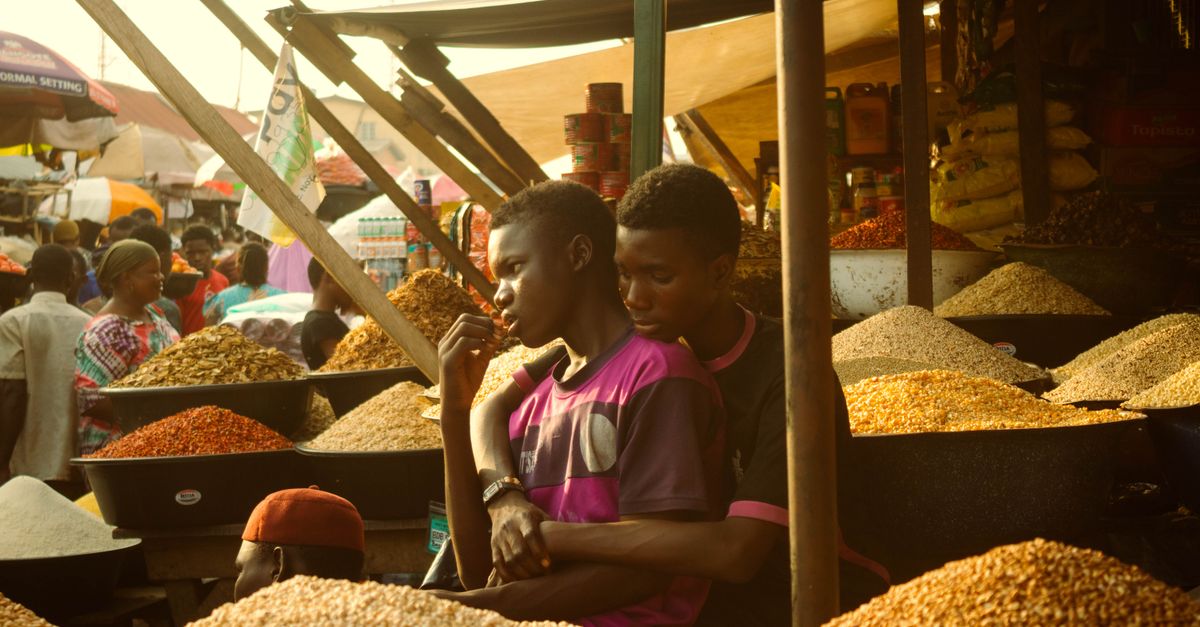
Balogun Market on Lagos Island is nominally a fabric market, but its food section — a warren of stalls on the lower floors and surrounding streets — constitutes one of the largest and cheapest eating options in the city. Mama-put stalls (the beloved Nigerian term for informal canteen) serve pounded yam with egusi and a choice of protein from around NGN 1,500; the white rice and stew combo runs NGN 800-1,000. The market operates Monday to Saturday from roughly 8 AM to 6 PM. Navigation requires local guidance on the first visit — ask any stall vendor to point you toward the food section.
Suya belts — the informal strips of open-air grills that appear at roundabouts and major intersections from around 6 PM — are where Lagos eats after dark. The canonical suya experience happens under a single bare bulb, at a plastic table on a roadside, with shredded cabbage and raw onion arriving alongside the spiced beef skewers. Alhaji Bukar's location near Adeniran Ogunsanya roundabout in Surulere is routinely cited by Lagosians as the city's finest; arrive after 8 PM and expect to wait 20 minutes for fresh skewers, NGN 2,000 for a substantial serving.
For a more curated market experience, the Ikeja City Mall Food Market (behind the main mall, not inside it) on weekend mornings draws vendors selling smoked fish, palm oil pressed the same day, ewa agoyin (mashed black-eyed beans with a peppery sauce) for NGN 600, and the best boli in Lagos — plantain roasted directly on charcoal embers, served with groundnut, NGN 400. The boli vendors set up by 9 AM; the fish stalls continue until afternoon.
Heading to East Africa? Read our Addis Ababa 3-Day Itinerary for more food adventures.