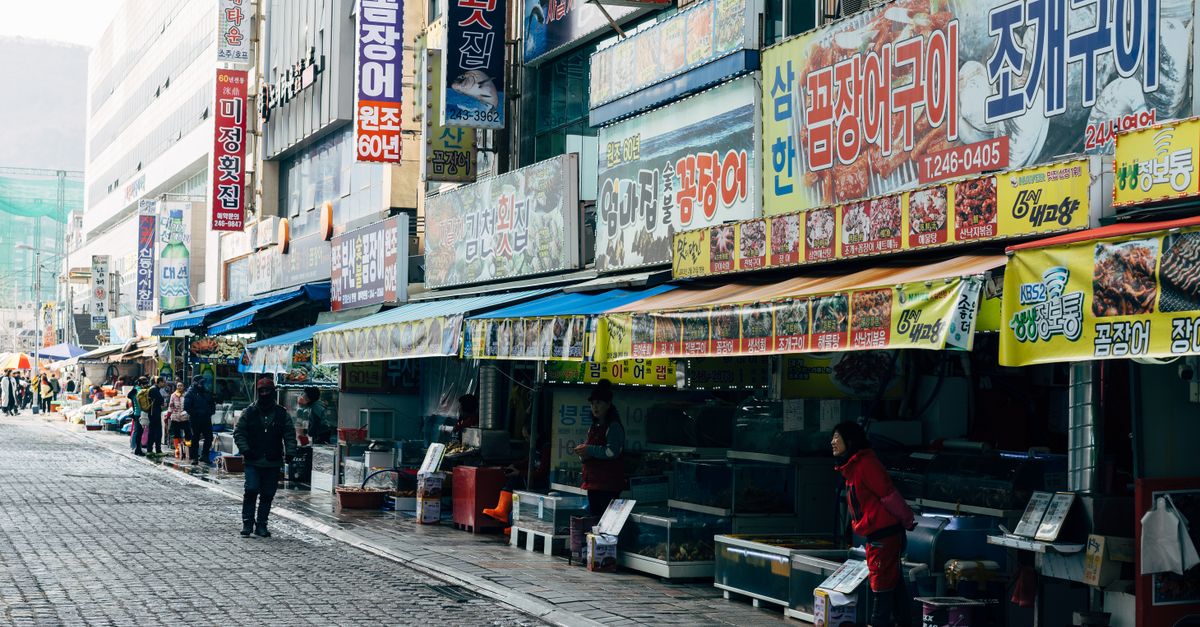
Busan is South Korea's beach city — a port metropolis where fish markets, Buddhist temples, and colorful hillside villages meet stunning coastline — and the food scene reflects this diversity.

Must-Try Dishes
1. Dwaeji Gukbap (Pork Rice Soup) — ₩8,000-10,000
Busan's signature dish — a milky pork bone broth with rice and sliced pork, seasoned tableside with salted shrimp, chili, and green onion. Ssangdungi in Seomyeon is the famous spot (₩8,000-10,000). Served 24 hours — the ultimate hangover cure.
2. Jagalchi Fish Market Sashimi — ₩30,000-50,000/2 pax
Korea's largest fish market — choose from live fish, crab, sea urchin, and octopus on the first floor, then take it upstairs to be prepared. A sashimi platter for 2 costs ₩30,000-50,000. The second-floor restaurants add side dishes. The freshness is unmatched.
3. Milmyeon (Cold Wheat Noodles) — ₩7,000-9,000
Busan's summer noodle — thin wheat noodles in an icy broth or spicy sauce. The cold, chewy noodles are perfect beach-day food. Gaemijip near Busan Station has served this since 1953 (₩7,000-9,000).
4. Ssiat Hotteok (Seed Pancake) — ₩2,000-3,000
A sweet Korean pancake filled with seeds (sunflower, pumpkin, flax) and brown sugar — Busan's famous street snack, different from the syrup-filled Seoul version. BIFF Square vendors sell them fresh (₩2,000-3,000).
5. Eomuk (Fish Cake) — ₩1,000-2,000
Busan's fish cake is far superior to elsewhere in Korea — made from fresh fish rather than processed. Skewered and served in hot broth at street stalls (₩1,000-2,000/skewer). The Samjin Eomuk brand shop sells premium versions.
6. Grilled Eel (Jangeo Gui) — ₩20,000-30,000
Freshwater eel grilled with a sweet soy glaze — available at restaurants along the Nakdong River estuary. Rich, fatty, and deeply savory. ₩20,000-30,000/person at Gimhae eel restaurants.
Where to Eat
City Center — Tourist-Friendly
The main tourist area has the most accessible restaurants with English menus and familiar service styles. Prices are 20-30% higher than local neighborhoods but convenience is worth it for first-time visitors.
Local Neighborhoods — Authentic & Budget
Venture 10-15 minutes from the tourist center to find where locals eat. Prices drop significantly and authenticity rises. Language barriers exist but pointing at dishes and smiling works universally.
Markets & Street Food — Best Value
The city's markets and street food areas offer the cheapest and often the best eating experiences. Follow the queues, eat what locals eat, and budget for multiple small dishes rather than one large meal.

Dining Tips for Busan
The best food in any city comes from specialists — restaurants and stalls that have perfected a single dish over years or decades. The cramped stall with the longest queue of locals invariably serves better food than the spacious restaurant with the bilingual menu and zero customers. Follow the crowds, eat what locals eat, and budget for multiple small meals rather than one large dinner.
Street food is safe when the vendor is busy — high customer turnover means food is cooked fresh and doesn't sit at dangerous temperatures. Avoid pre-cooked items that have been sitting under heat lamps for hours. Steaming, sizzling, and smoking are signs of freshly prepared food. Morning markets and evening food stalls typically offer the freshest options.
Local markets are the most affordable and authentic eating experience in any Asian city. Visit the main market early in the morning when vendors set up — the energy, the colors, and the breakfast food reveal the city's character more effectively than any museum or monument. Budget 60-90 minutes for a market visit including breakfast.
Dietary restrictions and allergies can be communicated with a few prepared phrases in the local language. Download Google Translate's offline language pack before your trip. Most Asian food cultures are accommodating of preferences when communicated clearly. Vegetarian options are available nearly everywhere, though the definition varies — fish sauce and shrimp paste appear in many 'vegetarian' Southeast Asian dishes.
Street Food & Markets
Busan's street food scene is best experienced through three distinct hubs, each with its own character and specialties. BIFF Square (Busan International Film Festival Square) in Nampodong is the undisputed street food capital — a narrow alley packed with vendors selling ssiat hotteok, eomuk fish cakes, tornado potatoes, and tteokbokki (spicy rice cakes, ₩3,000-4,000). The square buzzes from mid-morning through midnight and is completely free to browse. Arrive hungry and eat your way down both sides.
Jagalchi Market, Korea's largest seafood market, deserves two visits: once in the early morning around 6 AM when the catch comes in off the fishing boats and vendors are arranging live octopus, sea urchin, and geoduck clams in tanks, and again at lunchtime when the second-floor restaurants start grilling. The outdoor market surrounding the main building has haenyeo (female divers) selling fresh abalone and sea cucumber from buckets — ₩10,000-20,000 for a small portion eaten on the spot with a squeeze of lemon.
Gukje Market (International Market) opened to feed Korean War refugees in the 1950s and never stopped. The covered labyrinth holds hundreds of stalls across six zones selling everything from cheap jeans to traditional medicine, but the food alley on the market's southern edge is the draw. Bindaetteok (mung bean pancakes, ₩2,000-3,000) are cooked on flat iron griddles; hotteok (sweet pancakes, ₩2,000) come stuffed with brown sugar and cinnamon; and cheap makgeolli (rice wine, ₩2,500-3,000 a litre) keeps the whole enterprise lively. The market closes around 7 PM — go at lunch when it's at its most chaotic and delicious.
Haeundae Beach area hosts a nightly pojangmacha strip — traditional orange-tented street food carts — along the beach road from around 5 PM. Grilled corn, steamed blue crab, and spicy silkworm larvae (beondegi, ₩2,000) compete with soju-fuelled chicken stalls. The beach setting adds atmosphere that no indoor restaurant can match.
Planning Your Food Exploration
The most rewarding food experiences come from planning meals around the local eating schedule rather than forcing your own rhythm onto a foreign city. Most Asian cities eat early — breakfast stalls open at dawn and close by 9 AM, lunch service peaks at noon and ends by 2 PM, and dinner starts at 5-6 PM. Night markets and street food stalls offer the best evening options, typically running from 6 PM until 10 PM or later.
Budget allocation matters. Spend 30-40% of your food budget on one memorable meal — a signature local restaurant, a cooking class, or a fresh seafood dinner. Allocate the rest to street food, markets, and casual local restaurants where the authentic flavors live. This strategy ensures you taste both the refined and the everyday versions of the local cuisine without breaking the bank.
Photography etiquette at food stalls and small restaurants varies by culture. In most of Asia, photographing your food is completely normal and even expected. Photographing the cook or the stall itself — ask first with a smile and gesture. Most vendors are flattered; a few prefer not to be photographed. In sit-down restaurants, photograph freely but be discreet about photographing other diners.
Food allergies and dietary restrictions require preparation. Write your restrictions in the local language (Google Translate helps) and show the note at each restaurant. Common allergens like peanuts, shellfish, and gluten appear in unexpected places — soy sauce contains wheat, fish sauce is in many Thai and Vietnamese dishes, and peanuts appear in Indonesian, Malaysian, and Chinese cooking. Communicate clearly and ask about ingredients rather than assuming from the menu description.
The single best food investment in any Asian city is a cooking class. For 5-50, you'll visit a local market, learn 4-6 dishes hands-on, and gain techniques that let you recreate the flavors at home. The market tour alone — learning to identify local herbs, spices, and produce — transforms your understanding of the cuisine for every subsequent meal during your trip.


