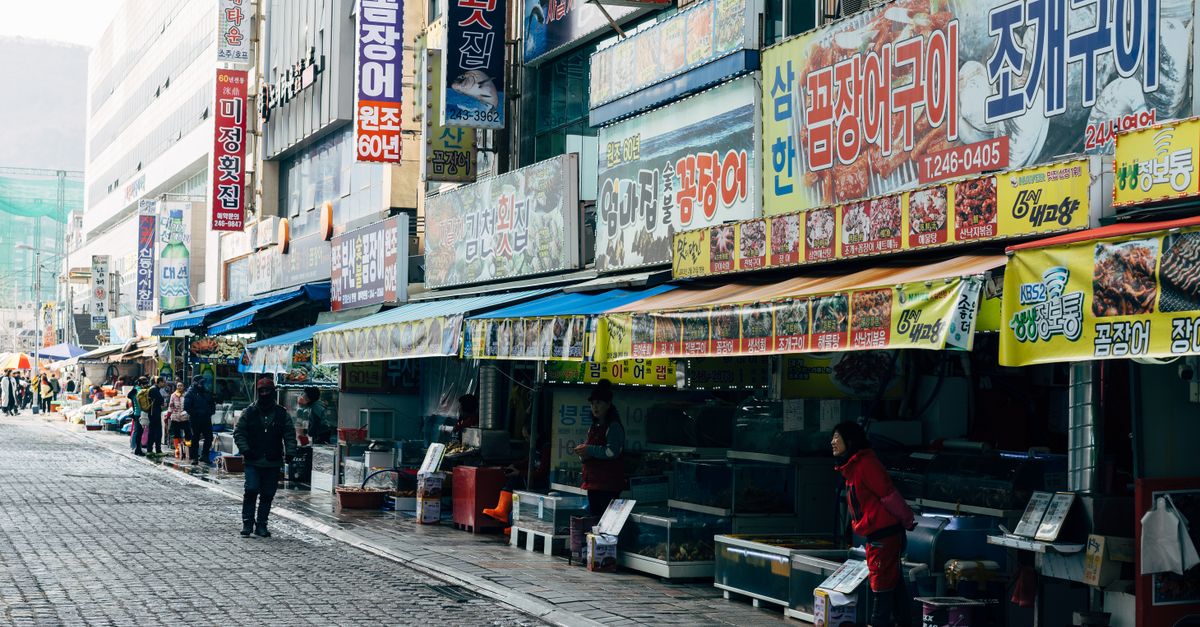
Busan is South Korea's beach city — a port metropolis where fish markets, Buddhist temples, and colorful hillside villages meet stunning coastline. The second-largest city offers a more relaxed alternative to Seoul with equally excellent food, vibrant nightlife, and cultural depth. Three days covers the beaches, temples, and one of Asia's great fish markets.

Haeundae Beach, Haedong Yonggungsa & Gamcheon Village
Explore the city's most iconic sights and neighborhoods. Start early to beat crowds at the most popular attractions and save the atmospheric evening experiences for after sunset.
Explore the city's most iconic sights and neighborhoods. Start early to beat crowds at the most popular attractions and save the atmospheric evening experiences for after sunset.
Jagalchi Fish Market, BIFF Square & Taejongdae
Venture beyond the center to discover the city's cultural depth. Day trips and secondary attractions often provide the most authentic local experiences with fewer tourist crowds.
Venture beyond the center to discover the city's cultural depth. Day trips and secondary attractions often provide the most authentic local experiences with fewer tourist crowds.
Beomeosa Temple, Gwangan Bridge & Nightlife
Use your final day for deeper exploration, markets, and food discovery. The less-visited corners of any city reveal the character that guidebooks miss. Allow time for spontaneous discovery.
Use your final day for deeper exploration, markets, and food discovery. The less-visited corners of any city reveal the character that guidebooks miss. Allow time for spontaneous discovery.

Exploring Busan
Haeundae Beach is Busan's most famous — a 1.5-kilometer crescent of white sand flanked by modern hotels and the Haeundae Sea Cloud residential towers. The water is warm enough for swimming from June through September. Beach culture here is serious — parasols, music, and a party atmosphere during the Busan Sea Festival (August). Off-season, the beach is quiet and perfect for walking.
Gamcheon Culture Village — a hillside neighborhood of colorfully painted houses, murals, and installations created through an art revitalization project. The village map (₩2,000) guides you through narrow alleys, staircases, and hidden galleries. The panoramic views from the upper paths encompass the entire village cascading down to the harbor. Allow 2-3 hours. Reach by bus 1-1, 2, or 2-2 from Toseong Station.
Haedong Yonggungsa Temple (free) perches on a cliff over the ocean — one of Korea's few seaside temples. Built in 1376, the complex descends stone staircases to a platform where the Buddha statue gazes over crashing waves. The sunrise here is considered one of Korea's most spectacular. Located in the northeast, 30 minutes from Haeundae by bus.
Jagalchi Fish Market is the largest in Korea — a massive building of fish vendors on the ground floor and restaurants above. The first floor is a wet market of extraordinary variety — live octopus, sea urchin, king crab, and fish species you've never seen. Choose your seafood, carry it upstairs, and the restaurant cooks it. The second floor charges a cooking fee (₩5,000-10,000) but no markup on the fish.
Taejongdae, the southern tip of Yeongdo Island, has dramatic cliff walks through forest to lighthouse viewpoints over the Korea Strait. Clear days reveal Japan's Tsushima Island across the water. The Danubi train (₩3,000) circles the park for those who don't want to walk. The cliffs are steep and the views are genuinely dramatic.
Beomeosa Temple, in the forested mountains north of the city, is one of Korea's most important Buddhist temples (free). Founded in 678 AD, the complex of halls, gates, and a 1,300-year-old wisteria vine sits in a valley that erupts in cherry blossoms in spring and fiery foliage in autumn. The 1-hour hike from the temple to Geumjeongsan fortress adds mountain views.
Gwangan Bridge, Korea's longest suspension bridge, is best viewed from Gwangalli Beach at night when the bridge is illuminated in changing colors. The beachfront bars and restaurants have unobstructed views. The Busan International Film Festival (BIFF) in October transforms the nearby Haeundae and Centum City areas into Asia's premier film event.
Practical Tips
South Korea is one of the world's most connected, efficient, and safe countries. High-speed KTX trains, ubiquitous Wi-Fi, and a culture of technological convenience make travel seamless. The Korean won (₩) is the currency — budget ₩100,000-200,000/day for mid-range travel. T-money cards (₩2,500 at any convenience store) work on all public transport.
Korean etiquette: use two hands when giving or receiving items, pour drinks for others (never yourself), and remove shoes when entering homes and some traditional restaurants. Bowing is the standard greeting. Age hierarchy matters — older people are served first and addressed with respect. Tipping is not practiced and can even be considered rude in some contexts.
Korea's four seasons are dramatic. Spring (April-May) brings cherry blossoms. Summer (June-August) is hot and humid with a rainy season (jangma) in July. Autumn (September-November) has spectacular foliage and ideal temperatures. Winter (December-February) is cold (-10°C to 5°C) but brings skiing, hot springs, and fewer tourists. The busiest domestic travel periods are Chuseok (autumn harvest, September/October) and Lunar New Year (January/February).
Best Times to Visit & Budgeting
Timing your visit matters enormously for both weather and crowds. Peak tourist seasons bring higher prices, sold-out accommodations, and crowded attractions. Shoulder seasons (the weeks just before and after peak) often deliver the best balance — good weather, manageable crowds, and reasonable prices. Off-season travel is the cheapest but check for monsoon rains, extreme heat, or seasonal closures.
Budget planning for three days should account for accommodation (30-40% of total), food (20-25%), transport (15-20%), activities and entrance fees (15-20%), and a contingency buffer (10%). The biggest savings come from choosing accommodations wisely — a well-located mid-range hotel that eliminates taxi costs can be cheaper than a budget hotel in a remote area plus daily transport.
Travel insurance is non-negotiable. A single hospital visit in most Asian countries costs more than a year of comprehensive travel insurance (0-80 for a 2-week trip). Ensure your policy covers emergency medical evacuation — this is the expensive scenario that justifies the premium. Download your policy documents to your phone for offline access.
Currency exchange tips: ATMs generally offer better rates than airport exchange counters. Withdraw larger amounts less frequently to minimize per-transaction fees. Carry some US dollars (0-100) as universal backup — they're accepted in emergencies across most of Asia. Notify your bank of travel plans to prevent card blocks. Use a travel-specific card (Wise, Revolut) for the best exchange rates and lowest fees.
Download essential apps before arriving: Google Maps (with offline maps for your destination), Google Translate (with offline language packs), the local ride-hailing app (Grab for Southeast Asia, DiDi for China, Uber/Ola for India), and your accommodation booking confirmation. A portable battery pack (10,000-20,000 mAh) keeps your phone alive through a full day of navigation, photography, and ride-hailing.
Getting Around Busan
Busan's public transport system is excellent, affordable, and entirely legible to foreign visitors. The metro is the backbone — four main lines cover nearly every tourist destination with signage in Korean, English, and Chinese. A single ride costs ₩1,400–1,600 (approximately USD $1.05–1.20) depending on distance, paid with cash at ticket machines or a T-money card. The T-money card (₩2,500 deposit at any convenience store) also works on buses and saves the queuing time at machines. Reload at CU, GS25, or 7-Eleven.
Key metro journeys: Haeundae Beach is on Line 2 (Haeundae Station, exit 3 or 5) — about 35 minutes from the central Seomyeon interchange. Jagalchi Fish Market uses Line 1 (Jagalchi Station, exit 10). Gamcheon Culture Village requires Line 1 to Toseong Station followed by bus 1-1, 2, or 2-2 (15-minute ride, ₩1,300). Haedong Yonggungsa Temple sits outside the metro network — take Line 2 to Osiria Station and then bus 181 (30 minutes total, ₩1,800 combined).
Busan's city buses fill the gaps between metro lines and run frequently (every 8–15 minutes on main routes). Fares are ₩1,300 flat. Google Maps handles Busan bus routing accurately — input your destination, select transit, and it will show the exact bus number, stop name, and departure time. Naver Maps is preferred by locals and more accurate for real-time arrival data but requires a Korean phone number for full functionality.
Taxis are metered, honest, and cheap by any international standard. The base fare is ₩4,800 (approximately USD $3.60) for the first 2 kilometres. Haeundae to Jagalchi — a cross-city journey of around 14 kilometres — costs ₩15,000–18,000. Kakao T is the ride-hailing app used by virtually every Korean taxi driver; it works in English, accepts international cards, and allows advance booking, making it significantly more useful than flagging on the street when you need a specific pickup location like a temple car park or beach entrance.
Cycling is underutilised but practical along Haeundae and Gwangalli beaches, where flat seafront paths run for several kilometres. The city's public bike-share scheme (Tashu) requires a Korean phone number for registration, but several rental shops near Haeundae Beach offer hourly hire at ₩5,000–8,000. The Nakdong River greenway, extending west from the city, is popular with serious cyclists and reachable by metro.