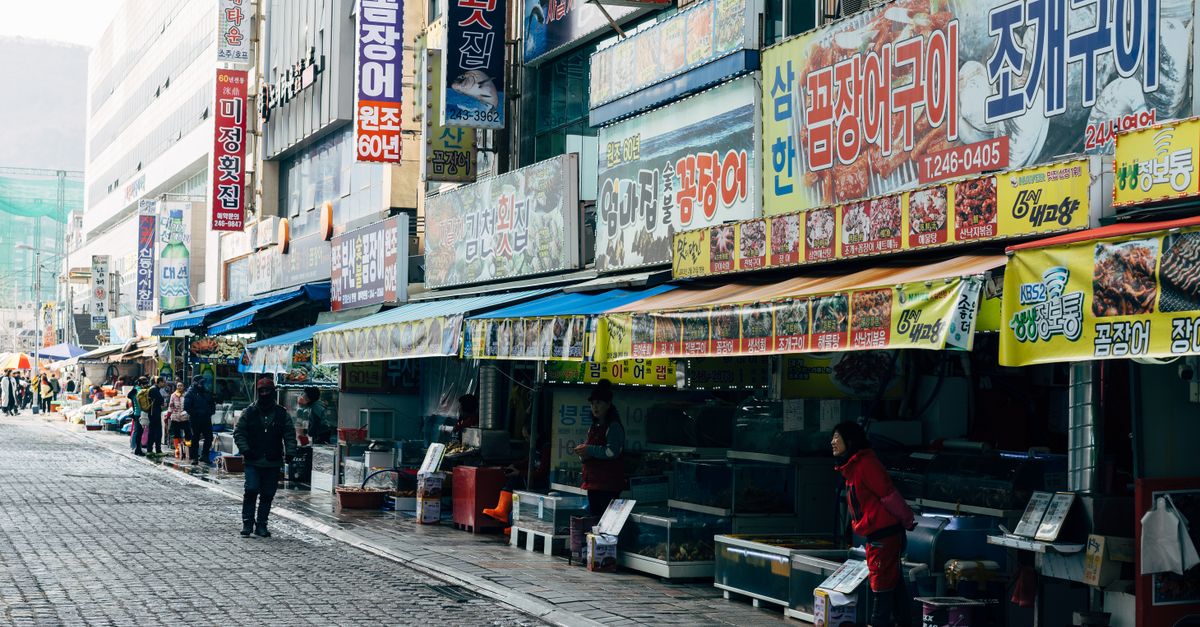
Busan rewards the budget-conscious traveller with an embarrassment of riches: a coastline of white-sand beaches, a labyrinthine fish market that feeds the whole city, hillside villages painted every colour of the rainbow, and a street-food culture so deeply ingrained that a satisfying meal rarely costs more than a cup of coffee back home. South Korea's second city punches well above its weight on both spectacle and affordability, and once you understand how the locals move, eat, and spend their leisure hours, you'll discover that stretching your won here is not a compromise — it's a strategy that puts you closer to the authentic city than any luxury hotel ever could.
Getting There on a Budget
The cheapest way to reach Busan from Seoul is to book a low-cost carrier seat weeks in advance. Jeju Air, T'way Air, and Air Busan all operate multiple daily flights between Gimpo or Incheon and Gimhae International Airport (PUS), and promotional fares start as low as KRW 25,000 one way — though a realistic average for a ticket booked two to three weeks out sits closer to KRW 45,000–60,000. Factor in the airport-to-city transfer cost and the journey time (roughly two to three hours door-to-door), and flying is not always the slam-dunk saving it appears to be.

The KTX high-speed train is the benchmark against which every other option is measured. A standard adult ticket from Seoul Station to Busan Station takes exactly two hours and forty minutes and costs KRW 59,800 in economy class. The SRT (Super Rapid Train), which departs from Suseo Station in southeast Seoul, shaves a few minutes off the journey and typically undercuts the KTX by around KRW 5,000. Both trains run frequently throughout the day, and booking via the Korail website or the SRT app at least a week ahead secures the best seats. If you're travelling during a major Korean holiday — Chuseok or Seollal — book a month ahead or accept standing room.
Intercity express buses are the true budget option. Seoul's Express Bus Terminal runs coaches to Busan's Central Bus Terminal roughly every thirty minutes around the clock. Journey time is four to five hours depending on traffic, but fares hover around KRW 23,000–28,000. The overnight bus, departing around midnight and arriving at dawn, allows you to skip a night's accommodation entirely — a move seasoned budget travellers know well. From within the region, trains from Daegu (KRW 14,700 by Mugunghwa) or Gyeongju (KRW 4,800 by local train) connect seamlessly to Busan's subway network at the terminus.
Budget Accommodation
Busan's guesthouse and hostel scene has matured considerably over the past decade, driven by the city's growing appeal to solo backpackers, Korean domestic travellers, and the annual wave of visitors attending the Busan International Film Festival in October. The result is a competitive market where a clean, well-located bed rarely demands more than KRW 20,000–35,000 per night.

Kim's Guesthouse Busan sits in the Seomyeon district, putting guests within walking distance of the underground food street and the convergence of subway Lines 1 and 2. Dormitory beds run KRW 18,000–22,000 depending on season, and private twin rooms hover around KRW 55,000. The owners speak good English, the WiFi is reliable enough for remote work, and the communal kitchen is genuinely usable — not just a kettle and a microwave. It's the kind of place where you'll find yourself sharing restaurant recommendations with other guests over instant coffee at 8 a.m.
Busan YHA (Youth Hostel Association) near Nampo-dong offers the institutional reliability of a certified hostel network. Mixed dorms cost KRW 22,000 and female-only dorms KRW 25,000. Its location is ideal for exploring Jagalchi fish market, BIFF Square, and the Gamcheon Culture Village access bus — three of Busan's best free or near-free experiences. Breakfast is available for KRW 5,000 extra, though the convenience stores around Nampo subway exit make that option redundant.
Backpackers Beach House Busan near Haeundae is the choice for travellers who want to wake up close to the sea. A dorm bed costs KRW 28,000–35,000 in high season (July–August), dropping to KRW 20,000–25,000 in spring and autumn. The trade-off is that Haeundae's beach-resort pricing bleeds into its restaurants and cafés, so you'll want to commute to Seomyeon or Nampo for cheaper meals. The beach itself, however, is steps away — a reasonable premium for the right kind of traveller.
Outside the hostel circuit, Busan has a robust network of motels and love hotels that, despite their reputation, offer excellent value for couples or pairs. A clean double room in a mid-range motel near Seomyeon routinely goes for KRW 40,000–60,000 per night and usually includes a private bathroom, fast WiFi, and a flat-screen TV. Apps like Yanolja and Goodchoice (both available in English) let you book same-day at discounted rates.
Eating Cheaply Like a Local
Busan has a legitimate claim to being South Korea's finest food city, and the extraordinary thing about that claim is that its most celebrated dishes cost less than a subway fare back home. The city's culinary identity is built on the sea and on the flavours that survived the Korean War, when millions of refugees from the north transformed Busan's street-food culture in ways that still define what locals eat today.

Milmyeon — wheat noodles served in a cold, tangy broth with a spoonful of gochujang paste — is Busan's signature cold noodle dish, and every self-respecting neighbourhood has at least one dedicated shop. The original, and still the benchmark, is Gaya Milmyeon near Seomyeon, where a bowl costs KRW 8,000 and the queue at lunchtime tells you everything you need to know. Arrive at 11:30 a.m. to beat the worst of it.
Dwaeji gukbap — a rich pork bone soup served with a mound of rice submerged directly in the broth — is the city's other obsession, eaten at all hours including for breakfast. Ssiat Dwaeji Gukbap near Seomyeon is the famous name, but budget travellers should know that dozens of hole-in-the-wall alternatives in the Bujeon Market area serve an equally fine bowl for KRW 9,000–12,000. The ritual of adding kimchi, sliced green onions, and salted shrimp to your own bowl is half the pleasure.
At Jagalchi Market, the covered fish market on the waterfront, the ground floor is a wholesale market for fishermen and restaurateurs. The real action for travellers is on the upper floors, where raw fish restaurants serve sashimi platters assembled from whatever was landed that morning. A two-person platter — enough to make two people genuinely full — costs KRW 30,000–50,000, which remains remarkable for the quality. Arrive before noon for the best selection.
The Bujeon Market interior food stalls offer Busan's cheapest sit-down meals: bibimbap for KRW 6,000, tteokbokki (spicy rice cakes) for KRW 4,000, and kalguksu knife-cut noodles for KRW 7,000. These are neighbourhood places with no English menus and no interest in tourist prices — point at what the person next to you is eating and you won't go wrong.
For late-night eating, the pojangmacha tent stalls that appear around Seomyeon and BIFF Square after 9 p.m. serve fried chicken, sundae (blood sausage), and odeng fish cake skewers from KRW 1,000 per stick. A full evening of grazing costs KRW 10,000–15,000 and doubles as the city's best free entertainment.
Free and Low-Cost Attractions
Busan's geography is its greatest free attraction. The city climbs steep hillsides behind wide beaches, and the views from its elevated neighbourhoods — particularly at dusk, when the apartment lights begin to flicker on and the sea turns copper — are as dramatic as anything you'll pay to see anywhere in Asia. The following are among the best experiences that cost little or nothing.

Gamcheon Culture Village (entry KRW 2,000 for a stamp map) is Busan's most photographed neighbourhood — a cascade of pastel-coloured houses tumbling down a hillside above the port, originally built by followers of the Taeguk-do religious sect in the 1950s. The stamp map directs you to a dozen small art installations tucked between alleyways, and the rooftop café at the top has views that justify the bus ride alone. Take Bus 2 from Toseong subway station.
Haeundae Beach is free to access year-round and genuinely beautiful outside peak summer months. In spring and autumn, when the crowds recede, you can walk the full 1.5-kilometre stretch without encountering the packed towel-to-towel conditions that define August. The Dongbaekseom Island walking trail at the western end of the beach takes forty minutes and offers sea cliffs, pine forest, and a bronze mermaid statue.
Taejongdae Park (entry free, observatory road toll KRW 1,000) occupies the southern tip of Yeongdo Island and contains some of Busan's most dramatic coastal scenery: basalt sea cliffs, a lighthouse dating from 1906, and a rocky beach where locals swim in summer. The circular walking path takes about ninety minutes. The Danubi Train (KRW 3,000) runs the main road circuit for those who prefer not to walk.
Beomeosa Temple, set in a forested valley on the northern slope of Geumjeongsan mountain, is a working Buddhist temple dating to 678 CE and charges no entry fee. The forty-minute subway-and-bus journey from central Busan is itself scenic, and the temple complex — monks in grey robes, the smell of incense, the percussion of wooden prayer blocks — provides a complete counterpoint to the coastal city below.
BIFF Square near Nampo-dong is free to walk and permanently lined with street food vendors, handprint plaques from Korean film stars, and the kind of low-key urban energy that makes spontaneous afternoons in foreign cities so memorable.
Getting Around on a Budget
Busan's subway system is efficient, clean, and inexpensive enough that it should be your primary mode of transport for virtually every journey in the city. The network has four main lines — Line 1 (orange), Line 2 (green), Line 3 (brown), and the Donghae Line — connecting every major neighbourhood from the airport in the west to Haeundae in the east. A single fare costs KRW 1,500 with a T-money card (KRW 1,800 if you pay cash), and the card can be loaded at any CU or GS25 convenience store in increments as small as KRW 1,000.

The T-money card provides a KRW 100 discount per ride compared to single-journey tickets and crucially enables free transfers between the subway and city buses within thirty minutes of tapping out — a meaningful saving if your journey requires a subway-to-bus connection, which many journeys to outer attractions do. Load KRW 20,000–30,000 when you arrive; it will last several days of normal sightseeing activity.
City buses fill the gaps between subway stops and are particularly useful for reaching Gamcheon Culture Village (Bus 2 from Toseong Station) and Taejongdae Park (Bus 88 from Nampo Station). Fares are the same as the subway — KRW 1,500 with T-money — and the free transfer window applies. Google Maps and Naver Maps both give accurate real-time bus routing in Busan with English interfaces.
Taxis in Busan start at KRW 4,800 for the first two kilometres. For short hops of three to four kilometres — say, from Seomyeon to Nampo-dong — the fare rarely exceeds KRW 7,000–8,000, making taxis a reasonable option for late-night journeys when buses thin out. The KakaoTaxi app (English-language) lets you hail a cab without needing to speak Korean.
Money-Saving Tips
Managing a tight budget in Busan is less about deprivation than about knowing the rhythms of the city. The following strategies, used together, can cut your daily expenditure by 30–40% without sacrificing any meaningful experience.
Eat at market interiors, not market entrances. The stalls closest to the street entrance of any market — Bujeon, Gukje, Dongmun — charge a tourist premium. Walk thirty metres past the first row and prices drop noticeably. The vendors who cater to market workers and early-morning regulars operate on margins that would make a tourist café blush.
Time your Jagalchi visit correctly. The best-value raw fish platters at Jagalchi are available from 9 a.m. to noon, when the catch is freshest and the stall operators are still competing for the day's first customers. Arriving in the afternoon means paying a premium for fish that has been sitting on ice for hours.
Use the free beach lockers at Haeundae. The city-operated changing rooms and locker facilities on Haeundae Beach are free during off-peak months (October–June) and cost KRW 2,000–3,000 in July–August. Avoid the private rental shops nearby that charge three times as much for the same service.
Buy snacks at convenience stores before entering tourist areas. The markup on water, snacks, and coffee near Gamcheon Village and Taejongdae is significant. A 500ml water bottle costs KRW 900 at a CU; the same bottle sold from a tourist cart near Gamcheon's viewpoint is KRW 2,000.
Check the Yanolja app for same-day motel deals. Korean motels that haven't filled by late afternoon frequently slash rates by 20–40% for same-day check-in. This works best on weeknights — weekend demand keeps prices firm until 9 p.m. or later.
Visit temples early and bring your own lunch. Beomeosa Temple has no entry fee, and the mountain trails above it are free. Pack kimbap rolls from a convenience store (KRW 1,500 each), hike the Geumjeongsan ridge, and you have a full-day excursion for under KRW 5,000 including transport.
Take the limousine bus from the airport, not a taxi. The airport limousine bus (KRW 7,000) runs to Seomyeon and Haeundae and takes thirty to sixty minutes depending on traffic. A taxi for the same journey costs KRW 25,000–35,000. The bus is not slower in practice — Gimhae Airport is west of the city, and taxis are subject to the same highway traffic.