Kyoto's famous temples draw millions of visitors each year, yet the city quietly harbors neighborhoods, shrines, and rituals that most travelers never encounter. Beyond the perpetually crowded Fushimi Inari and Kinkaku-ji, there is a Kyoto that moves at a different pace — intimate, slightly faded, and profoundly atmospheric. These are the places where locals actually spend their time, where the incense is thicker and the silence more complete.
This guide is for the traveler who has already done the highlights, or who deliberately wants to skip them entirely. It's for people who find more meaning in a quiet moss garden than in a gate flanked by tour groups, who prefer eating at a counter with four seats over a restaurant with an English menu. If that sounds like you, Kyoto will reward your curiosity in ways that the brochure version never could.
Most visitors come to Kyoto with a checklist. This guide is the anti-checklist — ten places and experiences that require a little more effort, a little more wandering, and in return offer something genuinely rare: the feeling that you've found something that belongs to you.

1. Fushimi Neighborhood — Beyond the Torii Gates
Every visitor photographs the torii gates at Fushimi Inari, but virtually none of them walk ten minutes further into the Fushimi sake district that surrounds it. This is one of Japan's most historic sake-producing areas, and the streets around Teradaya, the historic inn, are lined with old kura (sake warehouses) that have been functioning since the Edo period. The water here, drawn from the Momoyama Hills, is considered among the softest and most mineral-balanced in Japan — the reason sake has been brewed here for four centuries.
Gekkeikan Okura Sake Museum on Minami-Hamaderamachi is the anchor attraction, but the real find is simply walking the canal-side streets between the brewery district and the Fushimi Momoyama castle ruins. The canal, edged with weeping willows and low wooden bridges, looks like a film set — except it's completely real and almost always empty of tourists. In cherry blossom and autumn foliage seasons, this is one of Kyoto's most beautiful spots, and you will very likely have it to yourself.
Take the Kintetsu Kyoto Line to Momoyama-Minamiguchi Station, or ride the Kintetsu from Kyoto Station — the journey takes about 15 minutes. The sake museum is open 9:30am–4:30pm, closed Monday, with entry at ¥300 including one small cup of sake. The canal walk is free and best done in the early morning or late afternoon when the light hits the willows sideways.
Don't leave without stopping at Torisei restaurant near the canal for kushikatsu and fresh Fushimi sake on tap — the lunch set costs around ¥1,200 and is one of the best-value meals in the city. The staff will explain which sake pairs best with each skewer if you ask in simple Japanese or even with gestures.
2. Nishiki Tenmangu — The Shrine Inside the Market
Nishiki Market is on every Kyoto itinerary now, which is fine — it genuinely is wonderful. But almost no one notices the small shrine embedded inside it, Nishiki Tenmangu, tucked behind a torii gate that most visitors walk past assuming it's a restaurant entrance. This is the guardian shrine of the market itself, dedicated to Sugawara no Michizane, the god of learning, and it has been here since the Heian period — long before the market grew around it.
The shrine is remarkable for its "touch and wish" fox statues, which you rub for different kinds of luck, and for the fact that you can stand in a Shinto shrine while the smell of pickled vegetables and grilled skewers drifts in from both sides. It sounds incongruous but feels completely natural — commerce and spirituality have coexisted in this exact spot for over a thousand years. There is a small collection box and incense burner, and the shrine cat, an orange tabby, is often sleeping near the candles.
Nishiki Market runs between Teramachi and Takakura streets near Shijo in central Kyoto. The shrine is about halfway down the arcade on the north side — look for the red torii gate. No entry fee. Open during market hours, roughly 9am–6pm. Most stalls in the market close by 5pm, so arriving around 4pm gives you the market at its most active and the shrine at its quietest.
Combine this with a walk along Pontocho alley just west of Kawaramachi — best at dusk when the lanterns come on and the restaurants are setting out their evening menus. It's only a five-minute walk and represents one of Kyoto's great free pleasures.
3. Daitoku-ji Temple Complex — The Zen Gardens Most People Miss
Daitoku-ji is technically on tourist maps but almost never crowded, because it requires advance planning that most visitors don't bother with. This vast Rinzai Zen temple complex in northern Kyoto contains 24 sub-temples, of which about six are open to the public at any given time — and each has a karesansui (dry rock garden) that rivals anything at the famous Ryoan-ji, without a single tour group in sight. The Zuiho-in sub-temple, built in 1535, has a garden that was redesigned in the 1960s by landscape architect Mirei Shigemori into a subtle Christian cross pattern — invisible to most viewers but remarkable once you know it's there.
Koto-in sub-temple is widely considered the most beautiful. Its maple-lined approach is one of Kyoto's most photographed paths in autumn, yet even then it remains serene. The tea room inside, Shigemori's influence again, is small enough that you can feel the intention of every rock placement. Obai-in is open only in spring and autumn and houses a rare garden with an artificial hill said to represent a turtle. None of these places appear on most itineraries.
Take city bus 101 or 205 to Daitoku-ji-mae stop, or walk 20 minutes north from Kinkaku-ji. Entry to most open sub-temples is ¥400–¥600 each. The complex is open from 9am–5pm but sub-temple hours vary. Arrive before 9:30am to have the gravel gardens to yourself for at least thirty minutes. The total visit including three sub-temples takes about two hours.
Insider tip: the temple complex sells unseasoned tofu from its own kitchen on certain mornings — ask at the first reception gate if it's available. Also, Imamiya Shrine, a five-minute walk east, has two competing yakimochi (grilled rice cake) stalls that have been rivals since the 1700s. Both cost ¥500 for two cakes and tea. Try both.
4. Philosopher's Path — Off-Season and Off-Hours
The Philosopher's Path along the canal between Ginkaku-ji and Nanzen-ji is famous, but famous at the wrong time. In cherry blossom season it is essentially a slow-moving human river. Visit it instead in January or February, when the bare cherry branches frost over and the canal runs slate-grey and fast, and you will find something far more beautiful — and closer to the spirit of the Kyoto philosopher Nishida Kitaro who actually walked this path every morning. The path is still lovely in summer at dawn, when the canal smells green and the café owners are hosing down their doorsteps before opening.
The real discovery along this path is not the path itself but the small galleries, tofu shops, and ceramics studios tucked into the narrow streets perpendicular to it. Karako, a tiny ceramics shop about halfway along, has work by local artists that costs a fraction of what equivalent pieces sell for in Gion antique shops. Omen, a noodle restaurant on the side streets west of the path, has been serving udon in its own style since 1969 and is still one of Kyoto's best meals at under ¥1,500.
The path runs about 2km between Ginkaku-ji-michi bus stop (buses 5 or 17 from Kyoto Station) and Nanzen-ji. Free to walk anytime. The full walk takes 30–45 minutes at a relaxed pace. Best visited at 7–8am regardless of season, when the light on the canal is horizontal and most of the cafés are just starting to open.
Nanzen-ji at the south end deserves more time than most visitors give it. The massive Sanmon gate (¥600 to climb, great views) and the brick aqueduct running through the grounds — a Meiji-era engineering project that now looks like a Roman ruin — are genuinely spectacular and almost always uncrowded because people assume the entry fee is for the whole complex (it isn't).
5. Tofuku-ji's Northern Garden — The Checkerboard Moss
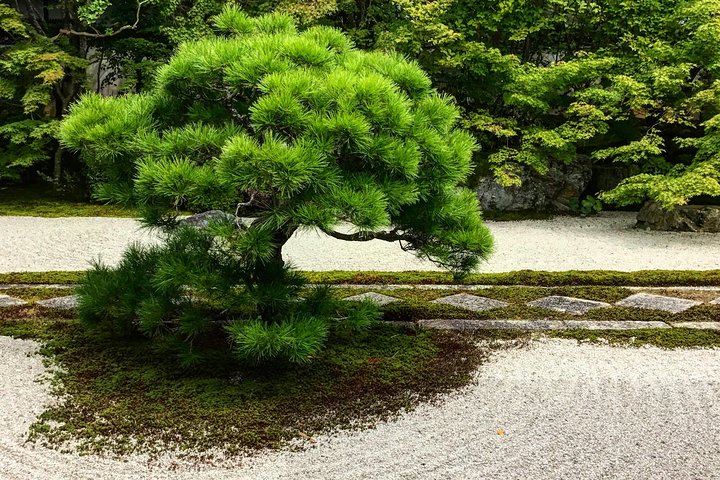
Tofuku-ji is one of Kyoto's great Zen temple complexes and its autumn foliage is genuinely famous — meaning it is mobbed in November. But the reason to come at any other time of year is the extraordinary set of four gardens surrounding the hojo (abbot's quarters), all designed in 1939 by Mirei Shigemori when he was just 38 years old. The north garden in particular is a masterpiece: a grid of stone columns alternating with moss squares in a pattern that looks like it was designed with a computer program in the best possible way. Nothing else in Japan looks quite like it.
Shigemori was controversial in his time for using modernist geometric forms in a Zen context, but visiting now it feels inevitable — the garden captures both the mathematical precision of Zen practice and its underlying wildness. The moss, when wet after rain, glows a green so saturated it looks digital. The south garden's massive rock groupings, representing the four mythological islands, are equally powerful. Together the four gardens form a complete philosophical statement that rewards slow looking.
Take the JR Nara Line to Tofuku-ji Station, a 10-minute ride from Kyoto Station. Entry is ¥500 for the gardens (extra ¥100 for the hojo in autumn). Open 9am–4pm (to 3:30pm December–February). Any time except mid-November is uncrowded. A Tuesday morning in June, with the moss wet from overnight rain, is about as good as Kyoto gets.
Combine with Fushimi Inari, a 10-minute walk or one JR stop south. Going to Fushimi Inari first at 7am before the crowds, then walking back to Tofuku-ji by 10am, makes for a perfect half-day in southern Kyoto.
6. Kamigamo Shrine — The Locals' Sacred Space
Kamigamo Shrine in northern Kyoto is one of the city's two oldest shrines (the other being Shimogamo), a UNESCO World Heritage site, and almost completely ignored by tourists. While Fushimi Inari attracts its millionth visitor every few months, Kamigamo on a weekday morning has only pigeons and elderly locals feeding them. Yet this place has been sacred ground since before Kyoto was even founded — its founding myth predates the city by centuries. The shrine's association with the thunder god gives it a different energy from most Kyoto shrines: more elemental, more weather-worn.
The grounds are remarkable for their natural setting: the Kamo River flows through the outer precinct, and the forested hills behind the inner sanctum make it feel genuinely ancient in a way that many heavily restored shrines do not. The stream running through the inner grounds, channeled over white sand in a ritual purification setting, is one of Kyoto's most photographed scenes among Japanese visitors — and virtually unknown to foreign visitors. The cormorant fishing demonstration on the Kamo River near the shrine, held in summer, costs nothing to watch from the bank.
City bus 4 from Kyoto Station runs to Kamigamo-jinja-mae stop, taking about 40 minutes. The shrine is free to enter; the inner garden area costs ¥500. Open 9am–4pm. Best visited on a weekday morning. The surrounding Nishigamo neighborhood has well-preserved machiya townhouses and a small but excellent morning market on the fourth Sunday of each month at the shrine's outer precinct.
The walk from Kamigamo south along the Kamo River back toward central Kyoto takes about 45 minutes and is one of the city's finest walks — wide gravel banks, the mountains visible in all directions, and almost zero tourist infrastructure.

7. Nishiki Koji — The Street That Isn't on Maps
Not to be confused with Nishiki Market, Nishiki Koji is a small street in the Shimogamo area of northern Kyoto that runs parallel to the Kamo River and is lined with some of the city's oldest surviving machiya townhouses, many still in residential use. A few have been converted into small galleries or craft studios whose owners will invite you in for tea if you knock and show genuine curiosity. This is the Kyoto that urban planners have been trying to preserve and that developers keep threatening — a low wooden streetscape from another century, completely functional in the present day.
On weekday mornings, you can watch tofu being delivered by bicycle, laundry being hung from second-floor windows, and small kitchen gardens producing the vegetables that will go into tonight's kaiseki meal at a restaurant you will never be able to book. None of this is performed for visitors because there are no visitors. The neighborhood also has one of Kyoto's best independent coffee roasters, Kurasu, which sources from Japanese-managed farms in Ethiopia and serves pour-over at ¥600 a cup — a genuine cult favorite among Kyoto's younger residents.
From Demachiyanagi Station (Eizan and Keihan lines, northeast of central Kyoto), walk southeast toward the river and explore the streets between the two Kamo River tributaries. No formal attractions, no entry fees. Best visited 8–11am on a weekday. The tofu shop Morika on the north end of the area sells fresh yudofu sets for ¥800 that are better than anything you'll find in the tourist restaurants near Gion.
This is the neighborhood to wander without a plan. Follow any street that looks old, and eventually you'll find something — a tiny shrine, a potter's studio with the door open, a vending machine selling sake in the wall of a warehouse. Kyoto hides its best things in plain sight.
8. Kurama Onsen — Mountain Hot Springs an Hour from the City
Kurama is technically famous — it's on the train maps — but almost no one stays long enough to use the onsen, which is the whole point of going. Kurama Onsen sits at the top of a winding road above the mountain village, surrounded by cedar forest, and its outdoor bath looks directly into the ravine below. On a cold evening in November or March, soaking in 42-degree sulfurous water while the cedar trees release their oil in the mist is one of the finest experiences available within city limits of any city in the world. The water here is radioactive in the therapeutic sense — high in radon content, considered excellent for joint and skin conditions.
The mountain itself has a temple, Kurama-dera, that you reach via a steep hiking path or a tiny cable car (¥200 one way). The temple is dedicated to Mao-son, a deity of the universe that is unique to Kurama and not worshipped elsewhere — giving the place a slightly alien spiritual atmosphere that sets it apart from standard Kyoto temples. A hiking trail connects Kurama over the mountain to Kibune, a village of riverside restaurants where you dine on platforms suspended over a fast-running stream in summer.
Take the Eizan Electric Railway from Demachiyanagi Station to Kurama — the journey takes 31 minutes and costs ¥430. Kurama Onsen entry is ¥1,000 for the outdoor bath, ¥2,500 for access to all baths. Open 10am–9pm, closed Wednesday. Bring your own towel or rent one for ¥200. Go on a weekday in early spring or late autumn for the best combination of scenery and empty baths.
The Kibune-Kurama hike takes about 90 minutes over the mountain. Restaurants in Kibune book up weeks ahead in summer (kawadoko river dining season, June–September), but walk-in lunch spots exist — Hiroya serves a simple set for ¥1,800 that won't require a reservation on weekdays.
9. Fushimi Momoyama — The Sake Breweries Locals Drink At
While tourists line up for the Fushimi Inari torii gates, the brewery district 15 minutes south is doing something much more interesting: making and selling sake at prices and in settings that have changed very little since the Meiji era. Gekkeikan, Kizakura, and Takasago all have their home base here, and their respective nomi-dokoro (tasting rooms) are where Fushimi locals spend their Friday evenings. A sake tasting flight at Kizakura costs ¥500 for five different varieties — including their nama (unpasteurized) ginjo that is not sold anywhere outside the brewery.
The Fushimi sake district also has a remarkable museum at Gekkeikan Okura that traces the history of sake production through the Edo period, with actual functioning equipment preserved in place. The copper kettles and cedar fermentation barrels have been in continuous use since 1637, making this one of Japan's oldest industrial operations. The tour ends with a tasting in a kura that smells of cedar and rice — deeply evocative even if you don't particularly like sake.
Fushimi Momoyama is two stops from Fushimi Inari on the Kintetsu Kyoto Line, or take the Keihan Main Line to Chushojima Station. Both are about 20 minutes from central Kyoto. Gekkeikan Okura Museum (¥300) is open 9:30am–4:30pm, closed Monday. The brewery tasting rooms are generally open from noon, and the informal ones (look for the sake barrels outside) don't close until 8 or 9pm.
The canal along the brewery district (the Toba-fushimi waterway) is perfect for cycling. Rent a bicycle from the station area for ¥500–¥800 per day and spend a morning riding between breweries, stopping for grilled fish and sake. This is one of Kyoto's most enjoyable and affordable half-days.
10. Pontocho Before the Restaurants Open
Pontocho alley is famous at night, when it's full of restaurant-goers navigating the narrow lane past red paper lanterns and matted doorways. But almost no one visits Pontocho in the morning, when it is something else entirely: a working neighborhood waking up. Fish deliveries arrive from Nishiki Market on bicycle. Chefs in white uniforms are hosing down stone steps. The smell of dashi stock drifts from half-open kitchen doors. This is the backstage version of one of Kyoto's most celebrated entertainment districts, and it's completely free to witness.
Walking Pontocho at 8am reveals how dense the layering of Kyoto's history actually is. The lane is so narrow that two people with umbrellas cannot pass without turning sideways. Every building is machiya construction, three stories of old wood compressed into a space barely four meters wide. At the north end where Pontocho meets Sanjo bridge, a small riverside café called Kaikado — housed in a former tin can factory dating to 1875 — opens at 10am and serves coffee in vessels made from their own tea canisters.
Pontocho runs between Sanjo and Shijo bridges on the west bank of the Kamo River, about 10 minutes walk from Karasuma-Oike subway station. No entry fee. The Kamo River banks directly east are best at evening, when hundreds of couples sit equidistant from each other (an unspoken local custom) watching the mountains turn purple. Dinner at a mid-range Pontocho restaurant costs ¥4,000–¥8,000 per person — reserve via phone a day in advance, or arrive at 5:30pm as places open and ask for counter seats, which are rarely reserved.
The best Pontocho secret: the kaiseki-style lunch sets at Nakamura-ro on the south end of Shijo, served 11:30am–1pm, cost ¥2,500 and represent the best value high-end food in Kyoto. They look like tourist trap pricing but the quality is genuine — this restaurant has been operating since 1716 and they have not gotten complacent about it.