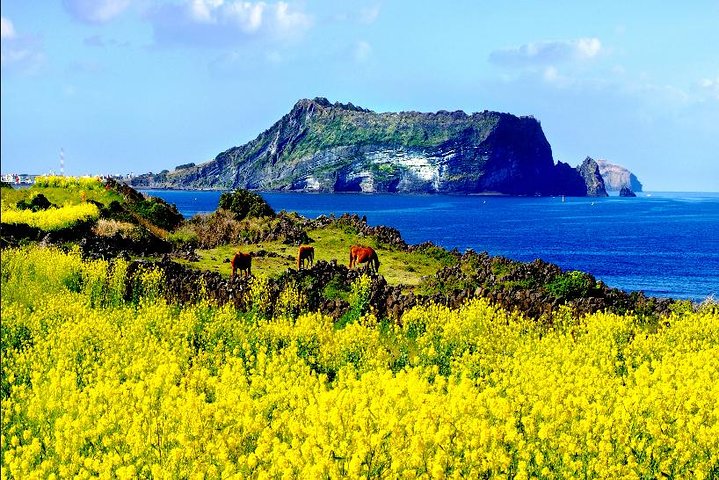
Jeju Island has a reputation as a premium honeymoon destination — five-star resorts, designer seafood restaurants, and Korean couples celebrating in matching outfits at every scenic overlook. That reputation is deserved but misleading, because beneath the luxury layer is an island that is entirely accessible on a genuine budget. The volcanic landscape — Hallasan mountain, ancient lava tubes, a crater that glows at sunrise — is almost entirely free to explore. Street food at Dongmun Market fills you up for KRW 5,000. The bus from the airport costs KRW 1,300. With a rental car shared between two people and a guesthouse bed, a full day on Jeju Island costs KRW 60,000-90,000 per person — less than most European city breaks — with an experience that is extraordinary.
Getting There on a Budget
Jeju International Airport (CJU) is one of the busiest airports in Asia, served by frequent domestic flights from Seoul and international connections from key Asian hubs. From Seoul, the choice is between Gimpo Airport (GMP) for the most frequent service (roughly 40 departures per day, 55-60 minute flight) and Incheon Airport (ICN) for some international-to-Jeju connections.

The budget carriers — Jeju Air, T'way Air, Air Seoul, Eastar Jet, and Jin Air — dominate the Seoul-Jeju route and offer some of the most competitive airfares in Asia. Booking 4-6 weeks ahead, Jeju Air and T'way regularly price one-way fares from Seoul Gimpo at KRW 30,000-50,000. During promotional sales (common during off-peak travel periods: January-February and June-July before Chuseok), fares can drop to KRW 18,000-25,000. Last-minute fares on busy holiday weekends (Chuseok, Lunar New Year, school holiday periods) spike to KRW 120,000-200,000 — avoid those dates entirely if budget is the priority.
From other South Korean cities, T'way and Jin Air offer direct Jeju connections from Busan (45 minutes, from KRW 25,000), Daegu (50 minutes), and Cheongju. From Japan, Osaka and Tokyo have direct Jeju connections on Jeju Air and T'way from approximately KRW 80,000-150,000 one-way. Taiwan Taoyuan is served by Jeju Air direct.
Booking strategy: use Naver Flight Search or the Jeju Air app directly for the best fares. Korean OTAs (Interpark, Skyscanner KR) sometimes surface additional deals. Midweek travel (Tuesday, Wednesday) is consistently cheaper than Friday-Sunday departures. The Jeju Air credit card offers boarding priority and occasional fare discounts for frequent travelers.
Budget Accommodation
Jeju's accommodation range extends from KRW 15,000 dorm beds to KRW 1,000,000+ suite nights at the Shilla Jeju. Budget travelers will find a functional network of guesthouses, hostels, and minbak (Korean family guesthouses) concentrated in Jeju City and scattered along the coast, particularly near Seongsan and Jungmun.

Guesthouse Dolhareubang (Jeju City, near downtown) is one of Jeju's most-recommended budget guesthouses, named after the island's iconic stone grandfather statues. Dorm beds from KRW 18,000-25,000 per night, private rooms from KRW 55,000-80,000. The common areas are sociable, the staff speak enough English to be helpful, and the location puts you within walking distance of Dongmun Market and the bus terminal. Breakfast is not included but the nearby convenience stores and market stalls cover that gap cheaply.
Jeju Backpackers (Jeju City center) is a purpose-built hostel catering specifically to international travelers, with mixed and female-only dorms from KRW 20,000-30,000. Free Wi-Fi, shared kitchen, and a common area where it is easy to find other travelers for car-rental splitting (the single most effective cost-reduction strategy on Jeju). Private rooms from KRW 65,000.
M Hostel Jeju (Jeju City) offers dorm accommodation from KRW 16,000-22,000, with a clean, functional setup that prioritizes value over character. Good location near the bus terminal. Private rooms from KRW 55,000. Used primarily by domestic Korean budget travelers, which means less English-speaking staff but an authentic local atmosphere.
Seongsan area minbak (family guesthouses) — If you plan to hike Seongsan Ilchulbong crater at sunrise, staying in the village at the base of the crater the night before is far cheaper than driving from Jeju City at 4 AM. Local minbak around Seongsan-eup offer basic private rooms from KRW 40,000-70,000 per night — small, simple, and family-run, with the distinct advantage of a five-minute walk to the crater entrance at 5:30 AM.
Eating Cheaply Like a Local
Jeju has a distinct culinary identity that sets it apart from the Korean mainland — black pork (heuk dwaeji), hairtail fish (galchi), abalone porridge (jeonbokjuk), and hallabong citrus are the island's signature flavors. The good news for budget travelers is that the best Jeju food is not in the expensive tourist restaurants near the resort areas — it is in the market stalls, neighborhood pojangmacha (street tents), and family-run restaurants that locals actually use.

Dongmun Traditional Market (Jeju City center, near the roundabout on Gwandok-ro) is the essential Jeju food experience and the budget traveler's best friend. The market has operated since 1954 and sells an astonishing variety of food from stalls priced for local residents, not resort guests. Key items: heuk dwaeji gimbap (black pork seaweed rice roll, KRW 3,000-5,000), hallabong juice (fresh-squeezed from Jeju's famous citrus variety, KRW 3,000-4,000), okdom jeon (pan-fried tilefish, KRW 8,000-12,000 per plate), hairtail fish jorim (braised galchi, KRW 10,000-15,000), and jeonbokjuk (abalone porridge, KRW 12,000-18,000 at market restaurants — the cheapest you will find it anywhere on the island). Dongmun Market is open daily from approximately 7 AM to 10 PM.
For black pork barbecue, the Heuk Dwaeji Street (Sinjeju Heuk Dwaeji Golmok) near Jeju City's Sinjeju area has a concentration of BBQ restaurants where black pork samgyeopsal is priced at KRW 15,000-18,000 per 200g — significantly below the tourist-oriented restaurants near Jungmun. Order the small portion first if you are unsure of how much you will eat; sides (banchan) are refilled free of charge.
Convenience stores (GS25, CU, 7-Eleven) are widespread across the island including at many tourist sites and rest stops. Korean convenience store meals — triangle gimbap (KRW 1,200-1,500), ramyeon cooked at the hot water station (KRW 1,500-2,000), ready-made rice meals (KRW 3,500-4,500) — constitute one of the most underrated budget food strategies in Korea. A full breakfast from a convenience store costs KRW 4,000-6,000.
For the iconic hairtail fish (galchi) experience without the restaurant markup, the Dongmun Market has stalls selling grilled galchi for KRW 8,000-12,000 per serving. The fish is silver, meaty, and unique to Jeju cuisine — do not leave the island without trying it.
Free and Low-Cost Attractions
Jeju's greatest attractions are geological and volcanic in origin, and the island's natural sites are priced with refreshing modesty for a destination at this tourism level.

Hallasan National Park — South Korea's highest mountain (1,950 metres) and Jeju's defining landscape is free to hike. The four main trails (Seongpanak, Gwaneumsa, Yeongsil, Eorimok) range from 3 to 9.6 kilometres one-way and take 2-5 hours ascending. Seongpanak and Gwaneumsa trails go to the summit crater lake (Baengnokdam) — among the most spectacular hiking destinations in Korea. Entry to all trails is free. Bring your own food and water, wear layers, and start before 12 PM (the park enforces turnaround times to ensure hikers descend before dark).
Seongsan Ilchulbong (Sunrise Peak) — A UNESCO World Heritage Site, this volcanic crater rising from the sea on Jeju's east coast is one of the most photographed landscapes in Korea. Entry costs KRW 2,000 per adult — among the best value admission prices for any major natural landmark in Asia. The 20-minute climb to the crater rim is steep but manageable. Sunrise visits (arrive by 5:30 AM) are extraordinary and uncrowded compared to midday. The surrounding haenyeo diving shows (free to watch, schedule posted at the site) add cultural context.
Manjanggul Cave — A 13.4-kilometre lava tube system listed as a UNESCO World Heritage Site, with a publicly accessible 1-kilometre section that passes past extraordinary basalt formations and a 7.6-metre-tall lava column, one of the largest in the world. Entry: KRW 4,000. The cave maintains a constant 10°C temperature year-round — bring a light layer even in summer. Located on the north coast between Jeju City and Seongsan.
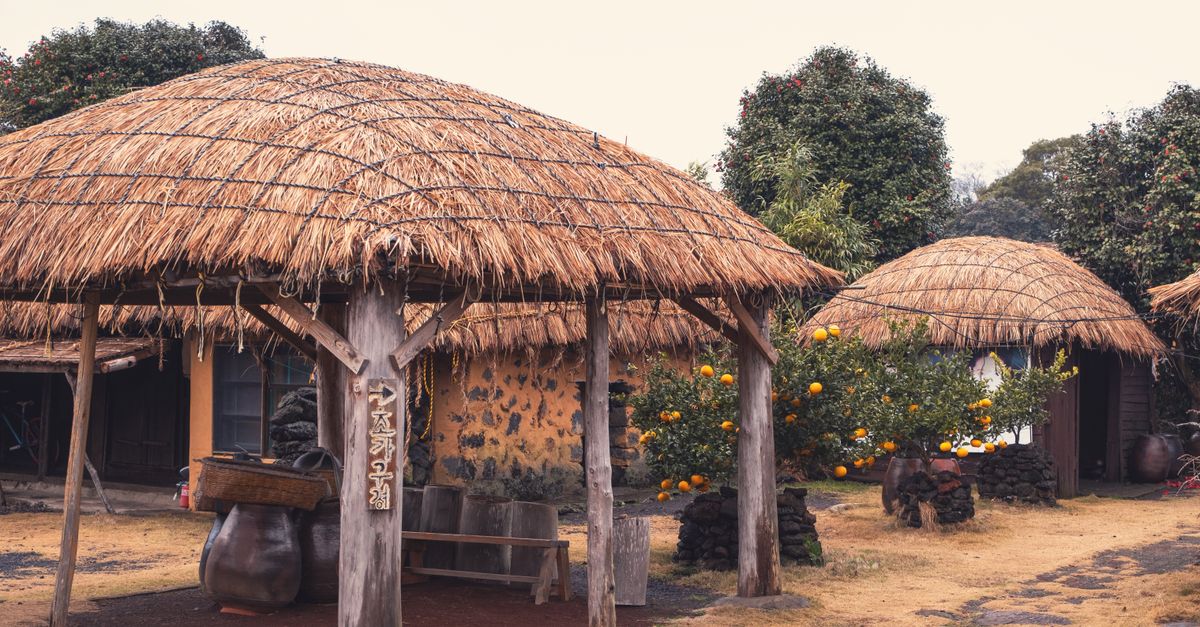
Jeju Folk Village Museum (Seongeup Folk Village area) — An open-air museum of traditional Jeju thatched-roof architecture, stone walls, and haenyeo culture, with guided demonstrations of traditional crafts and explanations of the unique Jeju social structure. Entry: KRW 11,000. Allow 90 minutes to explore the grounds properly.
The Olle Trails — 437 kilometres of marked coastal walking routes circling the entire island — are free to walk and arguably the most complete way to experience Jeju's coastline, villages, and volcanic landscapes at no cost beyond your own effort. Trail 1 (Seyonpoji Port to Gwangchigi Beach, 15 km) is one of the finest coastal walks in Korea.
Getting Around on a Budget
Getting around Jeju on a tight budget requires honest acknowledgment of the island's geography: it is 73 kilometres east to west and 41 kilometres north to south, with major attractions spread across all quadrants. The bus system exists but is genuinely slow and complex.

From the airport — City bus routes 100 and 600 depart from just outside arrivals and cover the main Jeju City hotels and bus terminal for KRW 1,300. The journey to central Jeju City takes 15-25 minutes. Taxis from the airport to Jeju City center cost KRW 8,000-12,000 and take 10-15 minutes.
Public bus island-wide (KRW 1,200-3,000) — Jeju has an intercity bus network that connects the main towns and coastal routes. The 201 and 202 express buses run the east and west coastal circuits respectively, stopping at major attractions. A full circuit bus ticket costs KRW 2,500-3,000. The system works but journey times are long — Seongsan from Jeju City by express bus takes approximately 80 minutes. The Jeju Bus Info app (available in Korean with some English function) or Google Maps provides routing. Bus stops at major attractions are signed in English.
Rental car (KRW 30,000-60,000/day) — The practical solution for anyone who wants to see more than two sites per day. Jeju Air Car Rental and AJ Rent-a-Car both have desks at Jeju Airport and offer compact car rentals from KRW 35,000-50,000 per day. An international driving permit is required alongside your national license. Parking at major tourist sites is well-signposted and typically costs KRW 1,000-3,000 per visit. Split between two people, the daily rental cost drops to KRW 17,500-25,000 per person — less than four bus rides and with total itinerary freedom.
Scooter/e-bike rental — Available from several shops in Jeju City from KRW 20,000-35,000 per day. A practical middle ground for solo travelers — faster than buses, cheaper than a car, and adequate for the main coastal Olle trail areas.
Money-Saving Tips
Jeju rewards travelers who plan transport and timing well. The following tips can meaningfully reduce daily costs without sacrificing any of the island's key experiences.
1. Rent a car and split it with other travelers. This is the single biggest cost lever on Jeju. A KRW 45,000/day car split between two people costs KRW 22,500 each — comparable to 3-4 one-way bus fares but with the ability to visit 5-6 sites per day instead of 2-3. Find car-share partners at your hostel or post in the Jeju traveler Facebook groups before arrival.
2. Buy a dedicated Jeju tourism card if staying 3+ days. The Tamna Free Pass (available at Jeju Airport tourist information desk) offers unlimited bus travel for 2-5 days from KRW 15,000-25,000 — significantly cheaper than individual fares if you use the bus system extensively. Factor in your actual planned bus usage before buying.
3. Hike Hallasan on a Tuesday or Wednesday. Weekend crowds on the Seongpanak trail are significant, particularly during cherry blossom season (late March-April) and autumn foliage (October). Midweek hiking gives you quieter trails, faster progress, and much better photography conditions. The experience is genuinely different.
4. Eat at Dongmun Market rather than tourist restaurants. Dongmun's abalone porridge, hairtail fish, and black pork gimbap cost 40-60% less than the tourist restaurants near Seongsan or Jungmun. Make the market your primary food base for at least half your meals.
5. Book flights 5-6 weeks ahead, midweek. Jeju Air and T'way Air price Seoul-Jeju fares algorithmically — prices are lowest Tuesday/Wednesday departures booked 5-7 weeks ahead. Sign up for Jeju Air's email newsletter for flash sale notifications (sales typically announced Monday for travel the following month).
6. Stay in Jeju City rather than Seongsan or Jungmun resort areas. Accommodation in Jeju City is 30-50% cheaper than near the tourist resort zones, the food options are better, and Dongmun Market is on your doorstep. With a rental car, travel time to Seongsan is 45 minutes and to Jungmun 30 minutes — the location premium of staying near those sites is rarely worth paying.
7. Bring snacks and water for Hallasan hikes. The mountain has a single refreshment point at Witseoreum Shelter, with limited stock at high prices. Buy water (1.5L, KRW 1,500-2,000) and triangle gimbap or kimbap (KRW 1,200-1,500 each) from a Jeju City convenience store before heading to the trailhead. Bring more food than you think you need — the descent takes as long as the ascent.