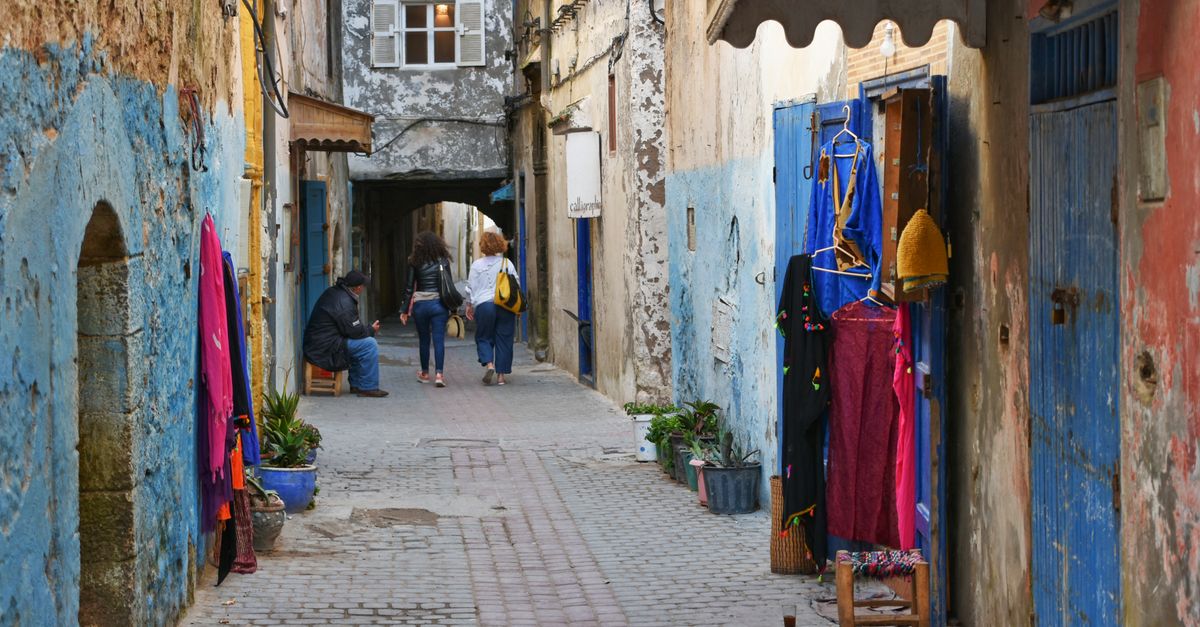
Essaouira is the easiest landing pad in Morocco for first-time visitors. The whitewashed Atlantic port, three hours west of Marrakech, has none of the maze-medina disorientation of Fez and none of the relentless commercial pressure of the Marrakech souks. The medina is a French-engineered grid laid out in 1764, the population is calm and used to travelers, the wind keeps temperatures pleasant, and the Atlantic light gives the entire town a blue-and-white photogenic quality that has drawn artists, hippies, surfers, and Game of Thrones location scouts for half a century. If Marrakech is the deep-end of Moroccan travel, Essaouira is the heated pool with steps.
This guide covers the practical first-time-arrival details: visa policy, the closed dirham, SIM cards, dress code in a more relaxed coastal town, where to base yourself within the medina or on the ramparts, the local culture around hammams and Friday couscous, and the specific small mistakes that catch newcomers — like arguing about the wind, or saving the Skala photographs for a crowded sunset.
Before You Arrive
Citizens of the United States, United Kingdom, Canada, Australia, New Zealand, and the European Union and Schengen Area can enter Morocco visa-free for stays up to 90 days. Your passport needs at least three months of validity from your departure date and one blank page for the entry stamp. Border officers occasionally request proof of onward travel — keep a screenshot of your return flight or onward Marrakech bus ticket on your phone. There is no entry fee, no e-visa requirement, and no vaccination requirement except for travelers arriving directly from yellow-fever zones.

The Moroccan dirham (MAD) is a closed currency. It is illegal to bring it into or out of Morocco, and you cannot reliably buy it abroad. Plan to arrive with EUR 100 or USD 100 in cash as a small float and pull dirham from any ATM at Essaouira-Mogador Airport (ESU) or in town on arrival. The exchange rate floats around MAD 10 per EUR and MAD 9.5 per USD. Banque Populaire, BMCE, and Attijariwafa ATMs accept Visa, Mastercard, and most chip-and-PIN debit cards with a flat MAD 25-35 foreign-card fee per withdrawal — withdraw a meaningful amount each time. When the ATM offers "conversion in your home currency," always decline and pay in MAD. The dynamic conversion costs you 4-7%.
Buy a Maroc Telecom or Orange SIM at the airport for MAD 50 (USD 5) with 10-20 GB of data and 30 days of unlimited local minutes. Both networks have full Essaouira coverage. Maroc Telecom edges Orange for the rural beaches south of town (Sidi Kaouki, Diabat). You need a passport for SIM registration. Plug type is C or E (European two-round-pin) at 220 V — bring a cheap travel adapter. Modest dress is appreciated but not strictly enforced in Essaouira; the coastal vibe is more relaxed than Fez or Marrakech, and shoulders, knees, and beachwear at the actual beach are all unremarkable. Tap water is safe in town but most travelers drink filtered or bottled to avoid stomach upset from unfamiliar mineral content.
Getting from the Airport
Essaouira-Mogador Airport (ESU) is a small single-runway facility 15 kilometers south of the medina, near Sidi Kaouki. Passport control takes 15-30 minutes. Pick up a SIM and pull cash before leaving the terminal — there is no ATM in the village between the airport and town. The taxi rank sits immediately outside arrivals.

There is no public bus from ESU into Essaouira. Your two options are a petit taxi or a pre-arranged transfer. Petit taxis at the rank should run MAD 150-200 (USD 15-20) by meter for the 20-minute drive to the medina, or you can negotiate a flat rate before loading bags. Insist on the meter — say "compteur s'il vous plait" — or agree the price up front. Petit taxis are limited to three passengers and the after-8-PM tariff rises 50%. Sharing a taxi with other arrivals is common and reasonable; if your flight has multiple medina-bound travelers, splitting MAD 200 four ways is MAD 50 each.
A pre-arranged riad transfer costs MAD 200 and is worth it for first-time arrivals because someone will meet you at the medina gate with a hand-drawn map to your door. The medina is a grid and not particularly hard to navigate, but with luggage in a new town after a flight, the meeting-at-the-gate service genuinely smooths the arrival.
Most travelers reach Essaouira by Supratours or CTM bus from Marrakech (MAD 80-100, three hours), arriving at the bus station 1.5 kilometers east of the medina. From the bus station, walk 15-20 minutes through the new town to Bab Doukkala, or take a petit taxi for MAD 15-25.
Getting Around the City
Essaouira is one of the most walkable towns in Morocco. The medina is a French-engineered grid roughly 600 meters by 400 meters, and you can cross it corner to corner in 10-12 minutes. Almost everything you came for — riads, fish-market grills at the Skala, the rampart walk, the harbor, the beach access at Bab el-Bahr — sits inside this grid. The streets are wide enough for two people to pass comfortably and named at every junction in both Arabic and French. Wear sandals, sneakers, or any shoes that handle a little sand.

The new town (where the bus station, supermarkets, banks, and chain hotels sit) is a 15-20 minute walk east of the medina, or MAD 8-15 by petit taxi. Petit taxis are blue in Essaouira (red in Fez and Casablanca, beige in Marrakech — the colors change by city). They use meters and an in-town fare almost never exceeds MAD 20. Maximum three passengers, after-8-PM tariff is 50% higher.
For the long Atlantic beach south to Sidi Kaouki (a hippie-surf village 25 kilometers down the coast), the Number 5 local bus from Bab Doukkala costs MAD 7 and runs hourly during daylight. A petit taxi to Sidi Kaouki runs MAD 80-120 one way, or MAD 200-250 round-trip with a one-hour wait. Grand taxis from the rank near Bab Doukkala handle Marrakech (MAD 100-130 per shared seat) and Agadir (MAD 90-120 per shared seat). They depart when full — six passengers in a Mercedes sedan — or pay for empty seats to leave immediately.
Where to Base Yourself
The Essaouira medina splits into three loose zones, and where you stay shapes the trip more than first-timers expect.

Inside the medina around Rue de la Skala and Rue Mohamed Diouri is the classic location: traditional riads with internal courtyards, ten-second walks to fish-market grills and rampart walks, the sound of seagulls and the call to prayer, and the lowest possible friction for first-time exploration. Riad prices range from MAD 350-500 for budget riads with shared bathrooms (Casa Lila, Riad Mimouna) through MAD 600-1,000 for mid-range with private bathrooms and breakfast (Dar Loulema, Riad Asmitou) up to MAD 1,500+ for boutique riads with sea-view roof terraces (Heure Bleue Palais, Villa Maroc). For first-timers staying three to five nights, this zone is the obvious pick.
Riads built directly into the ramparts on the seaward edge — Riad Mimouna's higher rooms, Riad Watier, and Heure Bleue's ocean suites — cost MAD 700-2,000 per night and offer the photogenic ocean-crashing-below-your-window experience. The trade-off is the wind, which is constant and audible at night. Some travelers love the white-noise effect; others find it relentless.
The Diabat side, six kilometers south of the medina near the ruined Borj el-Berod tower, is where the surf lodges and rural retreats sit. Prices range MAD 400-900 for a guesthouse double, but you need a daily MAD 80-120 taxi or a rental car to reach the medina. Sidi Kaouki, 25 kilometers south, has the best surf and the lowest prices (MAD 180-350 dorms and basic doubles) but is genuinely isolated — fine for surfers staying a week, less practical for a first Moroccan trip.
The new town has chain mid-rangers (Ibis, Hotel des Iles) at MAD 500-900 with car parking and easy bus-station access, useful for travelers with very early or very late connections but otherwise a less interesting base.
Local Culture & Etiquette
Morocco is a Muslim country with relatively moderate social norms, and Essaouira is more relaxed than Fez or the Atlas mountain villages because of decades of foreign exposure as a fishing port and artist colony. Basic etiquette still applies. Non-Muslims may not enter active mosques anywhere in Morocco, including the central Mosque Ben Youssef and the Sidi Mogdoul shrine on the southern beach. You can walk past, photograph the doors and minarets, and admire the architecture — just do not step over thresholds that are clearly marked or attended.

Photography of people requires permission. Ask "mumkin sura?" (may I take a photo?) before raising the camera, and accept "no" without arguing. Fishermen at the harbor are generally photo-friendly but appreciate a small tip (MAD 5-10) for posed shots. Older women, anyone in religious dress, and children should be photographed only with explicit permission. Never photograph the police, the Royal Gendarmerie patrols on the ramparts, or active prayer.
Ramadan, the lunar month of fasting, shifts about 11 days earlier each year. During Ramadan, restaurants and cafes inside the medina close from dawn to sunset, and visibly eating, drinking, or smoking in public is read as disrespectful. Tourist riads and a few harbor restaurants still serve meals, and most reopen at iftar (sunset) for spectacular communal breaking-of-the-fast meals — soup, dates, eggs, and grilled fish — that are worth experiencing.
Hammams are central to Moroccan life and Essaouira has both public neighborhood hammams (MAD 20-40 for the entry, gender-separated by time slot) and tourist-oriented hammams like Hammam Mounia (MAD 200-400 with a full scrub and massage). Public hammams require you to bring your own kessa scrubbing glove, savon noir black soap (sold for MAD 10-20 at any spice shop), and a towel. You strip to underwear, lie on a heated marble bench, and an attendant scrubs the dead skin off in long firm strokes. Tip MAD 30-50.
Friday is couscous day. Most local Moroccan families eat couscous as the midday meal on Friday, and many cafes and small restaurants offer couscous specials at MAD 50-90 — by far the best Moroccan home-cooking value of the week. Triskala, Cafe Berbere, and many medina cafes participate.
Common Mistakes to Avoid
Seven mistakes catch nearly every first-time visitor in Essaouira. They are smaller than the Fez or Marrakech mistakes but they will improve your trip immediately:
1. Arguing about the wind. Essaouira is one of the windiest coastal cities in North Africa — the steady Atlantic trade wind is why surfers come, why the climate stays cool in summer, and why the medina was historically a perfect port. The wind is not a flaw to be complained about. Pack a windbreaker or fleece in any season, accept that morning beach photos will be hair-in-face affairs, and lean into the kite-surfing and sailing scene that the wind makes possible.
2. Going to the Skala for sunset photos with the crowd. Sunset at the Skala is famously photogenic, and it is also where every cruise day-tripper from Marrakech ends up between 5:30 and 7 PM. Visit instead at sunrise, or one hour before sunset, when the cannon-and-rampart shots are uncrowded and the light is identical. The afternoon crowd photo is the cliche; the dawn shot is the trip's best image.
3. Eating at sit-down harbor restaurants. The fish-market grills 30 meters away serve the same fish, charcoal-grilled to order, for half the price. Sit-down harbor restaurants are price-marked for European tour groups. Eat the grills for lunch and save the sit-down splurge for a single dinner at Triskala or La Table.
4. Booking surf lessons through your riad without comparing. Riads charge MAD 400-500 for a half-day group lesson. Walking into Magic Fun Afrika, Explora, or Surf Berbere shops near Bab Marrakech directly gets you the same lesson for MAD 250-350. Equipment quality is identical.
5. Buying argan oil in the harbor tourist shops. The harbor and inner-medina tourist shops sell argan oil at MAD 400-600 per 100ml, often diluted. The Berber women's cooperatives on the Marrakech road outside town (visible from the bus on arrival) sell certified pure argan for MAD 200-280 per 100ml.
6. Skipping Sidi Kaouki because you do not surf. The 25-kilometer beach drive south to Sidi Kaouki is one of the most beautiful coastal landscapes in North Africa, the village has excellent fish lunches at La Mouette d'Or for MAD 80-150, and you do not have to surf — walking, horse rides, and lunch on the dune are reasons enough.
7. Refusing to bargain because "Essaouira is laid back." Vendors do quote 1.5-2x the real price even here. Smile, counter at 50%, settle in the middle. The negotiation is friendly rather than tense, but skipping it costs you 20-40% on every souvenir.