Essaouira crept up on the travel world slowly. For decades it was known mainly to wind-surfers (the Atlantic trade winds here are relentless and legendary), to the hippies and musicians who arrived in the 1960s following Jimi Hendrix, and to the Moroccan families who summered in its whitewashed medina behind the rampart walls. Then the guidebooks discovered it, the boutique riads multiplied, and Essaouira found itself on every "undiscovered Morocco" list — which is somewhat ironic, but has not substantially altered its unhurried character.
The city sits on a rocky Atlantic promontory 176 km north of Agadir, and the ocean defines everything about it: the constant wind that keeps temperatures cool even in July, the Portuguese-influenced rampart architecture facing the sea, the fishing port that produces the best sardines in Morocco, and a way of life distinctly different from the imperial cities of the interior. Essaouira is Gnawa music — the trance-inducing ritual music of West African-descended communities — and blue fishing boats and argan oil and the best wooden marquetry in Morocco.
The dirham makes Essaouira excellent value despite its growing tourism reputation. Most accommodation, food, and activities cost significantly less than equivalent experiences in Marrakech or Fez. The city is small enough to walk entirely in a day but rewards three to four days of slow exploration and beach time.

1. The Gnawa Music Quarter
The Gnawa are descendants of enslaved West Africans brought to Morocco from sub-Saharan West Africa beginning in the 16th century. Their music — characterised by the sintir (a three-stringed bass lute), the krakebs (iron castanets), and call-and-response vocals — developed as a vehicle for trance ceremonies (lila) used to heal the sick through spiritual possession. It has since entered the global music repertoire through its influence on jazz, blues, and North African popular music, and the annual Gnawa World Music Festival in June (one of Africa's largest music events) draws 500,000 people to Essaouira's ramparts.
The Gnawa musician community in Essaouira is concentrated in the medina's Essaouira-Mogador quarter, in a network of alleyways around the Place Moulay Hassan. Several authentic Gnawa zawiyas (brotherhood lodges) hold regular lila ceremonies that respectful visitors can observe on request. These are not performances — they are genuine ritual events — and the protocol for observation should be followed carefully: dress modestly, sit quietly, do not photograph without permission, and bring a small monetary contribution (MAD 50–100) as an offering to the brotherhood.
The easier entry point for visitors is the music shops along Avenue Zerktouni and around the medina's main square, where Gnawa musicians sell recordings and occasionally play informally. Several workshops also offer sintir lessons (MAD 150–200 per hour) for visitors willing to learn the instrument's basic technique. The sintir's deep, resonant buzz — somewhere between bass guitar and cello — is like nothing else in the world's instrument families.
The Gnawa World Music Festival in June transforms Essaouira's ramparts into a series of stages for the world's finest Gnawa masters, alongside jazz, blues, and electronic artists whose music connects to the Gnawa tradition. Most events are free admission; the major evening concerts on the main stage in the rampart square are also free. Book accommodation 3–4 months in advance for festival week; every room in the medina sells out rapidly.
2. Essaouira's Fish Souk at Dawn
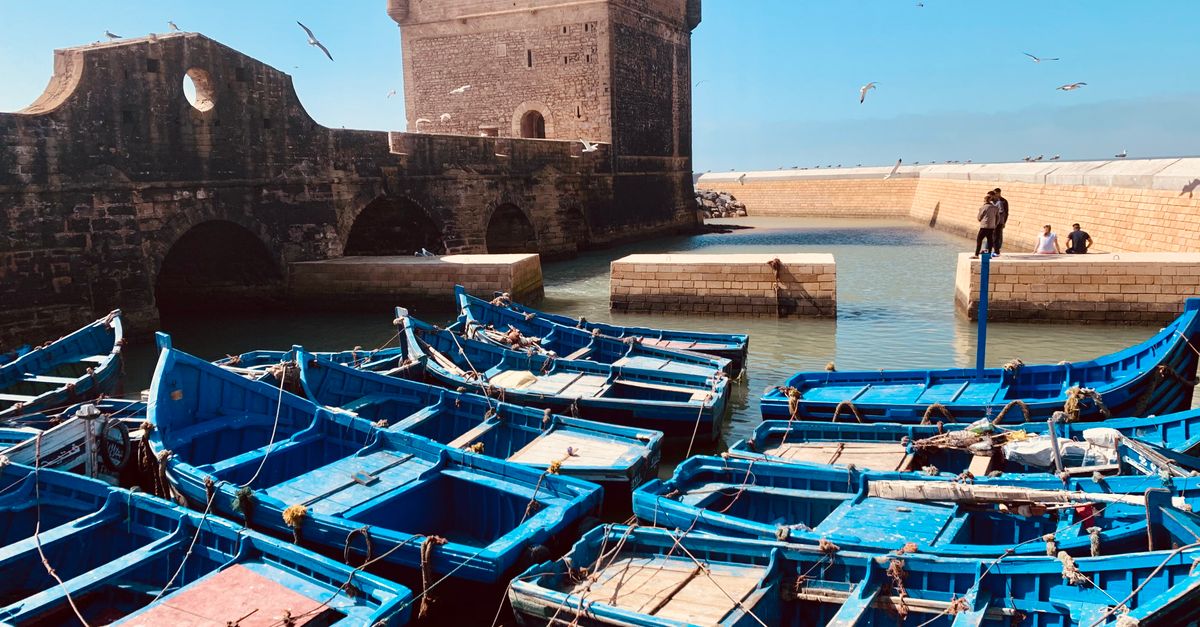
At 7 a.m. the fishing boats are returning from overnight sardine runs in the Bay of Essaouira, and the port's landing area becomes the most intensely colourful and olfactorily assertive scene in the city. The catch — overwhelmingly sardines, with anchovies, mackerel, sea bass, and occasional swordfish — is unloaded directly from the blue wooden boats into polystyrene boxes and immediately carried to the fish auction hall (Criée) where buyers from Marrakech, Casablanca, and local restaurateurs bid on the day's haul.
Non-buyers can observe the auction from the gallery above for free (ask the port gate guard for permission; MAD 20 often helps). The entire transaction happens in a rapid, specialised Moroccan Arabic auction dialect that takes years to understand, but the energy — the auctioneers singing prices, the buyers signalling with fingers, the porter relay teams running boxes to waiting trucks — is extraordinary to observe.
The fish souk stalls adjacent to the port sell direct to the public from 8 a.m. Sardines cost MAD 10–15 per kilo; sea bass MAD 40–60; local swordfish (espadon) MAD 80–100. Next to the fish stalls, a row of grill restaurants buy direct from the morning's landing and grill to order: a plate of fresh-grilled sardines with bread and harissa costs MAD 30–40 ($3–4 USD) and constitutes the finest possible use of the morning. The informal restaurant area just outside the port gate is the local option; the more photographed grills inside the port gate charge double.
The port is on the medina's northern side, accessible from Place Moulay Hassan in 5 minutes. The fishing fleet operates daily; the port is at its most active Sunday through Friday (the fleet rests on Saturday). Visitors must check in with the port guard at the entrance gate; photography of the port is officially prohibited but widely practised with discretion. The blue boats, the yellow boxes of fish, and the white medina walls behind make this one of Morocco's most photogenic dawn scenes.
3. The Marquetry Workshops of Rue Sidi Mohammed ben Abdallah
Essaouira is the centre of Moroccan wood marquetry — the art of creating decorative surfaces by embedding contrasting veneers of thuya wood (from the gnarled, aromatic Atlas cedar-relative that grows only in Morocco and Algeria) into geometric patterns. The city's marquetry tradition dates to the 17th century, when Portuguese merchants established the port town and local craftsmen developed the technique to supply both the domestic market and the export trade.
The workshops along Rue Sidi Mohammed ben Abdallah and in the adjacent Attarine souk produce everything from small trinket boxes to full bedroom furniture sets using marquetry techniques. The process involves slicing thuya burls into paper-thin veneers, cutting each piece to the geometric pattern, assembling the entire design like a jigsaw puzzle, and pressing it onto the wooden base. A complex piece (a large round table, for example) might require 10,000 individual cuts.
Workshop visits are freely welcomed by the craftsmen — watch without obligation, ask questions, buy directly from the workshop for 20–30% less than the medina's souvenir shops charge. A small thuya box costs MAD 60–120 ($6–12 USD); a large decorative bowl MAD 200–400. The thuya wood's deep, aromatic fragrance (similar to cedarwood but more complex) makes any piece a long-lasting sensory reminder of Essaouira. The best pieces have tight, precise geometry and smooth, polished surfaces; reject anything with rough edges or visible glue lines.
The most skilled marquetry master currently working in Essaouira — known by reputation as Si Ahmed the Carpenter — operates from a workshop on Rue Sidi Mohammed ben Abdallah accessible only through a passage that looks like a dead-end. His pieces take 3–6 months to produce and are purchased by collectors and interior designers internationally. He doesn't sell from stock but commissions pieces at prices reflecting genuine art market valuation (MAD 3,000–15,000 for major pieces). Worth visiting simply to observe the work regardless of purchasing intent.
4. Diabat Village Ruins and Hendrix History
Three kilometres south of Essaouira along the beach, the ruined village of Diabat sits among sand dunes at the mouth of the Oued Ksob river. The ruins are of a 19th-century village abandoned when the river mouth shifted and flooding made the location untenable — they are not dramatic by Mediterranean ruin standards, but the setting is magnificent: dunes, river, ocean, and the distant blue smudge of Essaouira's ramparts. The ruins carry a secondary layer of mythology as the place where Jimi Hendrix stayed during his extended visit to Essaouira in 1969 and supposedly drew inspiration for "Castles Made of Sand."
The Hendrix connection is partly apocryphal — historical evidence of exactly how much time he spent in and around Essaouira is thin — but the town's Gnawa musicians did interact with him and the impact of those encounters on his musical evolution has been credibly argued by musicologists. The mythology is less important than the walk itself: 3 km along an Atlantic beach where wild Atlantic rollers come in unimpeded, the wind is typically 30–40 km/h, and the only other people on the beach are kitesurfers and the occasional local horseback rider.
The walk to Diabat takes 45–60 minutes from the beach entrance south of the port. There is no path — follow the beach and cross the river mouth at low tide (ankle-deep in summer; waist-deep in winter). Diabat village itself has a café serving mint tea and basic tagines for MAD 30–60 — the proprietor, a man named Hassan, was the source of much of the Hendrix mythology and tells the stories with evident pleasure. No entry fee for the ruins; they are completely open and unmanaged.
The dunes above Diabat offer the best views of the surrounding landscape: the Essaouira archipelago of offshore islands (home to Eleonora's falcons that nest here in summer and winter in Madagascar), the agricultural plain extending inland, and the extraordinary light of the Atlantic coast in the late afternoon. The walk back along the beach against the wind is vigorous; time the return for the last hour of light when the ramparts of Essaouira glow amber against the Atlantic.
5. The Skala du Port Sunset Rampart Walk
Essaouira's sea ramparts (skala) are among the most photogenic in Morocco, but the port skala — the lower fortification running along the port's edge — is visited far less than the more famous medina skala with its cannon row. The port skala walkway runs above the working harbour and provides a changing view as you walk: first the blue boats of the fishing fleet, then the open Atlantic, then the islands of the Essaouira Archipelago with their resident osprey and Eleonora's falcon colonies, and finally the full breadth of the bay curving south toward the distant headlands.
The skala is best at sunset in the Essaouira context — partly because the light is extraordinary, and partly because the wind drops slightly in the late afternoon, making the exposed rampart walkway more comfortable. The cannon emplacements on the sea wall (Portuguese bronze cannon, dating to the 17th century, still in their original positions) are used as seating by local teenagers and elderly men who watch the sun go down in companionable silence every evening.
Access to the port skala is from the Bab Sbaa gate on the medina's northern side. No entry fee; the walkway is open until shortly after sunset when the port closes. The medina skala (the upper rampart with the famous row of Spanish and Portuguese cannon) is accessed from a separate entrance near Place Moulay Hassan and is also free. The two skala walks together take about 90 minutes and provide a complete circumnavigation of the medina's sea-facing defences.
The Essaouira Archipelago — the islands visible from the port skala — are now a National Marine Reserve and provide critical nesting habitat for Eleonora's falcon, a medium-sized migratory raptor that times its nesting to coincide with the autumn bird migration so its chicks are fed on exhausted migrating songbirds. The islands can be visited by boat in summer (enquire at the port; MAD 100–150 per person) but landing is restricted near the nesting areas. The falcons themselves are visible hunting over the town from August to October.
6. Moulay Bouzerktoun Wind Village
Fifteen kilometres north of Essaouira on a headland above a dramatically exposed beach, the village of Moulay Bouzerktoun is the epicentre of Morocco's windsurfing and kitesurfing scenes — and one of the most exhilarating coastal environments in North Africa. The wind here is so consistent and powerful that international kitesurfing competitions are held on the beach, and on a typical afternoon 50–100 kites are flying simultaneously in colours that make the beach look like a festival.
For non-kitesurfers, the appeal is simply the spectacle and the landscape: enormous waves driven by the trade winds against a rocky headland, with the Atlas mountains visible on clear days to the east, and a wild Atlantic beach stretching south toward Essaouira. The village itself is tiny — a hundred houses, a few simple restaurants, and the surf schools — and its human scale contrasts dramatically with the enormous natural environment surrounding it.
Kitesurfing lessons at Moulay Bouzerktoun cost MAD 800–1,200 per day including equipment. Windsurfing equipment rental (for experienced sailors) is MAD 200–300 per hour. Grand taxis from Essaouira run to Moulay Bouzerktoun for MAD 20 per person (30 minutes). The village has a handful of basic guesthouses charging MAD 150–200 per night — very basic but the location is extraordinary. The most dramatic light is late afternoon when the Atlantic turns silver and the kites become silhouettes against the sky.
The marabout (saint's tomb) of Moulay Bouzerktoun at the headland above the beach is a whitewashed domed structure that has given the village its name. Local fishermen make offerings here before setting out and the marabout is considered a protective spirit of the coast. Non-Muslims should approach the exterior with respect; entry to the tomb itself is not typically permitted but the terrace around it is accessible and the view from the headland is extraordinary.
7. The Medina's Foundouk Quarter
Essaouira's medina was purpose-built in the late 18th century by the Alaouite sultan Mohammed ben Abdallah to a plan drawn up by a French architect — making it the most regular and readable of Morocco's medinas, with a grid layout unusual for a city of this tradition. Within the grid, several former fondouqs (merchants' caravanserais, used to house traders and their goods during commercial visits) have been converted to artists' studios, craft workshops, and gallery spaces that form the nucleus of Essaouira's contemporary art scene.
The Gallery Damgaard on Avenue Oqba ben Nafia was the first major gallery to exhibit the self-taught Gnawa-influenced painters who emerged from Essaouira's spiritual traditions in the 1980s. Artists like Mohammed Tabal, Saïd Ouarzaz, and the late Houssine Miloudi developed an aesthetic combining Islamic geometric ornament with West African symbolic vocabulary that has been internationally exhibited and collected. The gallery and its associated workshop are still operating and showing current work by both established and emerging Essaouira artists.
Gallery visits are free; works sell from MAD 500 ($50 USD) for small pieces to MAD 20,000 for major canvases by the most established artists. The gallery staff are knowledgeable about the artists' backgrounds and the spiritual traditions that inform the work. The quarterly opening events (check the gallery Facebook page) bring together Essaouira's artistic community with visiting collectors in the courtyard of the old fondouk — some of the city's most lively evenings.
The area around the gallery also contains several independent artists working in medina studios — look for the hand-painted signs on doors. These artists welcome visits and sales without the gallery's intermediary commission, so prices at the studio door are typically 20–30% lower. The quality varies significantly; take time to look at multiple studios before purchasing. The most interesting work tends to be produced by younger artists who have moved to Essaouira specifically for the creative community it sustains.
8. Argan Oil and Orange Blossom Cooking Class
Essaouira's food culture — distinct from both the Marrakech and Fez traditions — is built on the coastal ingredients of the Atlantic: fresh fish, preserved lemons, argan oil (used in cooking here rather than just as a cosmetic), and the distinctive combination of saffron, ginger, and ras el-hanout spice blend that characterises coastal Moroccan cooking. A cooking class focused specifically on Essaouiran cuisine — rather than generic "Moroccan tagine" classes available everywhere — is one of the most distinctive experiences the city offers.
Dar Baba cooking school, in a riad on Rue du Rif, offers morning market-to-table classes (MAD 400–500 per person, 4 hours) that begin in the fish souk for morning catch selection, continue through the medina's spice market, and conclude with cooking and eating a full Essaouiran meal: fish pastilla with argan oil and almonds, fish tagine with preserved lemons and olives, and amlou (a paste of argan oil, almonds, and honey) served with warm msemen flatbread. The class is small-group (maximum 8 people) and the instruction is in both French and English.
The argan tree (Argania spinosa) is found only in the triangle between Essaouira, Agadir, and Taroudant — a UNESCO-protected Biosphere Reserve. The argan fruits are eaten by goats (who climb the thorny trees to reach them — one of Morocco's more extraordinary sights) and the seeds inside pass through the goat undigested, are collected by the cooperatives, and cold-pressed for oil. Culinary argan oil has a deep, nutty flavour; cosmetic argan oil is odourless. They are produced by different pressing methods and are not interchangeable.
Amlou — the almond, argan oil, and honey paste — is Essaouira's contribution to Moroccan breakfast culture, spread on warm bread and consumed with coffee or mint tea. It is essentially the Moroccan answer to almond butter and has genuine nutritional merits: cold-pressed argan oil contains tocotrienols (Vitamin E compounds) at eight times the concentration of olive oil. Purchase it directly from the market's spice stalls for MAD 40–60 per jar; the tourist shops charge MAD 150–200 for identically packaged products.

9. The Mellah Cemetery and Jewish Heritage
Essaouira had one of Morocco's most significant Sephardic Jewish communities for three centuries — at its peak in the 19th century, the Jewish population constituted 40% of the city and dominated its commercial and diplomatic life. The community virtually disappeared after 1948, emigrating to Israel, France, and the Americas in successive waves. What remains is the Mellah quarter, the Ben Zmirou synagogue (maintained by a French-Moroccan preservation foundation), and the Jewish cemetery above the beach — one of the most beautiful and melancholy cemeteries in Morocco.
The cemetery sits on a hillside above the Atlantic, its white tombstones facing the sea, the wind carrying sand across the graves in patterns that constantly rearrange themselves. The inscriptions are in Hebrew, French, and occasionally Arabic — three languages of a community whose story is one of the most complex in Mediterranean history. The cemetery is maintained by the Moroccan government and the Association for the Preservation of the Jewish Heritage of Morocco, and is accessible daily from 9 a.m. to 5 p.m. with a small donation (MAD 20–30).
The Ben Zmirou synagogue (also known as Haïm Pinto Synagogue) in the Mellah is open for visits by appointment through the Mellah cultural centre on Place Marrakech. The interior — while no longer regularly used for services — preserves its original woodwork, textiles, and ritual objects in a state of remarkable completeness. A donation of MAD 50 is appropriate; the caretaker who opens the synagogue speaks French and some English and provides historical context.
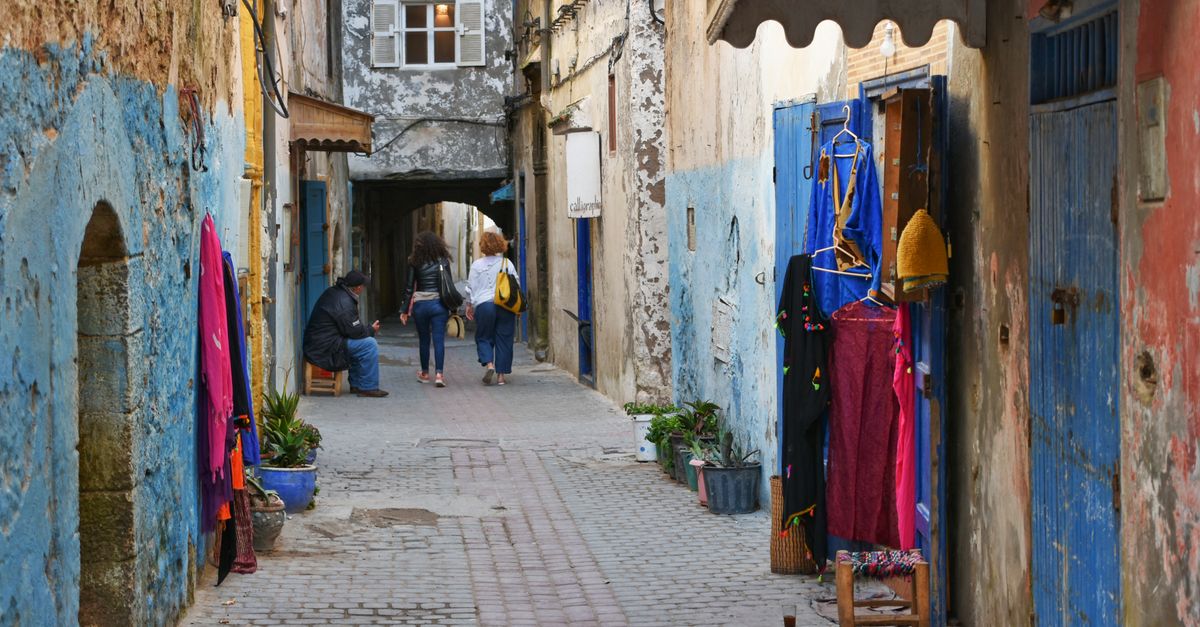
The Mellah quarter's architecture is distinctive: tall buildings with jutting wooden balconies (a feature of Moroccan Jewish domestic architecture that allowed women to observe the street without being visible) frame narrow alleys that are now increasingly converted to riad hotels and craft galleries. Walk the Mellah from the cemetery downhill to the Ben Zmirou synagogue and through to Place Moulay Hassan — the full walk takes 30 minutes and covers three centuries of a community's rise and disappearance in architectural form.
10. Sidi Kaouki Beach and Marabout
Twenty-five kilometres south of Essaouira, where the road ends at a wide Atlantic beach backed by dunes and argan forest, the village of Sidi Kaouki clusters around the white-domed marabout of its patron saint on a rocky promontory above the sea. The beach here is wider, quieter, and significantly more dramatic than anything near Essaouira town, with Atlantic rollers arriving in sets of three and breaking on a bar 200 metres from shore in a continuous display of coastal power.
Sidi Kaouki has developed a small but high-quality independent travel infrastructure: three or four excellent surf-focused guesthouses charge MAD 300–600 per night for rooms with Atlantic views, and the village's single restaurant serves the freshest sardines in Morocco cooked over charcoal fires for MAD 40–60 per plate. The population is perhaps 200 people; the beach can be 2 kilometres wide and entirely empty on a winter weekday.
Grand taxi from Essaouira to Sidi Kaouki costs MAD 30 per person (40 minutes). The road passes through argan forest — distinctive gnarled trees spread across the hillsides — and the occasional argan-eating goat in a tree (the famous sight; visible with genuine frequency on this road). Return taxis can be arranged through the guesthouse or by mobile phone call to the grand taxi drivers who work the route.
The marabout of Sidi Kaouki is a place of active pilgrimage for local Berber families. The annual moussem (saint's festival) at Sidi Kaouki draws hundreds of pilgrims who camp on the beach for three days of prayer, music, and communal celebration. The moussem date changes according to the Islamic calendar; ask in Essaouira for the current year's date. Visitors are welcome to observe respectfully, and the event represents one of the most genuine expressions of Moroccan Sufi popular religious culture accessible to any traveller.