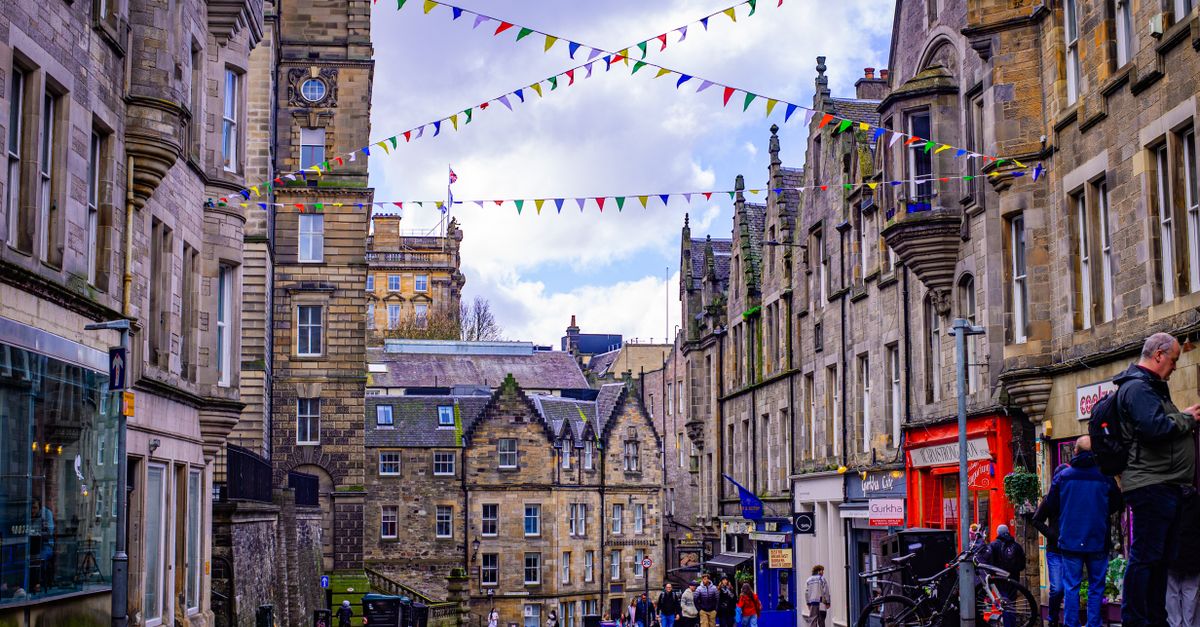
Edinburgh is the most dramatic city in Britain — a medieval volcano core, a Georgian New Town grid, a castle on a crag of lava, and the capacity to produce in a single afternoon the kind of light that Dutch Golden Age painters would have killed for. The tourist circuit (Royal Mile, the castle, Holyrood, Arthur's Seat) is genuinely extraordinary and should be done. But Edinburgh has layers below the tourist surface that most visitors never reach: a port district that was the city's commercial heart for centuries, a colony of Victorian residential streets that constitute one of the finest examples of 19th-century urban design in Europe, and a pub culture that is unlike anything else in the British Isles.
This guide is for the traveller who has already walked the Royal Mile and wants to walk somewhere else — the Dean Village water mills, the Water of Leith walkway, or the hill above Duddingston village where Turner painted Arthur's Seat from the south. It's for someone who wants to drink a proper dram of Scotch whisky explained by someone who knows the difference between sherry cask and bourbon cask and cares about it enough to tell you at length.
Edinburgh is at its finest in October: the festivals are done, the prices are down, the light is extraordinary, and the pubs are full of actual Edinburghers rather than actual festival-goers.

1. Dean Village and Water of Leith
The Dean Village is a milling community in a dramatic gorge of the Water of Leith, 5 minutes walk from the West End of Princes Street and almost entirely unknown to the visitors milling about the New Town above it. The village was a working mill settlement from the 12th century, the mills processing grain for Edinburgh's bakers. The Victorian tenements and grain stores still line the riverbank, the river still runs over the same weir that powered the mills, and the walk downstream to Stockbridge passes under ornate Victorian bridges that look entirely out of proportion to the small river they span.
The Water of Leith Walkway follows the river for 12 kilometres from Balerno in the southwest to Leith in the northeast — the only continuous walking route through central Edinburgh that never touches a road. The section from Dean Village to Stockbridge (30 minutes) and then to the Royal Botanic Garden (45 minutes further) is the finest urban walk in Edinburgh: willows trailing in the water, herons standing on rocks mid-stream, the backs of New Town mansions visible through the trees above, the sound of the city audible but distant.
From the West End of Princes Street, walk north on Queensferry Street and descend the stairs to the left at the bridge over the Water of Leith. The Dean Village is immediately below. The walkway downstream is signed with the Water of Leith symbol. The Dean Gallery (Scottish National Gallery of Modern Art, free) is immediately above the village and worth visiting for the Eduardo Paolozzi collection in particular — his giant reconstructed Dream of Frankenstein figure in the entrance hall is one of the finest pieces of British sculpture of the 20th century.
The walk from Dean Village to Stockbridge via the river is approximately 2 kilometres and takes 30 minutes at a slow pace. Stockbridge village — a gentrified neighbourhood of independent shops, coffee shops, and Sunday market (on St Stephen Street, 10am–5pm, worth the browse) — is the reward at the end. The Sunday Stockbridge Market sells Edinburgh's finest local produce: Perthshire salmon, Borders lamb, Dunlop cheese, and honey from Edinburgh's own urban hives. Arrive by 11am for the best selection.
2. Leith's Shore and the King's Wark
Leith is Edinburgh's port — 3 kilometres north of the Old Town, a former independent burgh (only absorbed into Edinburgh in 1920) with an entirely distinct character. The Shore, running along the Water of Leith from its mouth, was for centuries the commercial heart of Scotland's trade with Europe — wine from Bordeaux, timber from the Baltic, spices from the East. Today it's a strip of excellent restaurants, wine bars, and one of the finest Scottish whisky experiences outside the Highlands, in an atmosphere that is unmistakably both Leith and unrepeatable anywhere else.
The King's Wark pub on the Shore (established 1434, current building 17th century) is the oldest continuously licensed premises in Scotland. Drinking in it, on a winter afternoon with the gas fire lit and a Speyside malt in hand, is one of those pub experiences that makes you understand the appeal of a culture. The whisky selection is outstanding; the staff know what they're talking about; the food (traditional Scottish bar food: Cullen Skink, haggis, neeps and tatties) is honest and excellent. A decent dram of Glenfarclas 15-year costs £6.50 — criminally good value.
Take the Lothian Bus 16 or 22 from Princes Street to Leith Walk, then walk down Leith Walk to the Shore. Or take the Edinburgh Tram to Balfour Street and walk northeast. The Shore is signed. The best restaurants in Leith are consistently among the finest in Scotland: Kitchin (Tom Kitchin's restaurant, Michelin-starred, £65–90 for a tasting menu), and the excellent Fishers Bistro at the Shore for more accessible seafood dining (£25–35 per head, excellent Cullen Skink and dressed Crail crab).
The Royal Yacht Britannia (permanently moored at the Ocean Terminal, 15 minutes walk from the Shore along the waterfront) is a surprisingly excellent museum — the former home of the Royal Family at sea, preserved exactly as it was when decommissioned in 1997, with the full working machinery of the ship alongside the state apartments and the Queen's modest bedroom. Admission £18; worth it for the engineering section and the striking contrast between royal opulence above decks and working crew conditions below. Bus from the Shore to Ocean Terminal.
3. Greyfriars Kirkyard at Night
Greyfriars Kirkyard is one of the most atmospheric cemeteries in Britain — a 16th-century burial ground in the Old Town that contains the tombs of Edinburgh's Covenanting martyrs, the grave of the dog Greyfriars Bobby (whose loyalty to his owner made him one of Scotland's most beloved stories), and a locked enclosure (the Black Mausoleum) where the poltergeist of a notorious 17th-century judge reportedly manifests. The cemetery is open at all hours; the night visit — with the castle visible above and the city lights distant — is one of the finest free experiences in Edinburgh.
The kirkyard history is deeply Scottish: the Covenanters (Presbyterian Christians who resisted the imposition of Anglican episcopacy) were imprisoned here in appalling conditions in the 1660s — the Covenanters' Prison enclosure is still marked with a plague notice and the carved stones record names and cause of death in the unsentimental Scots Presbyterian tradition. The 17th-century mausolea are extraordinary: elaborate carved stone houses for the wealthy dead, their decorative programmes mixing Classical symbols with Calvinist scripture in a way that seems contradictory but isn't.
Enter from Candlemaker Row (near the Grassmarket) or from George IV Bridge. Always open. Free. The night visit (accompanied by ghost tours that run from the Grassmarket, £15 per person) is theatrical but also genuinely atmospheric — the guide's account of the poltergeist events (documented unexplained physical phenomena reported by hundreds of visitors since the 1990s) is treated with appropriate scepticism and appropriate openness. Come on a clear night in November for maximum atmosphere.
The Greyfriars Bobby statue outside the gate is bronze, small, and perpetually strobed by tourist cameras. The real grave of the dog is inside the kirkyard — a modest flat stone near the entrance, often decorated with small gifts by dog lovers. The story (Skye Terrier attends the funeral of his owner, John Gray, in 1858, and then guards the grave for the next fourteen years until his own death in 1872) is well-documented, touching, and entirely Edinburgian — the city has always been good at remembering the faithful.
4. Calton Hill at Dusk
Calton Hill, rising immediately east of Princes Street, is Edinburgh's second great viewpoint — less challenging than Arthur's Seat, more rewarding than the castle ramparts. The hill is dotted with monuments: the National Monument (an 1826 Parthenon replica, never completed, locally known as "Edinburgh's Disgrace"), the Nelson Monument (an upturned telescope, clockable for 1 pm time signal since 1861), and several other classical structures that make the hilltop look like the hill of a vanished ancient civilisation. At dusk, the silhouettes of these monuments against the western sky are one of Edinburgh's finest images.
The view from Calton Hill is arguably Edinburgh's most complete: the Old Town skyline (the Castle, the Cathedral of St Giles, the Canongate Kirk), the New Town grid extending north to the Firth of Forth, Arthur's Seat to the south and east, and on exceptionally clear days the outline of the Fife hills across the estuary. The hill is freely accessible at all hours; the internal stairs of the Nelson Monument (admission £5, open Monday to Saturday) give an additional 15-metre elevation above the hilltop.
Access from Regent Road at the foot of the hill (stairs and ramp) or from Calton Road on the southern side. The walk up takes 5–10 minutes. The City Observatory (now a restaurant and event space called The Lookout) has recently been beautifully restored; the adjacent Fringe venue space above it is accessible in August during the Edinburgh Festival Fringe but otherwise restricted. The hilltop is at its most dramatic in winter when the evening comes early and the castle lights are reflected in the Nor Loch car parks below.
The Regent Terrace below the southern face of the hill — a curved neoclassical terrace overlooking the Holyrood Park — is one of Edinburgh's finest residential streets and is worth walking in both directions. The Royal High School building on the face of Calton Hill (Thomas Hamilton, 1829) is one of the finest Greek Revival buildings in Britain and has been subject to conversion proposals (including a long-running campaign for the Scottish parliament to sit here) that have so far come to nothing, leaving the building magnificently purposeless on its hill.
5. Stockbridge and the Colonies
The Edinburgh Stock Exchange Colonies are a remarkable piece of Victorian social housing — rows of traditional cottage-style terraces built in the 1860s–80s by a building cooperative to provide affordable housing for Edinburgh's artisan working class. Each terrace has an identical design: the ground floor family accesses from the garden side; the upper flat accesses from the rear lane. The terraces are now expensive private housing, but the neighbourhood — near the Water of Leith in Stockbridge — retains a distinctive, intimate character that no other Edinburgh neighbourhood has replicated.
The Colonies, as they're called, occupy a grid of lanes between the Glenogle Road and the Water of Leith — a 10-minute walk from the Stockbridge village centre. The terraces are named for Scottish explorers (Livingstone, Nile, Teviot). The architectural clarity of the scheme — every terrace identical in form, differentiated only by the gardens and window boxes of individual owners — gives the neighbourhood a utopian calmness that the Victorian planners entirely intended. Walk through in September when the gardens are still in flower and the lanes are quiet.
From Stockbridge village, walk northwest along Arboretum Avenue and turn north at Glenogle Road. The Colonies start immediately. The entire neighbourhood can be walked through in 20 minutes; the best approach is to walk all the terraces in sequence (they're numbered and named) and observe the variety that individual occupants have introduced to the standardised architectural framework. The neighbouring Inverleith Park (the Royal Botanic Garden is at its edge) provides a destination for the walk's continuation.
The Royal Botanic Garden Edinburgh (free entry, open daily from 10am) is directly adjacent — a 28-hectare garden established in 1670, with extraordinary glasshouses (admission £8.50 for the glass house complex) and the finest rock garden in Britain. The rhododendron collection (second only to Kew's) is extraordinary in April and May. The Chinese hillside garden, established in 2012, is the most authentic representation of a Chinese scholar's garden outside China and is rarely crowded. Café in the garden serves decent coffee and Scottish baking from 10am.

6. Grassmarket and the Cowgate
The Grassmarket, below the castle rock in the Old Town, was the site of Edinburgh's public executions until 1784 — the Last Drop pub on the square takes its name from the hangings. Today it's a mixed neighbourhood of tourist pubs, student bars, and genuine old Edinburgh character. The Cowgate, the parallel road one level below the Grassmarket (Victorian Edinburgh built over it with enormous bridge arches, leaving the Cowgate in permanent darkness below), is Edinburgh's most atmospheric street — cavernous, semi-underground, lined with the arched vaults of the South Bridge that house clubs, art spaces, and some of Edinburgh's finest traditional pubs.
The Cowgate is below the South Bridge and the George IV Bridge — the Victorian infrastructure of the New Town is overhead, supported by massive stone arches that contain the original 18th-century street life of the city. The archaeological excavations of the Mary King's Close (a preserved medieval close sealed beneath the Royal Mile in the 17th century and opened to visitors as a museum since 2003) are the most famous example of this layered archaeology. Mary King's Close admission £17 — book in advance, genuinely extraordinary.
The Bow Bar on West Bow — the curving medieval street that connects the Grassmarket to the Royal Mile — is Edinburgh's finest traditional pub for whisky: 140 malt whiskies, no cocktails, no music, excellent traditional ales from Scottish craft breweries, and a bar counter of dark polished wood behind which the staff take their craft seriously. A pint of 80-shilling (the traditional Scottish ale style) runs £4; a Glenfarclas 17-year is £8. The pub fills after 5pm with lawyers, journalists, and academics from the nearby institutions.
The Flodden Wall walking tour, self-guided, traces the remains of Edinburgh's 16th-century city wall (built after the disastrous Battle of Flodden in 1513) through the Old Town — several sections of the original wall survive in the lanes behind the Grassmarket. A free map of the Flodden Wall route is available from the Edinburgh World Heritage Trust's website. The walk takes 90 minutes and reveals the medieval city's true extent and vulnerability in a way that standing on the Royal Mile never quite does.
7. Duddingston Village
Duddingston is a village within the Edinburgh city boundary — entirely surrounded by Holyrood Park and the Bawsinch nature reserve — with a 12th-century church, the oldest pub in Scotland (the Sheep Heid Inn, established 1360), a bird sanctuary on Duddingston Loch, and a village atmosphere that makes it feel utterly remote from the city 3 kilometres north. The walk to Duddingston from Holyrood Park entrance takes 30 minutes through the volcanic landscape of the park.
The Church of St Cuthbert dates from the 12th century and sits on the edge of Duddingston Loch — one of the most picturesque church settings in Scotland. The original Norman doorway survives. The loch is a bird sanctuary and Site of Special Scientific Interest — in winter it's home to significant populations of migratory ducks (goldeneye, tufted duck, pochard) and in summer the reeds support breeding reed warblers, one of Edinburgh's rarest breeding birds.
Walk from the Holyrood Palace car park eastward through the park on the signed path — the Duddingston village path is signed from the park. Alternatively, take Lothian Bus 42 from the Royal Mile to Duddingston village (15 minutes). The Sheep Heid Inn serves excellent Scottish pub food (haggis bon bons, Cullen Skink, Scotch beef burgers) and maintains a skittle alley that has been in operation since the 18th century — the only surviving indoor skittle alley in Scotland. A pint of 80-shilling costs £4.80.
The views back toward Edinburgh from the village — Arthur's Seat and Salisbury Crags visible above the loch, the Edinburgh skyline behind them, the volcanic geology naked and dramatic in the winter light — are the most beautiful views of the city from any immediately accessible point. Turner painted Edinburgh from near this viewpoint in 1822 and the landscape has barely changed. The combination of the church, the loch, the village pub, and the volcanic backdrop make Duddingston arguably the finest hour-and-a-half excursion from Edinburgh's centre.
8. The Scottish National Gallery of Modern Art
The National Gallery of Modern Art in Dean Village — two neoclassical buildings (NGMA One and Two) set in landscaped grounds designed by Charles Jencks — holds the finest collection of modern art in Scotland and is routinely undervisited despite being free and containing works by Picasso, Matisse, Hockney, Dali, and a remarkable collection of Scottish Colourists (Peploe, Hunter, Cadell, Fergusson) who produced some of the finest European painting of the early 20th century. The Charles Jencks earthworks in the garden (the Landform, completed 2002) are a significant work of landscape art in their own right.
The Scottish Colourists are the great undiscovered masters of British art — four Scottish painters who absorbed Fauvism and Post-Impressionism in Paris between 1900 and 1914 and returned to Scotland to paint the Scottish light with Mediterranean intensity. Peploe's still lives, Cadell's Edinburgh interiors, and Fergusson's figures are all extraordinary. The collection here includes the finest single group of Colourist work anywhere; the paintings repay time and close attention. Free admission; permanent collection always available.
Take the 13 bus from Princes Street to the Belford Road stop (10 minutes) or walk from Dean Village (5 minutes uphill). Open daily 10am–5pm. Free admission. The Jencks Landform in the front garden is an extraordinary earthwork — a series of spiralling grass mounds and pools that creates a constantly shifting geometrical landscape as you walk around it. The café in the ground floor of NGMA One is excellent — good coffee, locally sourced food, and a view of the Jencks garden that makes it the finest museum café in Edinburgh.
NGMA Two (across the road) holds the Paolozzi donation — the complete studio contents of the sculptor Eduardo Paolozzi, donated to the nation on his death in 2005. The basement is packed with his casts, maquettes, prints, and source material, creating an extraordinary archive of the creative process of a major sculptor. The reconstructed Paolozzi studio upstairs conveys the atmosphere of a working artist's space in a way that sanitised retrospectives never achieve. Admission to the Paolozzi wing is included in the free entry to NGMA Two.
9. Portobello Beach
Portobello is Edinburgh's seaside — a Victorian resort neighbourhood on the Firth of Forth, 5 kilometres east of the city centre, with a Georgian and Victorian promenade, a traditional ice cream parlour (Luca's, established 1908), and a wide sand beach that receives more open-water swimmers per capita than any other stretch of the Scottish coast. In summer (briefly) and on any dry day year-round, Portobello Beach is where Edinburgh goes when it wants to be by the sea, which is surprisingly often.
The sea at Portobello is cold by any reasonable standard — the Firth of Forth peaks at about 14°C in August — but Edinburgh's swimming culture approaches this with a cheerful stoicism that is one of the more admirable aspects of Scottish character. The wild swimming community (organised loosely around the Portobello Open-Air Swimming Group) swims year-round, including through winter storms, and the social media documentation of their collective insanity has made the beach internationally famous among open-water swimmers.
Take Lothian Bus 26 or 45 from Princes Street — approximately 25 minutes. The promenade runs along the beach from the southern end to the northern end (about 1.5 kilometres). The traditional Victorian swimming pool on the promenade (Portobello Swim Centre, opened 1901) has a 33-metre pool with Art Deco fittings and is one of the most beautiful public swimming pools in Scotland. Swim entry £5; open daily. Luca's ice cream parlour (1 Marine Esplanade) is open daily and the Knickerbocker Glory (a tall glass of ice cream, fruit, cream, and wafers, £7.50) is the traditional order.
The Portobello high street, one block from the promenade, has excellent independent shops and some of the finest fish and chips in Edinburgh (Caspian Fish Bar on the high street, £7–10 for the full Scotch fish supper — battered haddock, chips, salt, and — if you're an Edinburger — brown sauce). Portobello was recently the setting for an innovative Saturday morning vinyl record market (Portobello Market) that has become a weekly institution for Edinburgh's record collectors. Check the Edinburgh Markets website for current schedule.
10. Surgeons' Hall Museums
The Surgeons' Hall Museums on Nicolson Street, operated by the Royal College of Surgeons of Edinburgh, contain one of the most extraordinary medical history collections in the world — including the preserved specimens of the notorious grave-robbers Burke and Hare's victim (William Burke's skeleton, on display), historic surgical instruments, a wax anatomical collection, and an account of Edinburgh's central role in the development of modern medicine that is both honest about the dark aspects and genuinely enlightening about the scientific achievement. Not for the squeamish but utterly extraordinary.
The Royal College of Surgeons of Edinburgh was established in 1505 — making it one of the oldest surgical colleges in the world. The history of Edinburgh medicine includes Joseph Lister (who developed antiseptic surgical technique in Edinburgh in 1867), Arthur Conan Doyle (who based Sherlock Holmes's deductive method on the diagnostic technique of his Edinburgh medical professor Joseph Bell), and James Young Simpson (who discovered chloroform anaesthesia in 1847 by testing it on himself at his dining room table). The museum tells all of these stories in the original physical spaces.
Find it at 18 Nicolson Street, near the University of Edinburgh. Bus 3, 5, 7, or 8 from Princes Street. Open Monday to Friday 10am–5pm, Saturday noon–4pm. Admission £9. The building (William Henry Playfair, 1832) is itself a significant example of the Greek Revival that characterises so much of Edinburgh's 19th-century architecture. The Dental Collection is one of the finest dental history collections in Europe — extraordinary and unexpected.
The William Burke section of the museum addresses one of Edinburgh's darker histories directly and honestly: in 1827–28, William Burke and William Hare murdered 16 people and sold their bodies to the anatomist Robert Knox for medical dissection — the supply of bodies to medical schools being then an entirely unsatisfied demand that created a black market for corpses. Burke was hanged in January 1829; his skeleton and a book bound in his skin are among the exhibits. The museum treats this history with appropriate gravity and contextualises it within the institutional pressure on the Edinburgh medical schools to obtain teaching material.


