
Mykonos has a well-earned reputation as the most expensive Greek island, and no amount of clever planning will transform it into a budget destination in the traditional sense. But there is a meaningful difference between spending EUR 300 per day and spending EUR 80, and the gap between those two figures is almost entirely strategic. The same turquoise bays, the same windmill-studded skyline, the same cobblestone lanes of Chora's Little Venice — all of these are accessible without a reservation at a EUR 600-per-night suite or a EUR 60 sunbed at a beach club. This guide maps every practical lever available: when to come, where to sleep, what to eat and where to drink without paying for the brand premium that saturates Mykonos in high season.
Getting There on a Budget
Mykonos is served by JMK Airport on the island's northern edge, with direct international charter flights from most European cities during the summer season and year-round connections through Athens International Airport (ATH). The cheapest approach for most European travellers is a budget airline flight directly into JMK — Ryanair, easyJet, and Wizz Air all operate seasonal routes from London, Berlin, Paris, Warsaw, and other major hubs, with advance-purchase fares ranging from EUR 40-90 each way from northern Europe. Book 6-10 weeks ahead for July and August departures; the same routes cost EUR 120-180 closer to departure.

If flying via Athens, Aegean Airlines and Olympic Air dominate the ATH-JMK route (EUR 55-110 one way, 45-minute flight). The budget move is to take the ferry from Piraeus port in Athens instead. The high-speed Seajets or Golden Star Ferries reach Mykonos in approximately 2.5 hours from Piraeus and cost EUR 60-100 per person depending on season and advance booking. The slower conventional ferries (Blue Star Ferries) take 4.5 hours and cost EUR 35-50 — a significantly longer journey but viable for travellers with time rather than money as the priority.
From Athens, take Metro Line 1 (EUR 1.20) from the city centre to Piraeus port — the journey takes 45 minutes and deposits you at the port entrance. Book ferry tickets online at ferryhopper.com or directly with the ferry operator; peak-season departures on Friday evenings and Sunday afternoons sell out days in advance. The Saturday morning departures from Piraeus are consistently less crowded and often cheaper.
Arriving at JMK Airport, the public bus runs from the airport to the Fabrika bus terminal in Mykonos Town (EUR 1.80, 15 minutes, roughly hourly in peak season). This is the only affordable ground transport — the official taxis charge EUR 20-25 for the same journey, and the tourist shuttles operated by hotels are often restricted to guests. The Fabrika bus terminal is the gateway to the island's entire bus network, so arriving there by airport bus positions you perfectly for onward travel.
Budget Accommodation
Budget accommodation on Mykonos requires adjusting your expectations: "budget" here means sleeping for under EUR 60 per night rather than the EUR 350+ that premium properties charge in July. The good news is that genuine budget options exist; the challenge is booking them far enough in advance.
Paradise Beach Camping (Paradise Beach, EUR 20-22 per person tent plot, EUR 35-60 bungalows) is the single cheapest accommodation option on the island and one of the most social. The campsite sits directly on Paradise Beach — Mykonos's most famous party beach — and functions as a backpacker hub with a bar, communal facilities, and a clientele that is universally young, international, and enthusiastically committed to the beach party scene. Tent plots at EUR 20 per person include access to shower facilities; small bungalows sleeping two cost EUR 35-55 in shoulder season and up to EUR 60 in peak summer. The beach itself is EUR 0 to access — free public entry, with the choice to hire a sunbed (EUR 12-18) or bring your own towel. Book ahead: Paradise Beach Camping fills from mid-June onward.
Mykonos Backpackers (Paraga Beach area, EUR 30-50 dorm bed, EUR 80-120 private double) is the island's primary dedicated hostel, with air-conditioned dorms, communal kitchen, rooftop terrace, and a social atmosphere organized around beach trips and evening bar crawls. The location near Paraga Beach is a short bus ride from both Mykonos Town and the main party beaches. In July-August, dorm prices reach EUR 50-60 per bed — expensive by any European hostel standard, but genuinely the cheapest roof on the island outside the campsite.
Ano Mera village is where price-conscious travellers find the island's most affordable private accommodation. Small family-run guesthouses and rented rooms in this inland village — 8 kilometres from Chora, entirely off the tourist circuit — charge EUR 50-80 for a double room in season. Ano Mera has its own tavernas, a supermarket, a monastery, and a village square that functions as the social centre of the island's permanent population. It has no beach, but the bus to Mykonos Town runs regularly (EUR 2, 20 minutes). For travellers who want Mykonos's landscape without its full pricing structure, Ano Mera is the answer.
Airbnb and private rooms in outer Mykonos Town neighbourhoods (away from the prime Little Venice and Matoyianna areas) can reach EUR 70-110 per night for a private double in shoulder season — not cheap in absolute terms but competitive given the island's overall pricing level. The northern residential neighbourhoods behind the main commercial strip offer the best value within Chora itself.
Eating Cheaply Like a Local
Mykonos has a split food economy that is even more pronounced than most Greek islands. On one side: the glamorous restaurant terraces of Chora's Little Venice where a dinner for two with wine costs EUR 100-140. On the other: the gyros shops, local bakeries, and unfashionable tavernas where the same caloric satisfaction costs EUR 6-15. Knowing the difference between these two economies — and navigating deliberately between them — is the central skill of budget dining on Mykonos.

Vangelis Grill (near Fabrika terminal, Mykonos Town) is the island's most recommended budget food stop, a no-frills souvlaki and gyros counter where a pork or chicken gyros in pitta costs EUR 5-6 and a full portion of souvlaki with chips is EUR 8-10. The line at lunchtime is almost always populated by locals alongside tourists who have done their research. This is genuinely the best value hot meal on the island in terms of quality per euro.
The bakeries and fournos along the main streets behind Mykonos Town's commercial area sell fresh spanakopita (spinach pie, EUR 2.50-3.50), cheese pies (tiropita, EUR 2-3), and loukoumades (Greek doughnuts with honey and cinnamon, EUR 4 for a portion) throughout the morning. These establishments cater primarily to the island's working population and are priced accordingly — a full breakfast of a pastry, juice, and coffee at the counter costs EUR 5-7.
Nikos Taverna (Mykonos Town) is one of the most reliably affordable sit-down options within Chora itself. As a traditional Greek taverna rather than a lifestyle-restaurant, it prices by the standards of the local food economy: moussaka EUR 12, grilled octopus EUR 14-16, lamb chops EUR 16-18, Greek salad EUR 8-10. These are not budget prices by European mainland standards but represent genuine value against the EUR 22-35 mains at the seafront restaurants 200 metres away. The portions are substantial and the wine list includes local Cycladic wine by the carafe from EUR 12.
The supermarket in Mykonos Town (there are two on the main street behind the port, open until 10pm in summer) is the budget traveller's most powerful tool. A self-assembled Greek salad — tomatoes, cucumber, feta, olives, olive oil — costs EUR 5-7 in ingredients and can be eaten on any of the island's beaches or your accommodation terrace. A bottle of local Assyrtiko wine from the Cyclades costs EUR 8-12 at the supermarket versus EUR 30-45 at a restaurant. The supermarket also stocks horiatiki cheese, local honey, and dried figs at prices that make picnic lunches easily the best value dining experience available.
Free & Low-Cost Attractions
Mykonos is principally a sensory and social destination rather than a monument-dense one — the attractions are the landscape, the light, the architecture, and the people-watching, most of which is available for free. The island does not have a Parthenon, but what it does have is arguably as visually memorable.

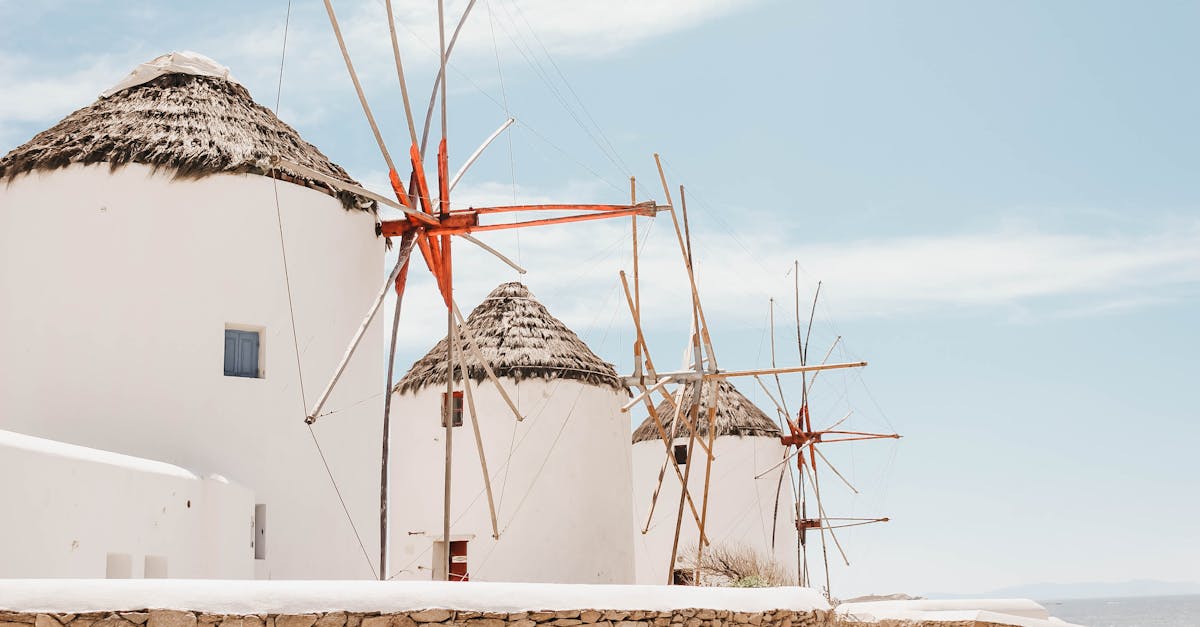
The Windmills of Kato Mili above Chora are the island's iconic image and cost nothing to visit. The seven white-washed stone windmills sitting on the hillside above Little Venice were built by the Venetians in the 16th century for grain milling and now function as the island's most photographed sight. Walk up to them in the late afternoon for the best light, when the sun is low behind them and the bay below glows. The surrounding hillside path offers continuous views over the old port and the Aegean.
Chora (Mykonos Town) is itself the main attraction — the labyrinthine network of white-cubic lanes, bougainvillea-draped archways, blue-domed chapels, and the waterfront strip of Little Venice where the buildings extend directly over the sea. Exploring it on foot for two or three hours costs nothing. The maze of streets was deliberately designed to confuse Aegean pirates, and it still successfully confuses visitors — getting lost in Chora is part of the experience rather than a navigational failure. The area around Matogianni Street is the commercial heart; the quieter northern neighbourhoods behind the main streets preserve more of the authentic residential atmosphere.
The Archaeological Museum of Mykonos (EUR 4, closed Tuesdays) houses finds from the ancient cemetery on the nearby islet of Rinia — funerary sculptures, storage vessels, and the famous 7th-century BC Mykonos Pithos, an enormous ceramic storage jar decorated with relief scenes from the Trojan War, one of the earliest narrative representations of the fall of Troy in existence. Small museum, substantial content, worth the EUR 4 for context on the island's pre-luxury history.
The Church of Panagia Paraportiani — a complex of five overlapping churches fused together over four centuries into a single asymmetric white mass — stands at the edge of the old Kastro quarter and is free to view from outside. The interior opens sporadically for services; the exterior in the morning light before the cruise ship crowds arrive is one of the island's genuine architectural wonders.
Paradise Beach (free entry) and Paraga Beach (free entry) are accessible by the public bus from Fabrika terminal (EUR 2 each way) and have sections of public sand where no sunbed hire is required. Arrive before 11am for a position on the free public section; by early afternoon the beach clubs' paid section dominates the available space. Bring your own water and snacks from the town supermarket.
Getting Around on a Budget
Mykonos has a functional public bus network operated by KTEL that connects Mykonos Town's Fabrika terminal to the main beaches and Ano Mera village. This is the foundation of budget transport on the island — use it for every journey where timing flexibility exists.

The Fabrika terminal (south side of Mykonos Town) serves all southern and eastern routes: Paradise Beach (EUR 2, 20 minutes), Platis Gialos (EUR 2, 15 minutes), Paraga (EUR 2), Kalafati beach (EUR 2.50). The Old Port terminal (north side) serves the northern and eastern routes: Agios Stefanos (EUR 1.80), Ano Mera (EUR 2, 20 minutes), Elia beach (EUR 2.50). Buses run from approximately 8am to midnight in peak season with frequency ranging from every 30 minutes on the main routes to every 90 minutes on quieter routes. Outside July-August, service thins significantly after 8pm.
Official taxis are available at the taxi rank by the old port and can be called by phone, but their pricing structure is fixed and significantly higher than the bus: EUR 10-15 for most journeys within the island, EUR 20-25 from the airport to town. For groups of three or four splitting the fare, taxis become competitive — a party of four splitting EUR 15 to Paradise Beach pays EUR 3.75 each, which undercuts the bus marginally. For solo travellers and couples, the bus is always the correct financial choice.
Renting a quad bike or ATV costs EUR 25-45 per day depending on season and provides full island mobility with parking flexibility that buses cannot match. This is the practical transport choice for a full day of beach-hopping across multiple beaches, and the cost, when split between two riders, is competitive with multiple bus journeys. Ensure the rental includes basic insurance and wear a helmet — the island's roads are narrow and the tourist traffic is genuinely dangerous in high season.
Money-Saving Tips
Time your visit for late September. The island is fully operational through to early October — beach clubs, restaurants, and nightlife venues all continue running — but prices drop 30-40% from their August peak. The sea temperature remains around 23-24°C, the days are warm and sunny, and the island's population thins to a manageable level. The difference between a September and August visit is both financial and experiential.
Eat at Ano Mera village at least once. The tavernas around the village square in Ano Mera charge local prices: grilled lamb EUR 13-15, fresh salad EUR 6, carafe of local wine EUR 10-12. The bus journey from Mykonos Town costs EUR 2 and takes 20 minutes. An entire dinner for two with wine costs EUR 40-50 — half what the same meal costs in Chora's tourist-facing restaurants.
Avoid beach club cocktails during peak hours. The beach clubs at Paradise and Super Paradise charge EUR 16-25 per cocktail from noon to 6pm. Beer costs EUR 8-12. Bringing a cooler bag from your accommodation with supermarket-purchased drinks is technically against the clubs' rules but widely practised. If you want the beach club experience, arrive at opening time (11am-12pm) when some clubs offer a buy-one-get-one on drinks and the atmosphere is more relaxed than the peak-afternoon crush.
Use the campsite bar at Paradise Beach for evening drinks. Paradise Beach Camping operates its own bar at prices significantly below the main beach club venues — a beer costs EUR 4-5, a basic cocktail EUR 8-10. The bar attracts the campsite's backpacker crowd and is genuinely social; the nearby SantAnna beach club charges three times as much for the same drinks in a more exclusive setting.
Buy your ferry tickets at least two weeks ahead. The fast ferries from Athens (Piraeus) to Mykonos peak at EUR 90-100 per person when booked at the last minute in July-August. The same ticket costs EUR 55-70 with two weeks' advance purchase and EUR 45-60 with a month's notice. The savings on a return trip are EUR 60-80 per person — more than a night's accommodation at the campsite.
Stay outside Chora for a lower nightly rate. Accommodation within 10 minutes' walk of Little Venice commands a significant premium. Properties in Ornos (family-oriented, calmer beach), Agios Stefanos (northern coast, bus-accessible), or the outer residential parts of Mykonos Town itself cost 25-40% less than equivalent rooms in the Chora centre. The bus connects all areas to Chora in under 20 minutes.
Swap one restaurant dinner for a supermarket picnic. A fully assembled Greek mezze from the supermarket — feta, olives, tomatoes, pitta, tzatziki, a bottle of Cycladic wine — costs EUR 15-20 for two and can be consumed on any of the island's viewpoints, beach access paths, or your accommodation terrace with a view that beats most restaurant settings on the island.


