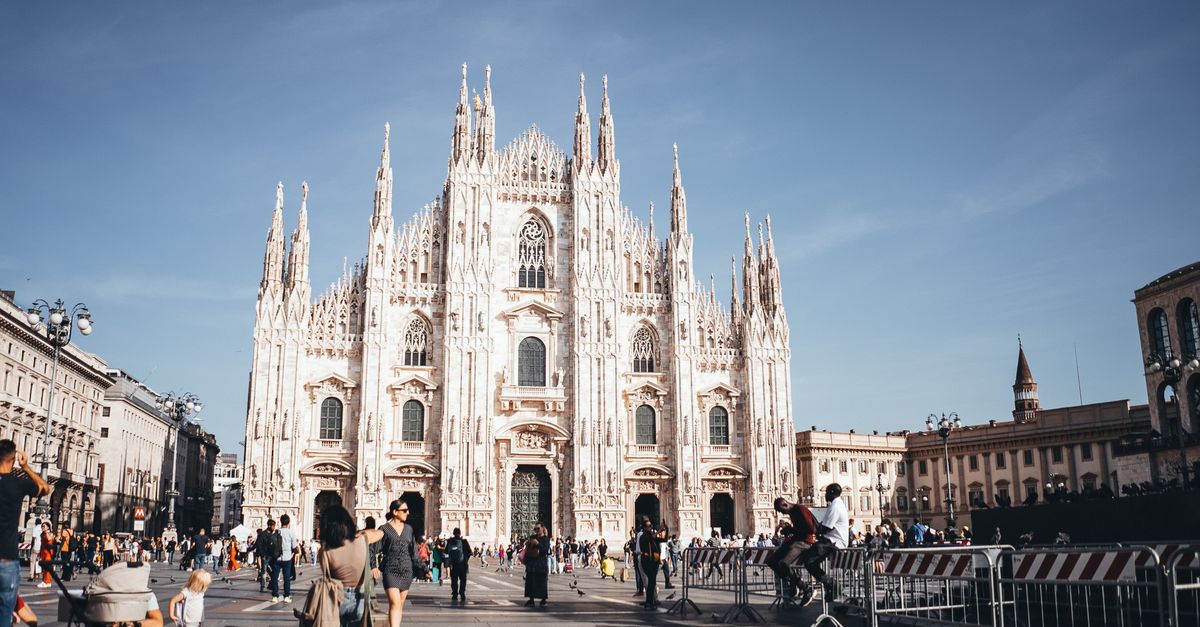
Milan has a reputation as Italy's most expensive city, and in the wrong hands it can be. But the Milanese themselves live well on reasonable budgets — the city rewards those who eat standing at a bar, buy a day transit pass, and know that an aperitivo drink at EUR 10 comes with an entire spread of free food. With a smart strategy, you can sleep centrally, eat properly, and tick off the city's greatest cultural treasures — including the Last Supper — for under EUR 90 a day. This guide breaks down every category with current prices so your money goes as far as possible in Italy's design and finance capital.
Getting There on a Budget
Milan is served by three airports, and the one you fly into matters enormously for your wallet. Malpensa Airport (MXP), the main international hub 45 km northwest of the city, handles most long-haul and budget airline routes. The Malpensa Express train is the gold standard transfer: EUR 13 for a direct 40-minute journey to Milano Cadorna station, which sits right on the metro network. Trains run every 30 minutes from early morning to late night. If you're travelling with a group, the price per head barely changes — but if you're solo or a couple, the Terravision coach is a real alternative at EUR 8 per person, connecting Malpensa to Milano Centrale in around 75 minutes. Book online in advance for the best Terravision prices; same-day cash tickets cost slightly more.

Linate Airport (LIN), just 7 km east of the city centre, primarily handles European flights and is far cheaper to get home from. Bus 73 runs directly to Piazza San Babila, a central metro hub, for just EUR 1.80 — the same standard ATM ticket used on the metro. The journey takes 25-30 minutes outside rush hour. Tram 35 and 45 offer a slightly slower but equally cheap alternative. A taxi from Linate costs EUR 20-30, which is fine for groups but wasteful for solo travellers when public transport is this easy.
Orio al Serio Airport (BGY), also called Bergamo Airport, is used almost exclusively by Ryanair and handles budget European flights. It is 45 km east of Milan. Orio Shuttle buses connect the airport to Milano Centrale for EUR 5-7 each way (book online). The journey takes about 60 minutes. Factor this travel time into your itinerary — a cheap Ryanair flight from Bergamo can still make sense if you're spending several days in Milan, but a same-day connection is tight.
For inter-city travel, Trenitalia and Italo high-speed trains link Milan to Rome (EUR 20-50 booked ahead), Florence (EUR 15-35), and Venice (EUR 10-30). Book at least two weeks in advance for the lowest fares — last-minute high-speed trains are expensive.
Budget Accommodation
Milan's accommodation market is tighter and pricier than most Italian cities, but a handful of excellent hostels and budget hotels provide reliable central options in the EUR 25-60 per person range.

Ostello Bello Milan on Via Medici, a 10-minute walk from the Duomo, is consistently ranked among Italy's best hostels. Dorm beds start at EUR 28-38 per night; private rooms run EUR 80-120. The in-house bar and lounge are lively without being chaotic, the breakfast is included in some rate categories, and the Navigli canal neighbourhood is right on your doorstep. Book at least three weeks ahead for peak summer months.
Combo Milano in Porta Venezia occupies a converted 19th-century building with a café, co-working space, and rooftop bar. Dorm beds start around EUR 30-40; private rooms from EUR 90. The neighbourhood is one of Milan's most interesting — multicultural, independent restaurant-heavy, and well-connected by tram. It's a genuine hotel-hostel hybrid rather than a party hostel.
Zero9 Hostel near Porta Garibaldi station offers some of the cheapest dorms in central Milan at EUR 22-32 per night. The location is excellent — Porta Garibaldi is on three metro lines and connects directly to Linate Airport. Rooms are functional rather than design-forward, but the price-to-location ratio is unbeatable.
For budget hotels (private room without hostel communal areas), the area around Milano Centrale station offers the widest range: two-star hotels with clean, en-suite rooms run EUR 60-90 per night. The neighbourhood is less atmospheric than Navigli or Brera but maximally convenient. Check Booking.com and Hostelworld for real-time availability, and watch for last-minute drops, especially Sunday to Thursday nights.
Eating Cheaply Like a Local
Eating well on a budget in Milan requires understanding one key cultural ritual: aperitivo. Between roughly 6 PM and 9 PM, most bars across the city — particularly in Navigli, Isola, and Porta Romana — offer a flat-rate deal: pay EUR 8-12 for a Campari Spritz, Aperol Spritz, or glass of wine, and help yourself to a free buffet. The spread varies by bar, but good aperitivo spots offer pasta, bruschetta, risotto balls, cured meats, and cheese. At the right bar, this is effectively dinner for the price of a drink.

Spritz Bar and Bar Basso (the original home of the Negroni Sbagliato, on Via Plinio) both run generous aperitivo spreads. In Navigli, virtually every bar along the canal does aperitivo — walk the strip and pick the one whose buffet looks most substantial.
For lunch, Milanese workers eat at paninoteche (sandwich bars) and tavola calda (hot-food self-service counters). Panino Giusto is a local chain with excellent sandwiches from EUR 5-8. Spontini serves its famous Milanese-style pizza slices — thick, focaccia-like, sold by the piece from EUR 3.50 — at multiple locations across the city; the original is on Corso Buenos Aires. A slice and a coffee makes a legitimate lunch for EUR 6.
For a proper sit-down budget lunch, seek out the fixed-price menu del giorno (daily lunch menu): first course + second course + water + coffee for EUR 10-14. This exists primarily in worker-oriented trattorie away from the tourist centre. Trattoria Milanese on Via Santa Marta (near the Duomo, remarkably) does a weekday lunch menu; Osteria del Binari near the Navigli offers reliable local cooking without inflated tourist prices.
Coffee culture is central to daily life: an espresso at the bar costs EUR 1.10-1.50. Sit down and the price jumps 50-100%. Always drink coffee standing at the bar — it's faster, cheaper, and more authentically Milanese. Likewise, tap water (acqua del rubinetto) is free at bars and safe to drink; always ask rather than automatically accepting bottled water.
Supermarkets for self-catering: Esselunga is the quality Italian chain with excellent ready-to-eat counters; Lidl and Carrefour Express are the cheapest for basics. A supermarket lunch — fresh pasta from the deli, bread, fruit — costs EUR 4-6.
Free & Low-Cost Attractions
Milan's greatest cultural assets are either free or reasonably priced — with one notable, unavoidable exception that requires planning months in advance.

Duomo di Milano — the city's Gothic cathedral is one of Europe's most extraordinary buildings. Entry to the main nave is free. Rooftop terrace access costs EUR 5 (stairs) or EUR 14 (lift), and the views over the city are genuinely spectacular on a clear day. Tickets to specific internal areas such as the archaeological excavations beneath the cathedral cost EUR 3-5. A combined ticket covering all internal areas plus the rooftop runs EUR 20. For a budget visit, the free nave plus EUR 5 stair access to the rooftop hits the key experience.
Castello Sforzesco — the massive 15th-century Sforza castle complex on the edge of Parco Sempione is free to enter. The castle's courtyards and Parco Sempione behind it make for a full half-day of exploration at zero cost. The castle museums (Pinacoteca del Castello, Egyptian Museum, furniture collections) charge EUR 5 each, or EUR 12 for a combined ticket. The free areas alone — the Filarete Tower, the Rocchetta courtyard — justify the visit.
Pinacoteca di Brera — Milan's premier art gallery on Via Brera houses Mantegna's Dead Christ, Raphael's Betrothal of the Virgin, and Caravaggio's Supper at Emmaus. Entry costs EUR 15. Critically, entry is free on the first Sunday of every month — if your trip aligns, this saves EUR 15 per person. Check brera.beniculturali.it for current opening hours before visiting.
Galleria Vittorio Emanuele II — the 1860s glass-and-iron shopping arcade beside the Duomo is free to walk through and is one of the most beautiful interiors in Italy. The luxury shops inside (Prada, Louis Vuitton, Gucci) are obviously not budget-friendly, but the architecture is free.
Santa Maria delle Grazie — the church housing Leonardo da Vinci's Last Supper is free to visit as a church. The refectory containing the Last Supper itself requires a separate, timed ticket costing EUR 15 plus EUR 3.50 booking fee. More importantly, tickets must be booked two to three months in advance — they sell out completely. Book at vivaticket.com the moment your travel dates are confirmed.
Getting Around on a Budget
Milan's public transport network — run by ATM (Azienda Trasporti Milanesi) — is extensive, efficient, and genuinely good value. It covers four metro lines (M1-M4), trams, and buses across the entire city and inner suburbs.

A single-ride ticket costs EUR 2.20 and is valid for 90 minutes on trams and buses (but only one metro journey). If you're making more than three journeys in a day, the 24-hour day pass at EUR 7.60 is better value. A 48-hour pass costs EUR 13.80; a 72-hour pass EUR 19.50. These cover unlimited metro, tram, and bus travel — the 72-hour pass essentially pays for itself on day one if you're moving around actively.
Buy tickets at ATM points (automated machines in every metro station), authorised tobacconists (tabaccherie, identified by the large T sign), and through the ATM Milano app. Never board without a valid ticket — inspectors are present and fines start at EUR 40.
The metro covers all major tourist areas: M1 (red line) runs to Cadorna (Malpensa Express), Duomo, and Porta Venezia. M2 (green) connects Navigli (Porta Genova stop), Centrale FS, and Cadorna. M3 (yellow) covers Centrale FS, Duomo, and Porta Romana. M4 (blue, newest line) links Linate Airport directly to the centre.
Trams are slower but more scenic and cover streets the metro misses. Tram 2 along the Navigli canals and Tram 15 through the Navigli are particularly useful. Walking between the Duomo, Brera, and Castello Sforzesco is entirely reasonable — the historic centre is compact enough for pedestrian exploration.
Cycling: Milan has a BikeMi bike-share network with around 300 docking stations. A 24-hour pass costs EUR 4.50, giving unlimited 30-minute journeys. For longer rides, each additional 30 minutes costs EUR 0.50. Perfect for flat city cycling between sights.
Money-Saving Tips
1. Build your days around aperitivo. A EUR 9-11 drink buys you a substantial free food spread at good bars in Navigli and Isola. This effectively replaces dinner and compresses a two-meal food budget into one transaction. Pick your bar based on buffet quality, not drink price.
2. Visit Brera on the first Sunday of the month. EUR 15 free per person. If your trip spans a first Sunday, this is a no-brainer. The gallery opens at 9 AM — arrive early before the free-admission crowds build.
3. Always drink coffee standing at the bar. EUR 1.20 at the counter vs EUR 3-4 seated. Over four days of coffee drinking, you save EUR 10-15. It's also faster and more authentically Milanese than lingering at a table.
4. Buy an ATM day pass, not individual tickets. If you're making more than three metro or tram journeys in a day — which is easy on a sightseeing day — the EUR 7.60 daily pass beats four single tickets immediately.
5. Book the Last Supper months ahead at the official price. EUR 18.50 official vs EUR 50-80 resale. Plan your visit date early and book the moment you confirm your trip. This single action saves EUR 30-60 per person.
6. Eat lunch, not dinner, at restaurants. The midday menu del giorno offers the same quality kitchen at EUR 10-14 that charges EUR 25-40 in the evening. The best trattorie in the city do weekday lunch menus specifically for the local worker crowd — tourists who show up at noon get the same deal.
7. Shop at Esselunga for picnic supplies. Parco Sempione behind Castello Sforzesco is a beautiful, large park perfect for picnics. Supermarket lunch + park bench is one of Milan's genuinely best budget meals. The ready-made pasta and roast chicken at Esselunga are excellent quality.