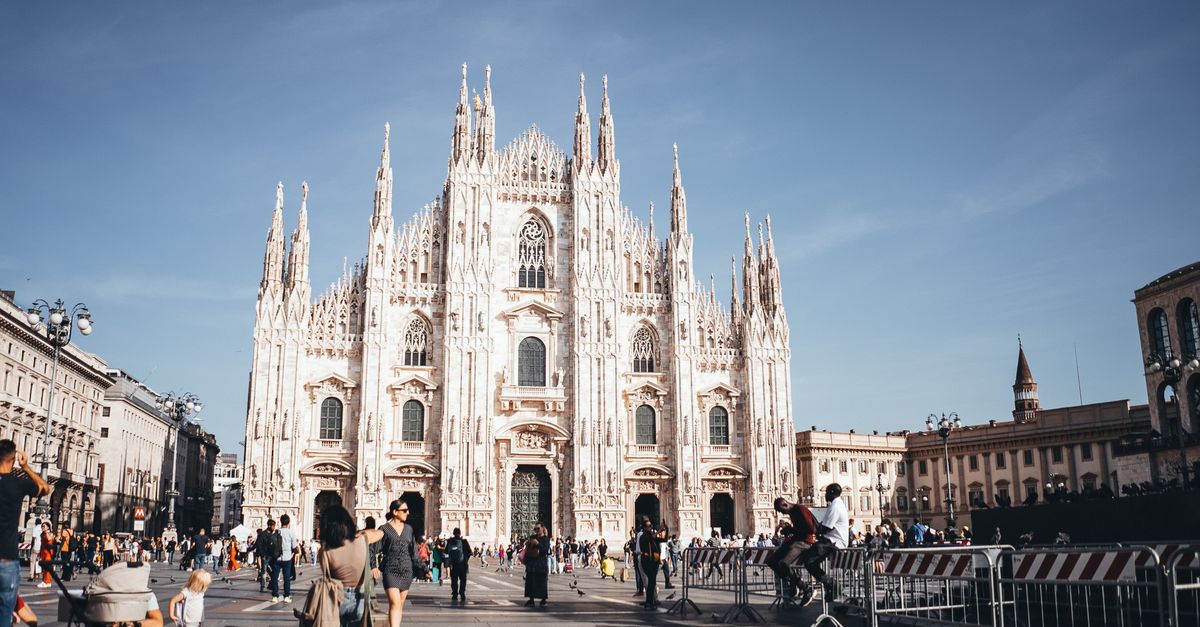
Most first-time Italy visitors put Milan somewhere after Rome, Florence, and Venice on their mental checklist — and most of them are wrong. Milan is one of Europe's most rewarding cities for the traveller who looks past the fashion boutiques and takes the time to find the aperitivo bars, the canal-side neighbourhoods, the Sforza castle at dusk, and the experience of standing 15 feet from Leonardo da Vinci's Last Supper in a 15th-century refectory. This guide covers everything you need before your first visit: visas, money, getting from the airport, navigating the city, choosing a neighbourhood, understanding the culture, and avoiding the mistakes that trip up first-timers every week.
Before You Arrive
Visas and entry: Italy is a member of the Schengen Area, which means citizens of most Western countries (USA, UK, Australia, Canada, Japan, and most EU nationals) can enter for up to 90 days within any 180-day period without a visa. From 2025, travellers from visa-exempt non-EU countries must obtain an ETIAS (European Travel Information and Authorisation System) authorisation before entering the Schengen Area — register at etias.com. The process takes minutes and costs EUR 7 for approved applicants. Check your nationality's specific requirements well in advance; citizens of countries outside the visa-exempt list must apply for a Schengen visa at the Italian consulate in their home country, which can take weeks to process.

Currency: Italy uses the Euro (EUR). Major credit cards (Visa, Mastercard) are accepted widely in hotels, restaurants, and shops, but Italy remains more cash-dependent than northern Europe. Small cafes, market stalls, and some trattorie are cash-only. Carry EUR 50-80 in cash at all times. ATMs (bancomat) are plentiful — withdraw from bank-branded machines and avoid airport exchange counters, which charge poor rates. Inform your bank of your travel dates to avoid fraud blocks on your card.
Italian SIM cards: For data, the three main providers are TIM, Vodafone, and WindTre. Tourist SIM cards are available at airport kiosks, official brand stores, and authorised resellers (look for the provider's logo). TIM and Vodafone offer better 4G/5G coverage across Italy; WindTre is typically slightly cheaper. Expect to pay EUR 15-25 for a SIM with 15-30 GB of data and some calling credit, valid for 30 days. You'll need to present your passport — Italian law requires ID verification for SIM purchases. Alternatively, EU residents' existing plans usually cover Italy with no roaming charges.
Power: Italy uses Type F (Schuko) and Type L plugs at 230V/50Hz. Most modern travel adapters cover both; bring one if your home country uses different plugs. USB-C chargers and standard British/American plugs need an adapter. Hotels occasionally have universal sockets — check before buying an adapter.
Getting from the Airport
Milan has three airports, and each has a distinct best-value transfer option into the city.

Malpensa Airport (MXP) — Milan's main international hub, 45 km northwest of the city. The Malpensa Express train is the definitive transfer: EUR 13, runs every 30 minutes, arrives at Milano Cadorna (M1/M2 metro) in 40 minutes. A second service runs to Milano Centrale (the main train hub) via Bovisa — slightly longer at 52 minutes, also EUR 13. Buy tickets at Trenord machines in the arrivals hall or online. The Terravision bus to Centrale costs EUR 8 but takes 60-75 minutes and is subject to motorway traffic. Taxis are metered with a flat rate to the city centre: EUR 100 to Cadorna area, EUR 110 to Centrale. Only licensed white cabs from the official rank — avoid unmarked private drivers in the arrivals hall.
Linate Airport (LIN) — 7 km east of the city centre, now directly connected by the M4 metro line (opened 2023). Take M4 from Linate station (inside the terminal) to San Babila or Duomo for EUR 2.20 — a single standard ATM ticket. The journey takes about 30 minutes. This is now by far the simplest and cheapest option from Linate, rendering the old Bus 73 (EUR 1.80, 30 min) largely redundant for tourists heading to the centre. Taxis from Linate to the centre cost EUR 20-30.
Orio al Serio Airport (BGY) — used by Ryanair as "Milan Bergamo," this airport is 45 km east. Orio Shuttle buses run to Milano Centrale every 30 minutes for EUR 5-7 (book online). The journey takes 60-75 minutes depending on traffic. Do not take a taxi from Bergamo to Milan — the fare exceeds EUR 90. If you arrive late at night, the last Orio Shuttle timing is critical to check before flying.
Getting Around the City
Milan's public transport network is operated by ATM (Azienda Trasporti Milanesi) and is one of Europe's most functional urban systems. It covers four metro lines, a dense tram network, and city buses.

The metro is the fastest way around the city. Four colour-coded lines cover all major areas: M1 (red) runs east-west through the centre, connecting Cadorna, Duomo, and Porta Venezia. M2 (green) connects Cadorna, Garibaldi, Centrale, and Porta Genova (for Navigli). M3 (yellow) links Centrale, Duomo, and Porta Romana. M4 (blue) is the newest line, running from Linate Airport through the city centre to San Cristoforo. A single ticket costs EUR 2.20, valid for 90 minutes on trams and buses or one metro journey. A 24-hour unlimited pass costs EUR 7.60; 48-hour EUR 13.80; 72-hour EUR 19.50. Buy tickets from ATM machines in every station, at tabaccherie (tobacconists, marked with a T sign), or via the ATM Milano app.
Trams are slower than the metro but cover streets and neighbourhoods the underground doesn't reach. Historic trams from the 1920s still run on several lines — riding the orange trams is itself an experience. Tram 2 and Tram 14 are useful for reaching Navigli. All ATM tickets and passes are valid on trams.
Walking: The historic centre is compact. The Duomo to Castello Sforzesco is a 15-minute walk through the Galleria and Via Dante. Brera is a 10-minute walk north of the Duomo. The city is flat, making it comfortable to explore on foot during mild weather.
BikeMi is Milan's bike-share scheme with 300+ docking stations. A 24-hour subscription costs EUR 4.50, with the first 30 minutes of each journey free. For a flat city with dedicated bike lanes in many areas, this is an excellent way to cover ground between sights.
Where to Base Yourself
Milan's neighbourhoods have distinct personalities, and the right base depends on what kind of trip you're planning.

Navigli is the most characterful option for first-timers on a budget. Built around two historic canals — the Naviglio Grande and Naviglio Pavese — this neighbourhood comes alive in the evening with aperitivo culture, independent restaurants, vintage boutiques, and a younger, creative crowd. It's not the most central area geographically, but M2 Porta Genova connects it to the rest of the city in minutes. Hostels and budget hotels run EUR 80-130 for a private room; mid-range boutique hotels EUR 130-200. The canal-side setting is unlike anything else in Milan.
Brera is Milan's art and design district, walking distance north of the Duomo. The streets are beautiful — narrow, cobbled, lined with galleries, design shops, and excellent restaurants. It's more expensive than Navigli (budget hotels EUR 110-160, mid-range EUR 180-280), but the walkability to the Pinacoteca di Brera, the Duomo, and the Castello is unbeatable for first-timers who want to be in the thick of it. The neighbourhood is calm in the mornings before the design crowd arrives.
Isola and Porta Nuova is Milan's contemporary neighbourhood, centred on the Bosco Verticale (the vertical forest apartment towers) and the Unicredit skyscraper. It's younger, less touristy, and increasingly interesting gastronomically — some of Milan's best new restaurants have opened here in the last five years. Metro M2 and M5 provide fast connections to the rest of the city. Budget accommodation EUR 70-120; mid-range EUR 130-200. This is the best base for travellers who want to experience the city the locals inhabit rather than the city on postcards.
Local Culture & Etiquette
The coperto is a cover charge of EUR 1.50-4 per person added to restaurant bills — it is entirely standard, legal, and not a scam. It covers bread, table linen, and service. Budget for it on every sit-down meal. If a menu displays the coperto amount, the restaurant is being transparent about it. Some casual trattorie and pizzerie have eliminated it in recent years, but assume it applies unless stated otherwise.

Aperitivo culture is Milan's defining social institution and one of the best deals in Italian dining. From around 6 PM to 9 PM, most bars in Navigli, Isola, Porta Venezia, and Porta Romana offer a drink (Aperol or Campari Spritz, Negroni, wine) for EUR 8-12, with unlimited access to a free food buffet. The quality and range of the buffet varies enormously — good bars offer pasta, arancini, bruschetta, cured meats, and cheeses. Pick your bar based on the spread, not just the drink price. This isn't tapas; it's a full meal at the price of a cocktail. Milanese workers use it as dinner several nights a week, and you should too.
Coffee etiquette is taken seriously. Stand at the bar counter to order; sitting down triggers the table-service price (often double). An espresso is consumed in 30-60 seconds, not nursed for an hour. Never order a cappuccino after 11 AM — it's considered a breakfast drink, and ordering one after lunch will earn you a very Milanese look of gentle disapproval. A caffè is always an espresso unless specified otherwise.
Meal times follow Italian patterns: lunch is 12:30-2:30 PM, dinner is 7:30-10:30 PM. Showing up at a restaurant at 6 PM for dinner will result in being told politely to come back in 90 minutes. Kitchens close between service periods. Most good trattorie are fully booked by 9 PM on weekends — book ahead for dinner or eat before 8 PM to walk in without a reservation.
Religious sites: The Duomo requires covered shoulders and knees for entry — scarves are available at the entrance for EUR 2 if you forget. Santa Maria delle Grazie (which houses the Last Supper) is an active church — be respectful and quiet.
Common Mistakes to Avoid
1. Not booking the Last Supper in advance. This is the single most common and costly mistake in Milan. Leonardo da Vinci's The Last Supper (Cenacolo Vinciano) at Santa Maria delle Grazie is the city's most important cultural sight — and tickets sell out two to three months in advance. The official price is EUR 15 plus EUR 3.50 booking fee at vivaticket.com. Third-party resellers charge EUR 50-80 for the same slot. Book before you book your flight. There is no walk-in option.
2. Spending all your time in the Duomo district. The streets immediately surrounding the Duomo are tourist infrastructure — overpriced cafes, tourist trap restaurants, souvenir shops. Milan's actual character lives in Navigli, Brera, Isola, Porta Venezia, and Prati. The Duomo is magnificent and worth 2-3 hours, but then take the metro and go somewhere real.
3. Ordering tourist-priced coffee at tourist cafes. Caffè Vergnano and similar chains in tourist areas charge EUR 4-5 for an espresso. Walk one block off the tourist strip and pay EUR 1.20. Milanese cafes are everywhere — there is never a good reason to pay tourist prices for a coffee.
4. Skipping the rooftop of the Duomo. The reverse mistake — so focused on budget that first-timers miss the EUR 5 stair access to the Duomo's rooftop terraces, which put you at eye level with Gothic spires and provide extraordinary views over the city and, on clear days, the Alps. This is one of the best EUR 5 sights in Europe.
5. Missing aperitivo because you ate dinner at 7 PM. Aperitivo runs 6-9 PM and is effectively a free dinner bundled with a drink. Tourists who eat dinner at 7 PM miss it entirely. Adjust: have a light lunch, do aperitivo at 6:30 PM, and if still hungry, eat a proper dinner after 8:30 PM. Or just do aperitivo properly and call it an evening.
6. Assuming Milan is just a fashion city. First-timers with no interest in fashion sometimes skip Milan assuming there's nothing for them. This misses the world-class art at the Pinacoteca di Brera and Pinacoteca Ambrosiana, the architectural masterpiece of the Galleria, the extraordinary Castello Sforzesco, the canal districts, and some of Italy's best food and nightlife culture. Milan has more to offer than its reputation suggests.
7. Not validating transport tickets. ATM ticket inspectors are present on metro platforms and trams. The fine for an unvalidated ticket is EUR 40 minimum — more than ten single journeys. Even if you bought a valid ticket, failing to stamp it counts as fare evasion. Validate every time, without exception.