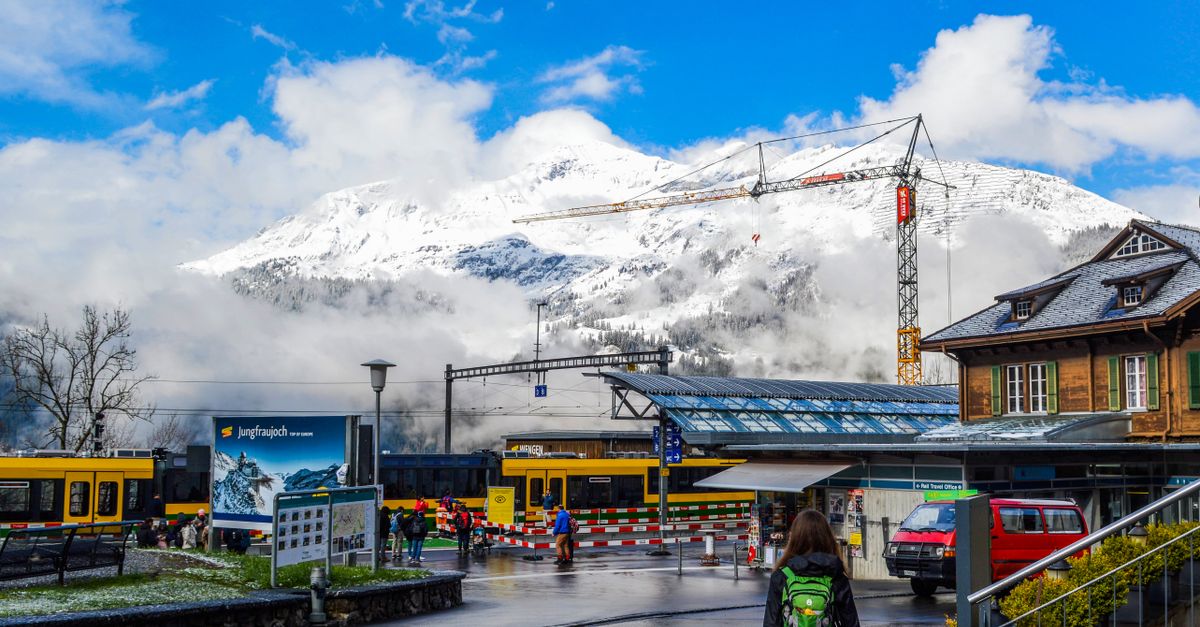
Interlaken sits between two lakes — Thunersee and Brienzersee — at the gateway to the Bernese Oberland, the most dramatic mountain region in Switzerland. It is the self-proclaimed adventure sports capital of Switzerland, offering paragliding, skydiving, white-water rafting, canyoning, and the now-famous "James Bond" paragliding over the Jungfrau region. It is also, paradoxically, a town with significant Swiss cultural heritage that the extreme sports marketing has almost entirely displaced from visitor consciousness.
The name itself tells the story: inter lacus — between the lakes. The town occupies the alluvial plain deposited by the Aare river between its two lake sections, and the geography of being surrounded by water on two sides and by mountains on the third gives it a spatial situation of extraordinary beauty that requires no bungee jumping to appreciate. The pedestrian zone, the casino gardens, and the view of the Jungfrau from the Höhematte park are among the most beautiful urban landscapes in Switzerland.
Interlaken is less expensive than Zurich or Lucerne but still Swiss in its pricing: coffee CHF 3.50–5, restaurant meals CHF 25–45, adventure activities CHF 80–200. The Swiss Travel Pass covers trains and boats; the adventure activities require separate payment. Budget CHF 100–160 per day depending on activity intensity. This guide focuses on the mountain access and cultural experiences that complement or replace the packaged adventure sports.
1. Harder Kulm — The Local Summit
The Harder Kulm, at 1,322 metres directly above Interlaken's eastern edge, is reached by a funicular from the town centre (7 minutes, CHF 34 return) and provides the famous panoramic view of both lakes, the town, and the Jungfrau massif that appears on every Interlaken promotional image. What the tourism materials fail to emphasize is that this view is genuinely one of the finest in Switzerland, and that the summit can also be reached by a hiking trail from the town that takes 2.5 hours and costs nothing.
The walking path (marked from near the funicular base station) climbs through beech forest on the Harder mountain's eastern flank, passing several viewpoints that open progressively to reveal the lake landscape below. The path is well-maintained and clearly marked throughout; it is moderate in difficulty and requires standard walking footwear rather than hiking boots. Arriving at the summit on foot rather than by funicular is a qualitatively different experience.
The funicular base station is a 20-minute walk north from Interlaken Ost station. Operating hours: April to October, approximately 8am to 9:30pm. The summit restaurant (CHF 30–45 for a full meal) serves Swiss alpine classics with the most spectacular lake and mountain view in the region. The Two Lakes Bridge — a pedestrian viewing platform suspended between the two summits of the Harder complex — is accessible to funicular passengers and provides the full 360-degree view. Allow 3 hours for a summit-to-town walking descent via the Harder trail.
The Harder mountain wildlife is an attraction that tourism materials almost never mention: the resident Alpine ibex population on the Harder flanks is often visible to early-morning funicular or hiking visitors, the marmots on the summit meadows are active throughout the summer, and the forest on the ascent trail has reliable golden eagle sightings in spring and autumn. Bring binoculars for the wildlife and the mountain panorama — they serve both equally well.
2. Lake Brienz — The Turquoise Lake
Lake Brienz (Brienzersee), east of Interlaken, is the more dramatic of the two lakes — its water has an extraordinary turquoise colour from glacial meltwater, and the surrounding mountains are steeper and more dramatic than those of Lake Thun. The lake is less developed for tourism than Thunersee and has preserved more of its 19th-century character in the villages along its shores. The boat from Interlaken to Brienz village (1.5 hours) is one of the most beautiful lake journeys in the Alps.
Brienz village at the eastern end of the lake is the centre of Switzerland's wood-carving tradition — the workshops and studios lining the main street of Brienz have been producing hand-carved wooden figures, bowls, and decorative objects for over 300 years. The Swiss Woodcarving School (Schnitzlerschule) has been training carvers here since 1884 and the village's main street is lined with workshops where you can watch skilled carvers working and purchase directly from the maker.
Boat from Interlaken Ost to Brienz runs multiple times daily (CHF 22 one way, covered by Swiss Travel Pass). Journey 1.5 hours. In Brienz, walk the main street (the wood-carving workshops display directly to the street) and continue to the base station of the Brienzer Rothorn rack railway — the last operational steam-powered rack railway in Switzerland, running to the summit at 2,350 metres with extraordinary views. The round trip costs CHF 60–80; the steam experience alone is worth it.
The Ballenberg Open-Air Museum, 3km east of Brienz, is the finest open-air architecture museum in Switzerland — over 100 original historic buildings from all regions of Switzerland, relocated and reconstructed on a 66-hectare site in the hills above Lake Brienz. Traditional crafts are demonstrated daily (cheese-making, bread-baking, lace-making, blacksmithing) and the buildings are furnished with period interiors. Admission CHF 20. Open mid-April to October, 10am to 5pm. Allow 4 hours minimum. Postbus from Brienz (10 minutes, CHF 5).
3. Jungfraujoch — Strategy for the Top of Europe
The Jungfraujoch station at 3,454 metres — the "Top of Europe" — is the most visited tourist site in the Swiss Alps and possibly the most expensive train journey per kilometre in the world (approximately CHF 220 round trip from Interlaken). Despite the price and the crowds, it is genuinely extraordinary: a permanent research station and tourist complex carved into the saddle between the Jungfrau and Mönch peaks, with access to the Aletsch Glacier, and views that extend from the Vosges mountains to the Apennines on an exceptional clear day.
The strategy for Jungfraujoch: take the first train of the day (the "Good Morning Ticket" is typically cheaper at CHF 145 and available for trains before 8am from Interlaken Ost), which reaches the summit before the main tourist influx from Zurich and Lucerne tour groups. The summit at 7:30am, with the snow blue in the early light and the glacier empty of visitors, is entirely different from the noon experience when queues form at every photo spot.
From Interlaken Ost, the journey via Grindelwald or Lauterbrunnen to Kleine Scheidegg, then the Jungfraubahn to the summit, takes 2.5 hours and is itself a major scenic experience — particularly the section from Kleine Scheidegg to the summit through the Eiger's north face tunnel, with brief stops at windows cut into the cliff at 3,000 metres. Plan 4–5 hours at the summit for the Sphinx Observatory, Aletsch Glacier walk, and ice tunnel.
The Aletsch Glacier, visible from the Jungfraujoch in its full 23km extent, is the longest glacier in the Alps and a UNESCO World Heritage Site. The walk onto the glacier from the summit complex (crampons provided, CHF 5) is the best physical engagement available without mountaineering equipment. The glacier is retreating significantly — photographs taken 20 years ago show dramatically more ice — which makes the experience simultaneously magnificent and elegiac.
4. Grindelwald — The Alpine Village
Grindelwald, 20km southeast of Interlaken in the valley below the Eiger's famous North Face, is one of Switzerland's finest alpine villages — a traditional Swiss farming community that evolved into a ski resort and summer hiking base while retaining a character of genuine mountain village life that Zermatt and Verbier have largely replaced with luxury hotel infrastructure. The Eiger North Face looming directly above the village is one of the most dramatic mountain perspectives in the Alps.
The First mountain area above Grindelwald (cable car, CHF 68 round trip) offers the best summer hiking in the Bernese Oberland for non-mountaineers — the Bachalpsee lake trail (2 hours return from the First summit station) passes two mirror lakes reflecting the Wetterhorn and Schreckhorn peaks, and the Cliff Walk (a steel walkway bolted to the cliff face at 2,200 metres) provides safe but vertigo-inducing views down to Grindelwald and across to the Eiger. Both are accessible in normal walking shoes.
Train from Interlaken Ost to Grindelwald takes 35 minutes (CHF 14, covered by Swiss Travel Pass for one zone). The village has excellent traditional restaurants serving Swiss alpine food at prices lower than Interlaken — budget CHF 20–35 for a full meal. The Firestarter Bar adjacent to the cable car base station is the social centre of the summer hiking community — excellent craft beer selection and an atmosphere that mixes serious mountaineers with day-hikers in a democratic way.
The mountain farmsteads (Sennhütte) around Grindelwald practise traditional alpine dairying — moving cattle to high pastures in summer and returning them to the valley before autumn. The Alpkäse (alpine cheese) produced on these summer farms is sold directly at the farmhouses and at the village market on Tuesday mornings. The Grindelwald cheese (a pressed cow's milk cheese with characteristic alpine herb flavours from the high summer pasture grass) costs CHF 22–30 per kilogram and is significantly better than any supermarket equivalent.
5. Lauterbrunnen Valley — Waterfall Country
The Lauterbrunnen valley, 13km southeast of Interlaken, is one of the most dramatic glacial valleys in the Alps — a sheer-sided trench 300 metres deep, 3km wide, and 18km long, with 72 named waterfalls descending its walls. The village of Lauterbrunnen in the valley floor is the gateway to the car-free villages of Wengen and Mürren on the valley sides, and the famous Trümmelbachfälle — the ten glacial waterfalls inside the mountain, the largest subterranean waterfall complex in Europe.
The Trümmelbachfälle (CHF 12, open daily 9am to 5pm) are accessed by a tunnel lift inside the mountain — 10 glacial waterfalls at different levels, draining the Jungfrau, Mönch, and Eiger glaciers at a rate of 20,000 litres per second in summer. The roar of water, the spray, and the view up the shaft through which the Eiger's meltwater descends are genuinely extraordinary and entirely different from the conventional alpine experience. Visited by significantly fewer people than the Jungfraujoch despite being far cheaper and equally remarkable.
Train from Interlaken Ost to Lauterbrunnen takes 20 minutes (CHF 8, covered by Swiss Travel Pass). Walk 2km south from the village to the Trümmelbachfälle entrance. The valley walk from Lauterbrunnen south to Stechelberg (5km flat walk along the valley floor) passes 14 named waterfalls visible from the path, including the famous Staubbachfall (297 metres, one of the highest free-hanging waterfalls in Europe) and the Mürrenbach waterfall. Completely free, extraordinary views, and far more interesting than the tourist infrastructure in the village.
The car-free village of Mürren (accessible by cable car from Stechelberg or funicular from Grütschalp — both reached by boat or train from Lauterbrunnen) is the quieter alternative to the more famous Wengen — a small alpine village on a shelf above the valley with extraordinary views of the Jungfrau directly opposite. The Allmendhubel viewpoint above Mürren (funicular from Mürren, CHF 15) gives the famous "big three" view of Eiger, Mönch, and Jungfrau simultaneously. Mürren has several excellent mountain restaurants and a total absence of car traffic — the ideal base for several days of Bernese Oberland walking.
6. Lake Thun — The Baroque Shore
Lake Thun (Thunersee), west of Interlaken, has a character entirely different from the glacial drama of Brienzersee — its shores are relatively gentle, the water warmer, and the surrounding villages contain some of the finest baroque castle architecture in Switzerland. The boat from Interlaken to Thun (2 hours) passes Spiez castle (a 12th-century castle on a lake peninsula with a notable Romanesque church), Oberhofen castle (a multi-period castle with extraordinary baroque interiors, now a museum), and the fortified town of Thun itself.
Spiez castle (CHF 12, open May to October, Tuesday to Sunday 10am to 5pm) is the most dramatically situated castle in the region — on a rocky peninsula jutting into the lake, with a vineyard on the south slope and a Romanesque church attached to the main structure. The interior is furnished with medieval and Renaissance pieces from the castle's various owners; the view from the tower over the lake is one of the finest in the region. The village of Spiez below the castle has an excellent local wine produced from the castle vineyard (Schlosswein Spiez) available at the castle shop.
Boat from Interlaken West to Spiez takes 30 minutes (CHF 12 one way, covered by Swiss Travel Pass). From Spiez, continue by boat or train to Thun — the journey passes Oberhofen castle (accessible by boat landing, CHF 12 museum entry) and Hilterfingen with its excellent local fish restaurants on the lakeside. The town of Thun itself has a remarkably preserved medieval upper town (Obere Hauptgasse, shops built above the pavement over the covered stream) and an excellent local market on Saturday mornings.
The Thun Kunstmuseum (CHF 12, Tuesday to Sunday 10am to 5pm) holds the finest collection of Swiss art from the 19th and early 20th centuries in the Bernese Oberland — with particular strength in the Bernese school of landscape painters who documented the Alps before mass tourism made the landscape images familiar. The paintings give an extraordinary insight into how the mountain landscape was perceived before the tourist economy was established. The museum building, in a converted granary, is itself a fine example of adaptive reuse.
7. Iseltwald and the Giessbach Falls
The small village of Iseltwald on the southern shore of Lake Brienz, accessible by boat from Interlaken (45 minutes) or by narrow road through the hills, became internationally famous in 2022 when a scene from the Netflix series "Squid Game Season 2" was filmed at the famous jetty over the turquoise lake. The resulting tourist influx was so intense that the village introduced a paid viewing system for the jetty. But the lake and the surrounding hiking trails remain genuinely extraordinary and worth visiting beyond the Netflix context.
The Giessbach waterfall, accessible by boat from Brienz or Interlaken and by the oldest surviving funicular railway in Switzerland (1879, still operating on its original hydraulic system), descends through multiple levels into Lake Brienz in a forest setting of extraordinary beauty. The Grand Hotel Giessbach (a stunning 1873 Victorian hotel, now a heritage protected monument offering rooms and day restaurant) creates an atmosphere of 19th-century Swiss tourism at its most theatrical. The waterfall is free to access from the boat landing; the funicular costs CHF 5 return; the hotel restaurant is CHF 35–60 for a full meal.
Boat from Interlaken Ost to the Giessbach landing stage takes 75 minutes (CHF 20 one way, covered by Swiss Travel Pass). The walking trail from the Giessbach landing stage up through the waterfall levels to the hotel takes 30 minutes and is one of the most beautiful short walks in the region — the spray and roar of the falling water combined with the forest and lake views create a sensory experience that photographs only partially capture.
From the Giessbach falls, walk the lake-level path east to Brienz village (2.5 hours along the lake shore) or take the next boat. The trail passes through forest that descends to the lake edge, with several small beaches accessible by scrambling down from the path. The lake water at these undocumented swimming spots is extraordinarily clear and cold (14–18°C even in July) — the turquoise colour visible from above becomes a surrounding embrace from within. Bring a swimming costume if you can handle glacially cold water.
8. Paragliding — The Real Experience
Paragliding from the Jungfrau region peaks — Männlichen, Schynige Platte, Beatenberg — is one of the most popular activities in Interlaken, and genuinely extraordinary. But most visitors book through their hotel or one of the market-stall touts and don't understand the difference between a 15-minute bunny-hill flight and the full mountain experience. The 30-minute flight from Männlichen (1,600 metres above Grindelwald) to the Grindelwald valley floor provides 30 minutes of thermal soaring above the valley, with the Eiger filling the horizon and the glaciers visible between the peaks.
Book directly with Paragliding Interlaken or SkyCrew Paragliding — both established operators with full safety certification and bilingual pilots who provide genuine flight instruction during the tandem flight rather than simply flying while you photograph. The tandem flight from Männlichen costs CHF 180–220 and takes 30–45 minutes of actual flight time. The GoPro footage package (CHF 30 extra) is worth buying — the frontal view of the Eiger and the thermal spiralling above the valley is genuinely cinematic.
The optimal conditions for paragliding in the Jungfrau region are the thermal weather of mid-June to mid-September, between 11am and 5pm when thermals are most active. Morning conditions are calmer and better for beginners who want a gentler experience. Book at least 2–3 days in advance, with a flexible date for weather-dependent rebooking — operators are experienced at managing weather windows and will typically reschedule without penalty for genuine weather cancellations.
A less expensive alternative to full paragliding: the Interlaken Hangliding (CHF 120–150 for a 15-minute flight from Beatenberg) or the zipline at the First mountain (CHF 35, available from the First cable car summit — the 84km/h zipline runs 800 metres over the valley with the Bernese Oberland peaks in every direction). Neither replaces the full flight experience, but both provide a version of the aerial perspective that makes the mountain landscape comprehensible in a new way.

9. Via Alpina — Mountain Walking
The Via Alpina is a 390km marked walking route crossing Switzerland from east to west, passing through the Bernese Oberland. The sections accessible from Interlaken — particularly the stage from Grindelwald to Lauterbrunnen over the Männlichen, and the stage from Mürren to Kandersteg via the Schilthorn — are among the finest mountain walking available in Europe for non-technical hikers. The routes follow well-maintained Swiss mountain paths with clear marking and regular mountain huts (Berghaus) for refreshment and accommodation.
The Männlichen to Kleine Scheidegg ridge walk (2 hours from the Männlichen cable car summit) is the most celebrated walking route in the Jungfrau region — a magnificent ridge path with the Eiger, Mönch, and Jungfrau directly in front and the Grindelwald and Lauterbrunnen valleys visible on either side. The walk is at 2,200–2,300 metres altitude with almost no technical difficulty, and the views are incomparable. Cable car from Grindelwald to Männlichen costs CHF 36 one way.
Accommodation in Swiss mountain huts on or near these routes costs CHF 40–60 per night for a dormitory bed with dinner and breakfast (half-board). The Swiss Alpine Club (SAC) huts are the most reliable for quality and require SAC membership (CHF 85/year) or a 50% premium for non-members. Several independent mountain huts (Berggasthäuser) along these routes provide similar accommodation at CHF 50–80 per night. Book at least one week in advance for midsummer.
The Schilthorn at 2,970 metres (famous from the James Bond film "On Her Majesty's Secret Service") offers the most spectacular panoramic view in the region — 200 peaks visible including Mont Blanc, the Matterhorn, and the Eiger simultaneously. The rotating restaurant (Piz Gloria) at the summit serves a full menu including the "James Bond Breakfast" (CHF 35). Cable car from Mürren costs CHF 44 one way. The Schilthorn walking circuit (from the summit to Birg, then trail walking to Mürren) is an extraordinary 3-hour mountain experience for experienced hikers.
10. Thun Old Town
Thun, at the western tip of Lake Thun 30km west of Interlaken, has a remarkably intact medieval old town that is almost entirely overlooked by the international visitors who stream through Interlaken toward the Jungfrau region. The Obere Hauptgasse — a medieval shopping street built over a covered stream with shops on the pavement level and a secondary shopping terrace above — is a unique piece of urban planning that has no equivalent in Switzerland and few equivalents in Europe.
The Thun castle, directly above the old town, dates from the 12th century and houses a local history museum (CHF 10, Tuesday to Sunday 10am to 5pm) with an extraordinary 15th-century wall tapestry (the largest medieval tapestry in Switzerland) and a panoramic view of the lake, city, and Bernese Alps from the corner towers. The castle is 5 minutes' walk uphill from the old town; the approach through the medieval lanes is the best in the region.
Train from Interlaken West to Thun takes 30 minutes (CHF 11, covered by Swiss Travel Pass). Saturday morning market on the central square (7am to noon) is the best in the Bernese Oberland — local farmers selling vegetables, cheese, flowers, and homemade products in the shadow of the castle walls. Budget CHF 15–20 for a morning of tasting and buying. The Thun market cheese selection is particularly good — Berner Alpkäse and Gruyère from the surrounding Emmental farms.
The Thun museum (Kunst Museum Thun) on the Thunerhof at Hofstettenstrasse 14 (CHF 12, Tuesday to Sunday 10am to 5pm) holds the finest collection of Swiss Impressionist painting in the region — the Bernese Oberland landscape as painted by early 20th-century Swiss artists who made the same mountains their subject that Monet made of Giverny. The collection has genuine quality and an unusual intimacy that large national museums can't provide. The museum café serves the best coffee in Thun.