
Most travellers to Morocco bypass Casablanca entirely or pass through its airport and rush onward to Marrakech. This is a mistake that locals find quietly amusing. Casablanca is not a city of imperial palaces or ancient medinas — it is Morocco's largest city (4.5 million people), its economic engine, and the most cosmopolitan urban environment in North Africa, with an Art Deco and Moorish Revival architectural legacy from the French Protectorate era (1912–1956) that is genuinely extraordinary and almost entirely unappreciated by international visitors.
The Morocco that exists in the real world — urbanised, educated, contradictory, creative, and complicated — is far more visible in Casablanca than in the medinas of Fez or Marrakech. The city has excellent contemporary art galleries, a thriving craft beer scene (Morocco's most liberal liquor licensing exists here), one of the world's best seafood restaurant strips, and a neighbourhood called Art Deco Boulevard that is the finest concentration of 1920s–30s architecture outside of Paris and Miami.
The Moroccan dirham (MAD) makes Casablanca's café culture, fresh-fish restaurants, and neighbourhood markets extremely affordable. The Art Deco neighbourhoods, the Hassan II Mosque exterior, and the Ain Diab corniche are all free to explore. A full day of walking, coffee, and seafood lunch costs under $20 USD.

1. The Art Deco Heritage Walk
The French urbanist Henri Prost designed Casablanca's Ville Nouvelle from 1917 with a master plan that accommodated both French colonial architecture and a Moorish Revival style (Mauresque) that combined Art Deco modernism with Islamic geometric ornamentation. The result — visible across a 3-kilometre stretch of central Casablanca around the Place Mohammed V — is one of the most coherent and beautiful planned city centres in the world, and one of the least-visited architectural heritage districts in North Africa.
The key buildings include the Palais de Justice (1922, with a spectacular central courtyard visible from the street), the Post Office (1918, with polychrome tile and carved plaster ornamentation), the Palace Hotel (1930, the finest Mauresque commercial building in the city), and dozens of private apartment buildings along Rue Mohammed el-Qorri and Boulevard Houphouët-Boigny with facades of extraordinary decorative invention. The Cathédrale du Sacré-Cœur (1930) — now converted to a cultural centre — is arguably the finest building in the city, a Gothic structure with Moorish detail whose interior can be visited on weekdays.
The heritage walk begins at Place Mohammed V (the central square) and radiates through the surrounding streets in a roughly 2 km circuit. Casablanca's Art Deco Heritage Association produces a free walking map available at the tourist office. The walk takes 2–3 hours at a reasonable pace. Alternatively, the association offers guided architectural tours (MAD 150 per person) on weekends that provide the historical context the buildings cannot supply themselves.
The walk is best on weekday mornings before the heat builds. Several of the Mauresque apartment buildings have open courtyards — push the heavy wooden street doors and explore the interior patios, which often contain fountains, tilework, and wrought iron of exceptional quality. Residents are generally tolerant of curious visitors who look rather than touch. The neighbourhood's Art Deco cafés — particularly the Café de la Poste on Place Mohammed V — provide excellent stopping points with coffee for MAD 15–20 per cup.
2. La Sqala Restaurant and Rampart Garden
At the edge of the old Casablanca medina, adjacent to the Portuguese rampart walls that survive from the city's 18th-century history, La Sqala Restaurant occupies a fortified structure that has somehow persisted through all of Casablanca's 20th-century transformation. The restaurant's garden — surrounded by the original rampart walls, with bougainvillea covering every surface and citrus trees providing shade — is one of the most beautiful and unlikely dining environments in Morocco, hidden behind a gate on Boulevard des Almohades that looks entirely uninviting from the street.
The food at La Sqala is traditional Moroccan at its finest: pastilla, bastilla de poissons (seafood version), authentic harira, and tagines made with local ingredients and genuine craft. The cooking is not experimental or modernised — it is Casawi (Casablanca) home cooking executed at restaurant standard. Prices are extremely reasonable by the standards of what's offered: a full three-course lunch costs MAD 150–200 ($15–20 USD) per person.
La Sqala is at the intersection of Boulevard des Almohades and Rue Colbert, a 10-minute walk from Place Mohammed V. Open daily from noon to 10 p.m. Book by phone for dinner; lunch is usually available without reservation. The garden fills with Casablanca's professional class at lunch; the evening is quieter and the rampart walls are lit for an atmospheric dinner setting. The mint tea service — poured from height at the table — is one of Morocco's great theatrical culinary performances.
The adjacent old medina of Casablanca — much smaller and less tourist-oriented than the imperial city medinas — can be explored in 30 minutes. The medina here dates mainly to the 18th and 19th centuries and contains a handful of mosques, the Kissaria covered market, and several fondouqs converted to budget accommodation. It lacks the grandeur of Fez but provides an authentic neighbourhood feel entirely absent from the Ville Nouvelle.
3. Quartier Habous (Nouvelle Médina)
The Quartier Habous is one of the most unusual urban environments in Morocco: a planned medina built by the French colonial administration in the 1930s as a model Islamic neighbourhood for the Moroccan population being displaced from the old medina by European development. The French hired Moroccan architects and craftsmen to build an entirely new quarter in traditional Moroccan style, complete with Andalusian arcaded streets, geometric tilework, carved plaster, and cedar-wood ceilings — all constructed to early 20th-century building standards in a layout that was nevertheless thoroughly legible as a traditional Moroccan urban space.
The result is simultaneously artificial and entirely charming. The Habous has matured over 80 years into a genuinely functioning neighbourhood with its own souk, mosques, bakeries, and community life. Its bookshops — the finest collection of Arabic-language literature in Casablanca — are concentrated along the main arcade and sell everything from Quranic texts to contemporary Moroccan novels for MAD 30–80 per volume. The craft shops here specialise in quality Moroccan goods at prices lower than the tourist districts: babouche slippers, jellabas, and leather goods of genuine quality.
The Habous is 4 km south of Place Mohammed V, accessible by taxi for MAD 20 or tramway. The neighbourhood is open all day; the souk is most active Thursday through Saturday mornings. The Royal Palace of Casablanca — the king's official Casablanca residence — is adjacent to the Habous; its exterior gates and rampart walls are impressive but entry is strictly prohibited. The Habous bakeries sell msemen, beghrir (spongy Moroccan pancakes), and fresh bread of extraordinary quality: a msemen costs MAD 2–3, consumed with honey and argan oil at the adjacent tea stalls for MAD 15 total.
The Habous's café culture is locally oriented rather than tourist-facing: men-only spaces (a few mixed cafés exist on the main arcade) serving café noir, café cassé (half coffee, half milk), and mint tea at MAD 8–15 per serving. The atmosphere is relaxed and the conversation animated. Sitting in one of these cafés for an hour costs almost nothing and provides the most direct encounter with ordinary Casawi daily life available in the city.
4. Ain Diab Corniche at Dawn
Casablanca's Ain Diab corniche — the 7-kilometre oceanfront promenade running west from the port — is the city's great gathering place, lined with beach clubs (some private, some public), seafood restaurants, nightclubs, and the Hassan II Mosque at its eastern end. At dawn, before the beach clubs open and the traffic builds, the corniche is at its most beautiful and most Casawi: joggers in athletic wear, older men walking with hands clasped behind their backs, fishing boats returning across the surf, and the Hassan II Mosque's minaret laser still visible in the grey pre-dawn sky.
The public beach sections of Ain Diab are accessible from the corniche and are used year-round by local families — the Atlantic waters here are cooler than the Mediterranean but swimmable from June to September. The surf on the Ain Diab coast is moderate and consistent, and a small local surf scene has developed around the breaks at Ain Seba and El Hank point. Surfboard rental is available from informal operators on the beach for MAD 50–80 per hour.
The corniche is served by the Casa Tramway (MAD 8 per trip) from the central Place des Nations Unies. Walking the full length takes 90 minutes. The seafood restaurants along the corniche serve some of Casablanca's best fish — restaurant Le Cabestan and the more affordable Ma Bretagne are the most celebrated — though the best value is at the informal grills near the port end of the corniche where the morning's catch goes directly onto charcoal. A full grilled sea bass lunch with salad and bread costs MAD 60–80 ($6–8 USD).
The Hassan II Mosque — completed in 1993, the world's third-largest mosque and the only mosque in Morocco open to non-Muslim visitors — sits at the corniche's eastern anchor. Guided tours in English run at 9 a.m., 10 a.m., and 11 a.m. for MAD 130 ($13 USD) and are genuinely impressive: the prayer hall floor accommodates 25,000 worshippers, the ceiling opens hydraulically to the sky, and the minaret (at 210 metres, the world's tallest) is visible 50 km out to sea. The building's scale is best appreciated from the ocean perspective — the corniche walk westward from the mosque gives the best external view.
5. Central Market (Marché Central) Fish Hall
The Marché Central on Rue Chaouia in central Casablanca is primarily a produce market, but its fish hall — a separate building accessed through the main market — is one of the finest wet markets in North Africa. The Atlantic waters off Casablanca produce extraordinary variety: gurnard, monkfish, John Dory, anchovies, Atlantic bluefin tuna, sardines, sea urchins, and shellfish that appear in no other Moroccan market. The display is both beautiful and indicative of the extraordinary marine productivity of the northwest African coast.
Several restaurants have colonised the space adjacent to the fish hall and operate a simple service: choose your fish from the market stalls, hand it to the cook, specify how you want it prepared (grilled, fried, or in chermoula), and sit at the plastic tables for a meal that arrives in 15 minutes. A whole grilled sea bream or sea bass costs MAD 60–80 ($6–8 USD) including bread, harissa, and salad. The fish is guaranteed fresh because you watched it being selected 10 metres from your table.
The main vegetable and fruit section of the Marché Central supplies Casablanca's professional class with seasonal Moroccan produce: argan oil from the Souss, olives from the Meknès region, fresh coriander and parsley in vast bundles, blood oranges from the Berkane region, and dates from the Tafilalet oasis. The spice section — cumin, ras el-hanout, saffron threads from Taliouine — sells at prices around 60% below the tourist souk equivalent.
The Marché Central is on Rue Chaouia, 5 minutes' walk from Place Mohammed V. Open daily 7 a.m. to 1 p.m.; the fish hall is particularly active 7–10 a.m. when the morning catch arrives. Saturday morning is the most active and colourful time to visit. The market is entirely local — almost no tourist infrastructure exists — and the experience of shopping here alongside Casablanca's housewives and professional cooks is genuinely authentic.
6. Villa des Arts Contemporary Galleries
On Boulevard Brahim Roudani in the Anfa neighbourhood, the Villa des Arts occupies a magnificent 1934 Art Deco villa surrounded by gardens and houses two floors of exhibition space for Moroccan contemporary art. The villa was originally a private residence, became a French colonial administrative building, and was donated to the Moroccan cultural foundation ONA in the 1990s for conversion to its current use. It is simultaneously one of Casablanca's finest Art Deco interiors and its most important contemporary art venue.
The programme rotates through solo and group shows of Morocco's most significant contemporary artists — painting, sculpture, photography, and installation — alongside international artists engaged with North African themes. The permanent collection includes works by Mohammed Melehi, Farid Belkahia, and Chaïbia Talal, three of the foundational figures of the Casablanca art movement that emerged in the 1960s and challenged both Western modernism and academic Arab painting with a distinctly Moroccan visual language.
The Villa des Arts is open Tuesday to Sunday, 9 a.m. to 7 p.m. Entry is free. The garden café serves coffee and Moroccan pastries in a setting of extraordinary botanical richness — bougainvillea, orange trees, and roses from varieties developed by Moroccan horticulturalists. The villa is 10 minutes from the corniche by taxi (MAD 15) or a 20-minute walk from Place Mohammed V.
Thursday evening is vernissage night — exhibition openings that draw Casablanca's arts community for cocktails and conversation in the villa's courtyards. Check the villa's website for the current schedule. The vernissages are open to any interested visitor and provide the best opportunity to meet Casablanca's creative class in a genuinely convivial setting. The conversation is typically in Darija Arabic, French, and occasionally English.
7. Sidi Abd el-Rahman Marabout
On a rocky islet connected to the Ain Diab corniche by a causeway that floods at high tide, the white-domed complex of the Sidi Abd el-Rahman marabout is Casablanca's most spiritually significant site and one of its most visually extraordinary. The complex contains the tomb of the 15th-century saint Sidi Abd el-Rahman — venerated by the Gnawa brotherhood, by practitioners of the local healing tradition, and by ordinary Casawis who come to pray for intercession in matters of health, marriage, and fortune.
The marabout is not a tourist attraction — it is an active site of Sufi popular religious practice, and the approach should be made with genuine respect. Non-Muslims can observe from the causeway; entry to the tomb itself is restricted. On Thursday evenings and Saturday mornings, Gnawa musicians and healers gather in the complex for sessions that can be heard (and sometimes partially observed) from the causeway. The sound of the sintir and krakebs in the salt air above the Atlantic is extraordinary.
The causeway to Sidi Abd el-Rahman is on the Ain Diab corniche, approximately 2 km west of the Hassan II Mosque. It is accessible on foot at low tide; at high tide the causeway floods and access is cut for 2–3 hours. Check the tide table (available from the harbour master's office or online) before visiting. The tidal flooding is itself spectacular — the causeway disappears under Atlantic waves while the marabout complex above remains perfectly dry on its rock.
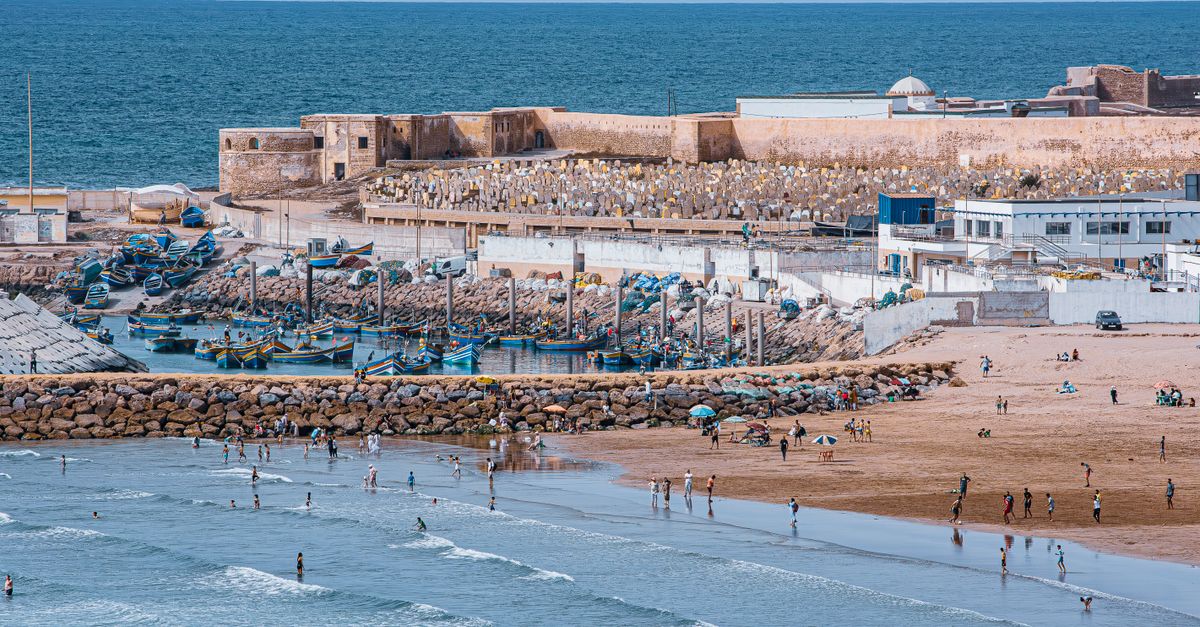
The fishing village immediately adjacent to the marabout's causeway — an informal settlement of perhaps 300 fishermen and their families — is one of Casablanca's most persistently traditional communities. The fishermen here use small hand-built wooden boats for coastal fishing and sell their catch from the boats directly to the corniche restaurants. The settlement has no tourist infrastructure whatsoever and the contrast with the corniche's beach clubs 200 metres away is striking.
8. Morocco Mall Food Court Local Gems
Morocco Mall, on the Ain Diab corniche, is Africa's largest shopping mall and its existence in a list of hidden gems requires explanation. The mall itself is of no particular interest to the culturally curious traveller. But the food hall in the mall's basement level contains several stalls run by genuine Moroccan food producers — not the international fast food chains that dominate the upper levels — selling traditional Moroccan street food at local prices in a clean, air-conditioned environment useful for midday respite from the heat.
The M'semen stall sells the layered Moroccan flatbread (similar to a multi-layered crêpe) with fillings ranging from honey and argan to kefta and egg — MAD 10–15 per piece. The Amlou stand sells the almond-argan-honey paste with warm bread as a snack for MAD 20. Several seafood stalls sell chilled ceviche-style preparations of local Atlantic fish with preserved lemon dressing. The Moroccan pastry counter (Moroccan sweets — chebakia, ghoriba, and kaab el-ghazal) sells by weight at MAD 80–100 per kilo — half the tourist souk price for better quality.
The mall's aquarium (a separate paid attraction, MAD 100) is one of the finest in North Africa, containing Atlantic species including sand sharks, rays, and the remarkable Moroccan coast's marine biodiversity. It is genuinely impressive for families and for anyone interested in the marine ecology of the Atlantic Moroccan coast. Open daily 10 a.m. to 10 p.m.
Morocco Mall is on the Ain Diab corniche, 5 km from central Casablanca. The tramway stops at the mall entrance. Parking is free. The mall's exterior fountain show (evenings at 8 p.m. and 9 p.m. in summer) draws Casawi families for a free light and music spectacle that is genuinely impressive. The corniche around the mall offers the best sunset views in Casablanca, looking west across the Atlantic with the Hassan II minaret laser visible to the east.
9. Casablanca's Street Art in Maarif
The Maarif neighbourhood, Casablanca's upmarket residential and commercial district south of the city centre, has developed a significant street art scene over the past decade, with international and Moroccan artists commissioned to produce large-scale murals on the neighbourhood's broad residential walls. The work ranges from photorealistic portraiture of Moroccan cultural figures to geometric abstraction drawing on Islamic tile tradition, and constitutes one of the most interesting urban art environments in North Africa.
The annual Casablanca Art Week (typically held in October) concentrates new mural production in Maarif and the adjacent Gauthier neighbourhood, and the festival events — walking tours, studio open days, artist talks — are open to all visitors. The Casablanca street art map (available from the tourist office and as a downloadable PDF from the festival website) marks 40+ major works within a 2-km walking circuit in Maarif.
The neighbourhood is accessible by petit taxi from Place Mohammed V (MAD 15–20) or by tramway. The self-guided walk takes 90 minutes to 2 hours. The Maarif neighbourhood's cafés — particularly the Comptoir d'Art gallery-café on Rue Al-Banafsaj — provide good stopping points with specialty coffee and local art on the walls. A coffee costs MAD 25–35 ($2.50–3.50 USD).
Several of the murals in Maarif address Morocco's complex identity politics — the coexistence of Amazigh (Berber), Arab, sub-Saharan African, and Jewish heritage within a contemporary Moroccan national identity. This makes the street art in Maarif considerably more politically and culturally layered than it first appears, and understanding the references (a knowledgeable guide or the festival walking tour notes help significantly) adds a dimension that a casual viewing cannot access.
10. Rick's Café and Casablanca's Cinematic History
The 1942 film Casablanca was shot entirely in Hollywood — no production crew visited the actual city — but the film's cultural impact on Casablanca's self-image has been remarkable. Rick's Café, opened in 2004 by an American diplomat named Kathy Kriger who invested her life savings in reconstructing the fictional bar from the film, is now Casablanca's most famous restaurant and a destination in its own right — despite (or because of) its entirely fictitious connection to the city's actual history.
The restaurant is housed in a beautifully restored Mauresque mansion in the old medina neighbourhood near the port. The interior — designed by a set designer who studied the film frame-by-frame — is an extraordinary exercise in cinematic architecture: a curved bar, a piano (where a pianist plays nightly), ceiling fans, rattan furniture, and the general atmosphere of a 1940s expatriate salon. The food is Moroccan-international fusion at high quality; the cocktails are among the best in Casablanca.
Rick's Café represents a rare case of successful cinematic tourism: a place that admits its own artificiality while delivering genuine quality within that framework. A dinner for two costs MAD 500–700 ($50–70 USD) — expensive by Casablanca standards but comparable to international restaurant pricing. Reservations are essential; book through the website at least 48 hours in advance. The pianist plays from 9 p.m.; the bar is open until midnight.
The film's actual filming locations — the Hollywood sets of Warner Bros. Studio — no longer exist, but Casablanca's tourist office has produced a guide to the real city locations that the film's scriptwriters drew on for inspiration, including the Gare de Casablanca train station (where the famous final scene's emotional logic originates) and the Ain Diab corniche hotels that housed the real-life refugees fleeing Nazi-occupied Europe that the film dramatises. This historical context — the Casablanca Conference of 1943, where Churchill and Roosevelt met and planned the D-Day invasion — makes Rick's Café's artificiality more meaningful than it first appears.


