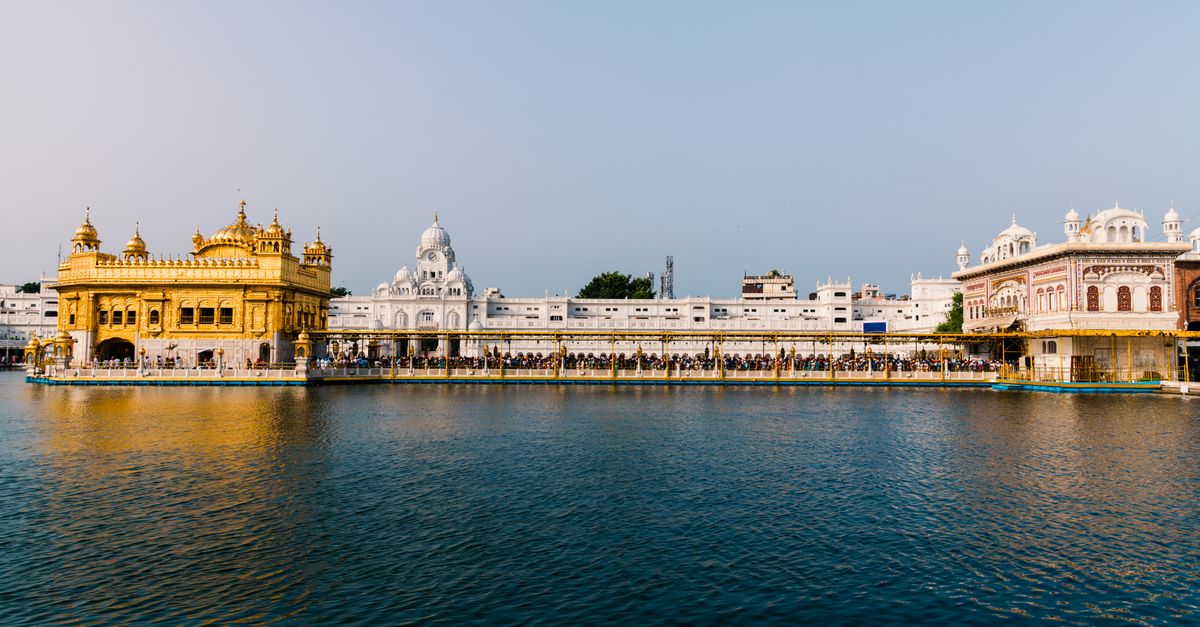
Amritsar's golden dome is the most photographed religious site in South Asia, and deservedly so — the Harmandir Sahib at dawn, reflected in the Amrit Sarovar, is one of the genuinely transcendent architectural experiences on earth. But Amritsar is also a much more complex city than the Golden Temple and the Wagah Border ceremony suggest. It's a Partition city that carries 1947 in its physical fabric, in the refugee neighborhood of Katra Jaimal Singh, in the lanes where Hindu, Sikh, and Muslim communities interweave in patterns that survived the violence. It's also a food city of extraordinary depth — the butter chicken was invented here, the kulcha tradition is specific to this region, and the breakfast culture alone warrants a three-day visit.
The surrounding Punjab countryside is flatter and more agricultural than any other part of India, and that plainness is its own kind of beauty — golden mustard fields in February, wheat in April, the rice paddies in monsoon. Within 30 km of Amritsar are Partition massacre sites, Mughal-era gardens, and Sikh historic battlefields that shaped the subcontinent's history and receive almost no visitors. Understanding Amritsar requires going beyond the Golden Temple to these surrounding contexts.
These ten hidden gems cut across the city's full identity: spiritual, culinary, historical, and agricultural. Come hungry, come curious, and come early — Amritsar begins at 4 AM when the first langar is served at the Golden Temple complex.

1. The Langar at 4 AM
The Golden Temple langar (community kitchen) is the world's largest free kitchen, serving 100,000 meals daily. It's known, toured, and photographed. What is not known is the 4 AM service — the hour when the kitchen is serving its first meal of the day to pilgrims who have been at the Harmandir Sahib for the Amrit Vela (pre-dawn prayers), to workers heading to early shifts, and to travelers who arrived by overnight train. At this hour, the dining hall has perhaps 200 people instead of the usual 5,000. The food is the same (dal, roti, sometimes rice), the service is the same, but the atmosphere is completely different — contemplative rather than logistical.
The Golden Temple complex itself at 4 AM is an extraordinary experience independent of the langar. The Harmandir Sahib (the main shrine) opens at 3 AM and the Palki Sahib ceremony — where the Guru Granth Sahib is carried from its overnight resting place into the temple on a golden palanquin — happens at 4 AM and involves the entire resident Granthi staff in full ceremonial regalia. This is the most important daily ritual at the temple and is attended almost exclusively by Sikhs from the surrounding region. Non-Sikhs are absolutely welcome; just cover your head, remove shoes, and observe the protocol.
The Golden Temple is in central Amritsar near the Katra Jaimal Singh wholesale market area. The complex is open 24 hours. Entry free (always). Head coverings provided at the entrance if needed. The causeway to the Harmandir Sahib at 4 AM, with no queue and the reflective sarovar surface lit by temple lights, is the visual experience that the midday photographs cannot capture.
After the langar at 4 AM, walk two minutes to the langar kitchen entrance where volunteers prepare the food from midnight onward. Expressing a genuine desire to participate in seva (volunteer service) — helping sort lentils, roll roti dough, or wash dishes — is welcomed and creates a completely different relationship with the space than tourist observation. No prior arrangement needed; simply show up at the kitchen entrance and indicate willingness.
2. Partition Museum
Town Hall in central Amritsar contains the Partition Museum — the world's first museum dedicated to the 1947 Partition of India. Opened in 2017, it collects testimonies, photographs, documents, and personal objects from the 14 million people displaced and the one to two million killed during the Partition. The museum is not academic — it's personal, visceral, and repeatedly devastating in a way that political history rarely achieves. The audio testimonies of Partition survivors recorded before their deaths play on headphones throughout the galleries.
The museum is important in Amritsar specifically because this city was bisected by the Radcliffe Line — the boundary drawn in five weeks by a British lawyer who had never been to India. Amritsar's Muslim population (approximately 30% in 1947) fled or was killed. The Muslim neighborhoods in the old city became Hindu and Sikh refugee neighborhoods. The physical city still shows this rupture in the changed names of lanes and markets, in the repurposed mosques, and in the family histories of almost every old Amritsar resident.
Town Hall is on the main road 5 minutes walk from the Golden Temple. Entry ₹200 for non-Indians / ₹50 for Indians. Open Tuesday to Sunday, 10 AM to 5 PM. Allow three hours minimum — rushing this museum is not possible. The final gallery, which asks visitors to record their own family's partition story (if any), is the most humanly important room.
The museum shop stocks the best collection of Partition literature in India: Saadat Hasan Manto's short stories, Urvashi Butalia's "The Other Side of Silence," and academic collections of survivor testimonies. These are the books that belong in the bag next to a Golden Temple photograph — Amritsar is incomplete without the history the museum addresses.
3. Jallianwala Bagh's Eastern Wall
Jallianwala Bagh is the site of the 1919 Amritsar Massacre, where British General Dyer ordered troops to fire on 25,000 unarmed civilians gathered in an enclosed garden, killing at least 379 officially (historians estimate between 500 and 1,500). The site is managed as a memorial and most visitors follow the standard path past the flame monument and the bullet-marked walls. The eastern wall, where most of the crowd fled when the shooting began, has a series of indentations at ground level — the marks where people's fingers scraped the brick as they tried to climb over while being shot. These marks have not been restored. They're behind a small barrier but clearly visible.
The well in the northwestern corner of the Bagh is marked as the site where dozens of people jumped to escape the firing — some died from the fall, others drowned in the crush. The well has been preserved and fenced, and a plaque records the deaths. The standard tourist visit often misses this corner entirely, circling the central flame monument and the marked walls without reaching the well.
Jallianwala Bagh is adjacent to the Golden Temple complex — a 2-minute walk from the main entrance. Entry free. Open daily 6:30 AM to 7:30 PM (seasonal variation). The best time to visit is early morning when there are fewer visitors and the history registers more directly. Avoid weekends during the tourist season (November-March) when the site becomes crowded enough to undermine the atmosphere.
The narrow entrance lane to Jallianwala Bagh from the main road is original — Dyer blocked it with his armored cars to prevent escape. Walking through this lane knowing that context makes the entry into the enclosed garden feel different from a standard heritage site arrival. History built into architecture, available for free, right next to the world's most visited Sikh shrine.
4. Gobindgarh Fort's Military History Museum
Gobindgarh Fort, inside Amritsar city, has been a military installation continuously since the 18th century — used by Maharaja Ranjit Singh's Sikh Empire, then by the British, then by the Indian Army until it was handed back to the Punjab government in 2017. The fort opened as a heritage site in 2018 and the Military History Museum inside is one of the best small military museums in India, containing original Sikh Empire weapons, British-era maps and dispatches, and exhibits on the fort's role in both World Wars. The fort also houses the Heritage of Punjab Museum with folk art and craft traditions.
The fort architecture itself is the attraction: bastions, moats, underground chambers, and a late Mughal structure called the Toshakhana (treasury) where Ranjit Singh stored the Koh-i-Noor diamond before the British took it. The connection to one of the world's most controversial gems — the Koh-i-Noor is still in the British Crown Jewels and still disputed — gives the Toshakhana room an unexpected contemporary resonance.
Gobindgarh Fort is on the Lawrence Road in central Amritsar, 2 km from the Golden Temple. Auto-rickshaws from the Golden Temple area charge ₹50. Entry ₹300 including multiple internal museums. Open Tuesday to Sunday, 10 AM to 8 PM. The evening illumination of the fort walls makes the exterior impressive; the interior museums are best in the daytime.
The evening show at Gobindgarh Fort (₹100 extra) includes a mock Sikh warrior performance and a light-and-sound history of the fort — variable quality but the production values are better than expected. The fort's food court serves decent Punjabi food at non-tourist prices. The fort is chronically undervisited relative to its content and the Golden Temple is chronically over-visited — the imbalance is unjustified.
5. Tarn Taran Sahib Gurudwara
Tarn Taran, 24 km south of Amritsar, has the largest sarovar (sacred pool) in the Sikh world — larger than the Amrit Sarovar at Harmandir Sahib in Amritsar. The Gurudwara Tarn Taran Sahib, founded by Guru Arjan Dev in 1590, was specifically designated as a pilgrimage site for those who could not travel to Amritsar. The result is a deeply Punjabi pilgrimage site that never developed a tourist infrastructure, remaining a place where Sikhs come for the sarovar bath and for the historic significance in pure pilgrimage terms.
The healing tradition associated with Tarn Taran's sarovar — Guru Arjan Dev specifically dedicated the tank to healing leprosy and skin diseases — is maintained. On Sundays, thousands of pilgrims arrive for the sarovar bath, including people who have traveled considerable distances with specific health intentions. This is Sikh pilgrimage culture in its functional, unsentimental, community-organized form.
Buses from Amritsar ISBT to Tarn Taran run every 20 minutes (₹40, 45 minutes). Shared autos from Amritsar run for ₹25-30. Entry free. The gurudwara is open 24 hours. The langar here serves the Punjabi thali format — more elaborate than the Harmandir Sahib langar — and is available from 8 AM to 10 PM. Dress code as for any gurudwara: cover head, remove shoes, wash hands and feet at the entrance.
The town of Tarn Taran itself is worth walking through after the gurudwara visit: the weekly market (Thursday) sells Punjabi agricultural produce and crafts from the surrounding villages. The old quarter around the gurudwara has haveli architecture from the 18th-19th century Sikh period that's in the process of slow deterioration — the carved wooden facades and brick jalali windows are worth documenting while they remain.
6. Wagah Border's Village Side
The Wagah Border ceremony is on every Amritsar itinerary — the synchronized lowering of flags by Indian BSF and Pakistani Rangers soldiers, the military pageantry, the crowd of 3,000 on each side. This is correctly called a spectacle. What's not in any itinerary is the Wagah village on the Indian side, 500 metres from the ceremony ground, where the daily reality of the border is entirely different from the ceremonial performance. The village was bisected by the Radcliffe Line — the main street literally ends at the border gate. Families were separated. The village mosque is now on the Pakistani side.
The Wagah village community includes former border smugglers who have transitioned to legal border trade, families with relatives on both sides who haven't met since 1947, and small farmers whose land was divided by the border and who continue farming their half. Walking through the village after or before the ceremony and talking to the residents — with a Hindi speaker if your Punjabi doesn't extend — reveals a complex ongoing human situation that the flag ceremony spectacle completely obscures.
Buses from Amritsar to Wagah run every 30 minutes from the ISBT (₹30, 30 minutes). The ceremony is free. Arrive 90 minutes before sunset (sunset time varies by season) for a front-row position. The village is accessible by walking 500 metres back from the ceremony ground along the main road toward Amritsar.
The dhabas in the Wagah village area (not the tourist stalls at the ceremony ground) serve excellent Punjabi dal-makhni and roti for ₹80-120 — the dhaba immediately before the village entrance on the Amritsar side is particularly good. Eat here before the ceremony rather than after, when the tourist crowd descends on the ceremony area food stalls.
7. Kesar Da Dhaba (4 AM Breakfast)
Kesar Da Dhaba has been operating at the same location in Pasian Bazaar since 1916. It's mentioned in enough food media that "undiscovered" would be inaccurate. But the 4 AM opening — specifically the pre-dawn service before the tourist food circuit wakes up — is genuinely unharvested by anyone except locals and dedicated food travelers. At 4 AM, Kesar Da Dhaba serves its original menu of dal makhni (the dal that was slow-cooked overnight, making it dramatically richer and thicker than the fresh-cooked version served later) and tandoori roti to taxi drivers, Golden Temple pilgrims, and the occasional overnight train arrival who knows exactly where to go.
The dal makhni at 4 AM is a fundamentally different dish from the dal served at noon. The twelve-hour overnight slow-cooking reduces the black lentils and kidney beans to an almost spreadable consistency, the cream and butter integrate fully, and the tandoor smoke permeates the dal rather than sitting on its surface. This is the dal that all the restaurant chain versions are trying and failing to reproduce. It's ₹120 a portion. With two rotis, it constitutes the single best meal in Amritsar for ₹170.
Kesar Da Dhaba is in Pasian Bazaar near Bhandari Bridge, about 15 minutes walk from the Golden Temple. At 4 AM, auto-rickshaws are scarce; the walk from the Golden Temple complex is manageable and safe (the streets are always active near the gurudwara). The dhaba doesn't look like much — simple seating, no décor — which is the correct indicator for a century-old restaurant that has never needed to attract strangers.
The rest of the Kesar Da Dhaba menu is also excellent (paneer dishes, kheer, seasonal specials) but the overnight dal is the irreplaceable item. If you arrive after 7 AM, the overnight dal is usually finished and the fresh-cooked version replaces it. Good, but not the same. Prioritize the pre-dawn visit on your first morning in Amritsar over any sleep-in.
8. Durgiana Temple
The Durgiana Temple in Amritsar is architecturally identical to the Golden Temple — the same sarovar, the same island shrine connected by a causeway, the same gold and white exterior — but it's a Hindu temple rather than a Sikh gurudwara. Built in 1921 on the site of an ancient Lakshmi-Narayan temple, it intentionally referenced the Golden Temple's design as a statement of interfaith solidarity in a city where the communities lived alongside each other. Most tourists never find it despite it being 500 metres from Jallianwala Bagh.
The Durgiana Temple complex includes a separate shrine dedicated to Hanuman (the Sheetla Mata temple within the same compound is the oldest extant religious structure in Amritsar, predating the Golden Temple), an active dharamshala for pilgrims, and a community kitchen that serves free prasad meals at morning and evening pujas. The temple's principal deity is Lakshmi-Narayan, but the complex incorporates Durga, Shiva, and Hanuman shrines in a typically Hindu syncretic arrangement.
The temple is on the main road between Jallianwala Bagh and the railway station — auto-rickshaws from anywhere in the tourist center charge ₹30. Entry free. Open 5 AM to 11 PM. The morning puja (6 AM) and evening aarti (7 PM) are the most atmospheric times. The sarovar here is smaller than the Amrit Sarovar but equally serene, and the crowd at the Durgiana temple is perhaps 5% of the Golden Temple crowd despite the architectural similarity.
The lane leading from the Durgiana Temple toward Katra Jaimal Singh market passes through the old Hindu commercial neighborhood of Amritsar — hardware dealers, wholesale fabric merchants, and the spice market that supplies all of Punjab with whole spices. This is the working commercial city that operates entirely parallel to the pilgrimage economy. The ghee merchant at the corner of this lane (his shop is recognizable by the copper drums outside) has been selling pure buffalo ghee to Punjab's halwais and cooks since 1935.

9. Rural Punjab on the Attari Road
The 30-km stretch of highway between Amritsar and the Attari border crossing passes through core Punjab agricultural land — the flat, intensively farmed land of the Majha region that produces India's primary wheat surplus. Stopping along this road during harvest season (April for wheat, October for rice) reveals an agricultural system of extraordinary efficiency and a farming community that's simultaneously prosperous and under severe stress from water table depletion and input cost inflation. The farmers along this road are the most politically engaged agricultural community in India — they led the 2020-2021 farm protest that ultimately won against the central government.
The villages between Amritsar and Attari — Chheharta, Jandiala Guru, Sultanwind — are regular Punjabi village economies: dhaba culture, the mandatory wrestling akhada (each village has one), the gurudwara as community center, and the weekly market. Jandiala Guru specifically is known for Punjabi folk instrument making — the sarangi and tumbi (the short-necked instrument associated with bhangra music) are made by craftsmen here whose families have been instrument makers for four generations.
Hire a bicycle from any shop near the Amritsar bus stand (₹100 per day) and cycle the Attari Road in the early morning before traffic builds. The 30 km is flat and manageable in three hours with stops. Alternatively, any Attari-bound bus from Amritsar ISBT stops on request along the highway. The instrument-making workshops in Jandiala Guru are open 9 AM to 6 PM on weekdays; ask for the gaddi-wala lane in the village center.
A handmade tumbi from Jandiala Guru costs ₹800-2,000 depending on wood quality and decoration — the same instrument sells in Amritsar tourist shops for ₹3,000-5,000. Custom sarangi (traditional bowed instrument) takes two to three weeks to make to order and costs ₹4,000-8,000. These are working instruments, not decorative pieces — the craftsmen will tune them and play to demonstrate the sound quality before you buy.
10. Sadda Pind Cultural Village
Sadda Pind is not hidden in the conventional sense — it's a purpose-built cultural village 4 km from the Golden Temple that opened in 2011. What makes it worth including here is that it's chronically underutilized and misunderstood. Most reviews describe it as a "tourist trap folk village," which is unfair and inaccurate. Sadda Pind is a sincere reconstruction of a traditional Punjabi village economy, and on a slow weekday afternoon it functions as a genuinely educational space where craft demonstrations (pottery, blacksmithing, basket weaving, gur-making) are conducted by practitioners who actually know what they're doing.
The gur (jaggery) making demonstration is the strongest single experience at Sadda Pind: raw sugarcane is crushed in a traditional bullock-powered press, the juice is boiled in iron kadhais over wood fire, skimmed and stirred continuously, then poured into molds. The entire process takes four hours; the demonstration covers the critical middle section. The aroma of boiling sugarcane juice is distinctive and impossible to reproduce chemically — it smells like caramel, treacle, and something specifically agricultural that's connected to the Punjab countryside.
Sadda Pind is 4 km from the Golden Temple on the Fateh Garh Road. Entry ₹500 including lunch. Open daily 10 AM to 8 PM. The ₹500 includes a Punjabi folk meal — kadhi-chawal, sarson da saag, makki di roti, and lassi — that's better than most tourist restaurants. Arrive at 11 AM to coincide with the mid-morning demonstrations and stay for the noon meal.
The evening bhangra performance at Sadda Pind (included in entry) is by far the most skilled folk performance available in Amritsar — better than the hotel-lobby shows, more authentic than the Wagah ceremony entertainment. The performers are trained classical bhangra dancers (this is a technically rigorous form, not casual folk dancing) and the drumming is live, loud, and physically overwhelming in the best possible way. This combination of cultural authenticity and logistical convenience makes Sadda Pind the best day-trip structure for a first-time Amritsar visitor.