
Udaipur's reputation as the City of Lakes is fully earned, and it's also fully exploited. The Lake Palace hotel, the City Palace, the sunsets at Dudh Talai — all excellent, all photographed to exhaustion. The problem isn't that Udaipur is over-touristed in absolute terms; it's that the tourist trail is so well-worn that first-time visitors can spend four days here and see almost nothing of how the city actually functions. They miss the tribal village markets in the surrounding Aravalli Hills, the miniature painting workshops where the technique is 600 years old and the artists are genuinely happy to teach, the stepwells that are as architecturally complex as anything in Gujarat and are attended only by neighborhood women fetching water in the early morning.
The Mewar kingdom that built Udaipur was the most tenacious Hindu Rajput state in India — the only one that never submitted to Mughal authority. That stubbornness produced a culture deeply attached to its own artistic traditions. Miniature painting, folk music, silver jewelry, and tie-dye textiles (bandhani and leheriya) are living crafts here, not museum pieces. Finding the practitioners requires leaving the lakefront and heading into the residential neighborhoods and surrounding villages.
These ten hidden corners of Udaipur are the ones that make it worth staying longer than the standard three-night itinerary allows. Come at a different speed. The lakes will wait.

1. Bagore Ki Haveli's Rooftop at Dawn
Bagore Ki Haveli is well known as an 18th-century merchant's mansion turned museum on the Gangaur Ghat. What most visitors don't know is that the rooftop terraces of the haveli offer the best possible view of Lake Pichola at dawn — better than any hotel rooftop and better than the standard boat cruise — and that the museum opens at 9:30 AM, but the staff often allow early arrivals onto the upper terraces before the official opening if you arrive respectfully and tip the caretaker ₹100.
The haveli was built by Amir Chand Badwa, the prime minister to the rulers of Mewar, in the 18th century and contains 138 rooms spread across multiple floors and courtyards. The architecture is a layered accumulation — each generation added rooms, galleries, and terraces in a way that makes the floor plan genuinely confusing and the exploration thoroughly worthwhile. The collection inside includes the world's largest turban display and a gallery of antique garments from the Mewar court.
Gangaur Ghat is a 5-minute walk south from the main Lal Ghat tourist area. Entry ₹100 Indians / ₹200 foreigners. The evening cultural show at 7 PM (₹90 extra) is a folk dance performance that varies in quality but includes the Ghoomar dance specific to Rajasthan. Arrive for the evening show 30 minutes early to get the front row position on the ground floor — the view of the performers with the lake behind them through the open arches is the best visual in Udaipur's tourist circuit.
The rooftop itself, once you're up there legitimately, is a platform with 270-degree views: City Palace to the north, Jag Mandir palace in the lake to the west, the Aravalli hills to the east, and the Jagdish Temple spire visible above the old city rooftops. This view at 6 AM, with the lake surface perfectly still and the first boats crossing from the boat dock, is not reproducible anywhere else.
2. Shilpgram Craft Village (Weekday Mornings)
Shilpgram is a government-run crafts village 3 km west of Udaipur on the Rani Road, and it has a reputation problem: the annual Shilpgram Utsav in late December is a major tourist event, which has led many people to write off Shilpgram year-round as a crafts fair for tourists. That's inaccurate and worth correcting. The permanent village is a collection of authentic regional architecture from five western Indian states, with resident artisans who actually live and work in the recreated buildings during off-season months. On a Tuesday morning in February, you might have the entire 70-acre complex to yourself except for a weaver from Kutch working at a traditional loom and a leather craftsman from tribal Rajasthan making jootis.
The architecture is the real draw for architecture travelers: traditional houses from Mewar, Marwar, Saurashtra, Kutch, and Goa — each faithfully reconstructed with local materials and techniques. The Kutch section uses the distinctive bhungas (circular mud houses with thatched roofs and intricate mirror-work interiors) that are among the most beautiful vernacular structures in India. Seeing these structures in situ, occupied and lived-in, is different from seeing them in a photograph.
Autos from Udaipur city center to Shilpgram cost ₹80-100. The complex opens at 11 AM officially, but the resident artisans often start work earlier and the gates are sometimes open. Entry ₹50. Allow two to three hours for a proper walk-through. The best months for resident artisans are October through March; in summer, many return to their home villages.
The craft demonstrations at Shilpgram are genuine working sessions, not performances. Buying directly from resident artisans at the village avoids the markup at lakefront souvenir shops: leather jootis for ₹400-800, block-printed fabric for ₹200-600 per metre, and Kutch embroidery pieces for ₹500-3,000 depending on complexity. The artisans set their own prices and rarely bargain aggressively.
3. Tribal Haat Market (Girwa Valley)
The weekly tribal markets in the villages of the Girwa Valley surrounding Udaipur are among the most authentic market experiences in Rajasthan, and almost no tourist visits them because they require a 20-40 km drive from the city into the Aravalli hills. The Bhil and Garasia tribal communities of the region gather at rotating village markets — each village has its market on a different day of the week. Gogunda (Wednesday), Salumbar (Thursday), and Kotra (Saturday) are the most accessible from Udaipur.
These markets sell almost exclusively locally produced goods: tribal silver jewelry (heavier and less refined than Udaipur city jewelry, but authentically old-style), hand-spun cotton fabric dyed with natural pigments, clay cookware, wooden agricultural tools, and varieties of millet and pulse that predate the Green Revolution. The social function of these markets matters as much as the commerce — they're the weekly gathering point for dispersed village communities, and much of the activity is simply people meeting, exchanging information, and eating together.
Hire a car from Udaipur for ₹1,200-1,800 for a day trip to any of these markets. Standard taxis know the route but may need the specific village name — tell them the day and the destination. No entry fees, no tourist infrastructure. Dress conservatively (legs and shoulders covered). The markets run from 7 AM to 1 PM and are essentially finished by early afternoon.
The tribal silver jewelry sold at these markets goes by weight (not design) and is priced at market silver rates plus a small craft premium — substantially cheaper than the Udaipur city price for similar items. Bargaining is acceptable but aggressive haggling is not culturally appropriate. Bring cash in small denominations (₹100 and ₹500 notes). Very little English is spoken; Google Translate's camera function works surprisingly well for Hindi text.
4. Jaisamand Lake's Hidden Pavilions
Jaisamand Lake, 48 km southeast of Udaipur, was when it was built in 1691 the largest artificial lake in Asia. Today it's the second-largest artificial lake in India and the most overlooked major sight in the Udaipur region. The dam and the lake are vast — 102 sq km of water — and the marble cenotaphs, pavilions, and summer palaces that Maharana Jai Singh built along the shore are largely uninhabited and slowly being reclaimed by vegetation. That quality of beautiful, productive ruin is exactly what makes it worth the drive.
The dam wall itself is a piece of engineering worth studying: 375 metres long, with six marble spouts for flood relief, a flight of marble steps descending to the water, and two ornate marble elephants flanking the main pavilion. From the dam wall you can see the island palaces (the two main islands still support small Bhil fishing communities) and the Aravalli ridgeline beyond the water. The light on the lake at sunrise is extraordinary — the water color shifts from grey-blue to gold to green in about 30 minutes.
Hire a car from Udaipur for the round trip — ₹1,500-2,000 for the day. The road passes through the Jaisamand Wildlife Sanctuary (leopard territory — don't expect to see one, but go slow after dark). Entry to the lake area ₹35. Boat rentals are available from the Forest Department dock: ₹300 for a 30-minute boat to the island pavilions.
The island palaces are not restored and not managed for tourism — they're genuinely atmospheric ruins where peacocks roost in the empty rooms and the marble has been worn smooth by weather. The Hawa Mahal summer palace on the eastern shore has the best preserved interior. Visit on a weekday to have the entire complex to yourself. Picnic supplies from Udaipur are recommended; the single dhaba near the dam serves basic dal-roti for ₹60.
5. Mewar Miniature Painting Schools
The Udaipur tradition of miniature painting is the Mewar school — one of four major Rajput miniature traditions, distinguished by flat primary colors (particularly a vivid red), bold outlines, and scenes drawn from the Ramayana and local Mewar court history. The tradition is still taught in private ateliers in the old city neighborhoods of Mandi and Gangaur Ghat, and the artists are genuinely interested in teaching serious visitors for a fee rather than simply selling finished work to tourists.
The better teaching workshops (not the tourist shops selling machine-printed "originals") work with natural pigments on handmade paper or old cloth — the yellow comes from pomegranate rind, the blue from lapis lazuli, the red from the vermillion tree. A three-hour workshop introduces the basic techniques of outline drawing, color preparation, and the characteristic Mewar facial features (always shown in profile, always with a distinctive eye shape). You won't leave as a miniature painter, but you'll leave able to distinguish authentic handwork from print.
The best genuine workshop to approach is Dera Rawatsar in the old city near Jagdish Temple — a family atelier run by the fourth generation of a painting family. Workshop sessions (₹800 for two hours, including materials and a finished small practice piece to take home) are available daily by prior arrangement. Call ahead or walk in and inquire in the morning.
The old city painting workshops cluster between Bada Bazaar and the Jagdish Temple lane. Walking the lane and looking at actual work process (not finished pieces) in the open-fronted shops helps distinguish the working ateliers from the souvenir operations. A genuine workshop has the artist's grinders, pigment jars, and multiple works in various stages of completion. A souvenir shop has shelves of identical pieces.
6. Fateh Sagar Lake's Boatmen's Ghat
Fateh Sagar Lake is Udaipur's second large lake, north of the city center, and it's primarily a recreation lake rather than a heritage one. The tourist boat circuit here is unremarkable. What is remarkable is the working boatmen's community at the southern ghat — families who have operated passenger and fishing boats on this lake for at least five generations, living in the cluster of houses on the eastern shore that nobody seems to visit. The ghat itself, away from the tourist boat dock, is where the boats are repaired and maintained.
The boat repair culture here uses techniques that are specific to the shallow, freshwater conditions of the Aravalli lakes: the boat hulls are treated with a mixture of neem oil and resin that gives them a characteristic dark sheen. The boatmen are also skilled fishermen, and the morning catch (primarily rohu and catla) is sold directly from the boats to local households between 7 and 9 AM. This is as close to a working waterfront as Udaipur gets.
Walk north from the Nehru Garden on the eastern Fateh Sagar shore for 10 minutes — the working ghat is at the end of the paved path before the road curves away from the lake. No entry fee. The best time is 6:30 AM when the first boats return from the night fishing run. Evening is also good: the sunset from the working ghat, with no tourist infrastructure and the Aravalli hills in the background, is quieter and more genuinely beautiful than the sunset from the official Fateh Sagar Paal promenade.
Buy fresh fish from the returning boats for ₹80-120 per kg — significantly below the city market price. If you're staying in accommodation with a kitchen, this is the morning routine. If not, the conversation with the boatmen (most speak some Hindi, a few speak functional English from years of tourist lake interaction) is the real product. These families know Udaipur in ways the Lake Palace concierge never will.
7. Sajjangarh Wildlife Sanctuary at Dawn
The Monsoon Palace on the Sajjangarh hill above Udaipur gets tourist visitors — the sunset view from the palace is famous. The wildlife sanctuary that surrounds the hill is almost entirely unvisited. Sajjangarh Wildlife Sanctuary covers 5.19 sq km of scrub forest and rocky hillside habitat, home to leopard, nilgai, wild boar, hyena, and 180+ bird species. The leopard population in particular uses the sanctuary as a transit corridor between the Aravalli Range and the agricultural lands below — sightings are not guaranteed but are not unusual.
The sanctuary opens for visitors at 6 AM. The Forest Department runs guided nature walks on advance booking (₹300 per person, minimum two people) starting from the lower gate on the Sajjangarh Road. The walk takes 2-3 hours on rocky paths through dry deciduous forest. Birds are the most reliable sighting: Indian roller, white-throated kingfisher, painted spurfowl, and the occasional grey jungle fowl are common. Leopard signs (scratch marks, pugmarks) are found regularly even when the animals themselves are not visible.
The sanctuary entrance is on Sajjangarh Road, accessible from Udaipur by auto in 15 minutes (₹80-100). Book the guided walk by calling the Sajjangarh Range Forest Office a day ahead. Entry ₹150 for foreigners. The walk is genuinely different from the sanitized nature experience of a major reserve — small, accessible, wild enough to feel real.
The Monsoon Palace at the top of the hill is accessible by road (jeep rental from the lower gate, ₹200 for the vehicle, or walk 45 minutes uphill). The palace interior is not particularly impressive, but the panoramic view from the battlements covers all four lakes of Udaipur simultaneously — Pichola, Fateh Sagar, Swaroop Sagar, and Rang Sagar — which is the definitive overview photograph of the city and is best captured 20 minutes before sunset.
8. Maldas Street's Evening Food Circuit
Maldas Street, running from Hathipole gate into the old city, is Udaipur's local food street — entirely parallel to and almost completely unvisited by the tourist crowd that clusters around the Jagdish Temple restaurant area. From 6 PM to 10 PM, the vendors on Maldas Street serve the city's residents with a menu that's purely local: kachori-sabzi, mirchi bada, mawa kachori (Udaipur's specific sweet deep-fried pastry with milk-solid filling), rabri, and the local dal-baati being eaten at simple tables while bikes navigate around them.
The mawa kachori deserves its own paragraph. It was invented in Jodhpur but Udaipur has its own version — slightly smaller, fried in pure ghee rather than oil, and filled with a mixture of mawa (reduced milk solids), dry fruits, and saffron. The kachoris at Shri Mishrilal Hotel on Maldas Street have been made the same way for 60 years and cost ₹25 each. Two kachoris and a glass of rabri constitutes both dinner and dessert.
Maldas Street is accessible from Hathipole gate on foot from the tourist lakefront area (10 minutes) or by auto from anywhere in the city (₹50). The street is narrow — bicycles and pedestrians only in the evening. Walk its full length (about 400 metres) from Hathipole to the junction with Sukhadia Circle Road to understand the full range of food options.
Budget ₹150-200 for a full evening food crawl. The vegetarian options dominate (Udaipur is a predominantly vegetarian city) but a few stalls sell egg dishes. No restaurants here — only street stalls, dhaba-style seating on plastic chairs, and small shops with standing customers. This is where the city's office workers and college students eat. That's a recommendation.
9. Ranakpur Jain Temples (Afternoon Visit)
Ranakpur is 96 km north of Udaipur and technically outside the city, but it belongs on this list because the standard tourist pattern — arriving by coach at 10 AM with 200 others — misses the temple entirely. The Chaumukha Temple at Ranakpur, built in 1437, has 1,444 intricately carved marble columns, each unique, and the interior is the most complex carved-stone space in India. In the afternoon between 2 and 4 PM, when the coach tours have departed and the light enters through the marble lattice at a low angle, the temple is yours.
The marble used here is the white Makrana variety — the same stone used for the Taj Mahal. The carving is executed to the same standard as the Dilwara temples of Mount Abu, which is the highest standard of Jain temple architecture in existence. The main icon is a four-faced (chaumukha) Adinath — the first Tirthankara — and the pilgrimage tradition at Ranakpur is intensely focused and uninterrupted by the tourism around it. Jain pilgrims arrive for genuinely religious purposes; the tourists walk around them.
Hire a car from Udaipur for ₹1,800-2,200 round trip (about 2 hours each way). The temple is open to non-Jains from noon to 5 PM. No entry fee for the main temple; ₹200 camera charge. Shoes and leather items must be left at the entrance (this includes belts and leather phone cases — take them off). Wear white or light-colored clothing as a mark of respect.
The surrounding Ranakpur forest is a wildlife sanctuary in its own right — the road from Udaipur passes through the Kumbhalgarh Wildlife Sanctuary, and leopard, wolf, and sloth bear inhabit the area. The drive through the Aravalli forest in the late afternoon (returning from Ranakpur at sunset) is genuinely beautiful. Stop at the Kumbhalgarh Fort on the same trip for a half-day combination that covers the two most extraordinary non-lake sites in the Udaipur region.
10. Pichola Lake's Western Shore at Dusk
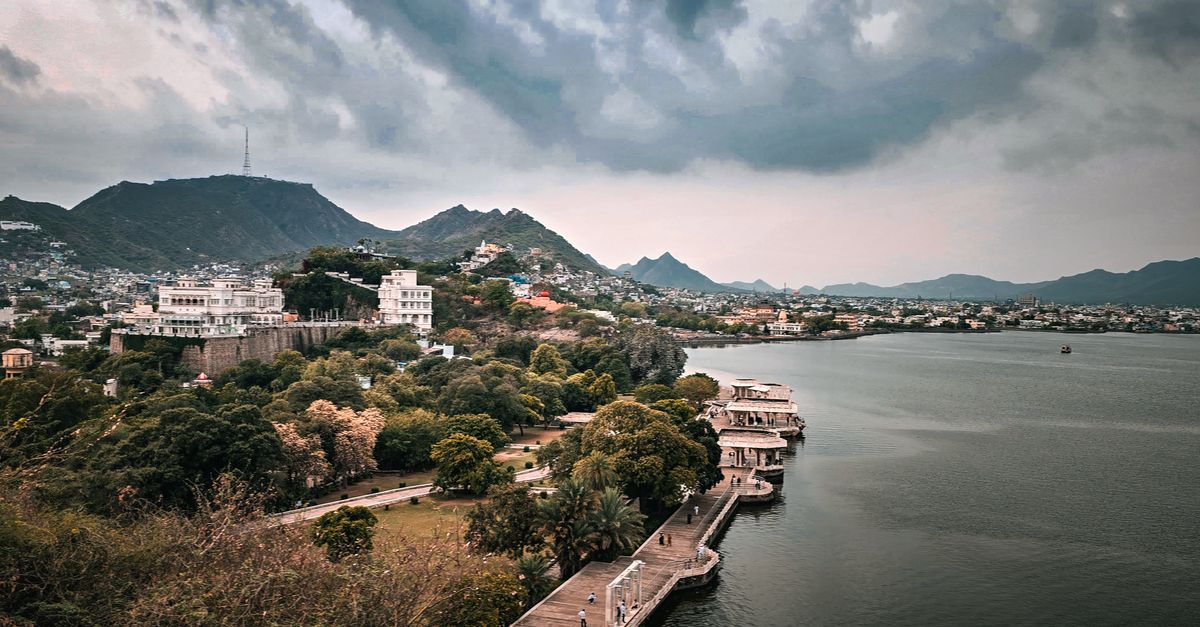
The famous view of Pichola Lake shows the City Palace and the Lake Palace from the eastern shore — from every rooftop restaurant, from every tourist boat, from every travel magazine. The opposite view — from the western shore looking back at the City Palace and the Udaipur skyline — is almost never photographed and requires a 25-minute walk or a short boat crossing to the Jag Mandir island and then a look eastward. This view, especially in the last 30 minutes before sunset, shows the City Palace as the Mewar kings saw it from the water.
The western shore of Pichola is accessible via the Ambrai Ghat area, past the Amet Haveli hotel, continuing south along the water's edge to where the path ends at a small fishermen's landing. From this point, looking northeast across the water, you see the full 400-metre facade of the City Palace reflected in the lake with the Sajjangarh hill and Monsoon Palace as the backdrop. It's one of the most compositionally perfect views in Rajasthan, entirely unmediated by tourist infrastructure.
Walk south from Gangaur Ghat along the lake edge, or take a boat to Jag Mandir island and look east from the island's east-facing marble terrace. The boat to Jag Mandir costs ₹550 for a 30-minute visit including the crossing, from the City Palace boat dock. Open daily 10 AM to 6 PM. Alternatively, the Ambrai Restaurant (on the western shore at Amet Haveli) has the exact view described above from its outdoor tables — ₹1,200 minimum spend, but the sunset thali is genuinely good.
The western shore at dusk sees local couples, families, and the occasional fisherman — not tourists. The light at 6:30 PM (winter) or 7:30 PM (summer) turns the City Palace facade to orange and the lake to copper. Photograph into the sun from this angle for silhouette shots, or turn 90 degrees to photograph the color in the sky and the reflection simultaneously. No flash, no drone, no tripod (the path is too narrow). This is handheld photography at golden hour, which is the best kind.


