
Tunis sits at the top of Africa with one eye on the Mediterranean and one on the Sahara, and its culture reflects that dual orientation with extraordinary richness. The city is home to the Medina of Tunis — UNESCO-listed and containing 700 monuments from the 8th to 19th centuries — but also to a French colonial Ville Nouvelle of grand boulevards, Art Nouveau apartment buildings, and café culture so deeply embedded that Tunisians consider it as authentically Tunisian as couscous.
Tunisia is the Arab world's most culturally accessible country for Western visitors: the society is secular, French is widely spoken, women travel independently without social difficulty, and the population's exposure to European tourism over five decades has created a welcoming openness without the tourist-fatigue that plagues more heavily visited destinations. The country's 2011 revolution — the spark that lit the Arab Spring — produced a democratic transition that has had its difficulties but maintains Tunisia's position as the most pluralistic society in the Arab world.
The Tunisian dinar (TND) makes Tunis extremely affordable. A full day of medina exploration, coffee at a café chantant, and a fish couscous dinner costs perhaps $15–20 USD. The Bardo Museum — one of the world's great Roman mosaic collections — charges TND 11 ($3.50 USD). These prices will not last; Tunis is very slowly being rediscovered by international tourism after a decade of security-driven absence.

1. The Bardo Museum's Roman Mosaics
The Bardo National Museum, housed in a former Ottoman palace in the western suburbs of Tunis, contains the world's largest collection of Roman-era mosaics — a collection so extraordinary that it makes the Roman mosaics in Rome, Pompeii, and anywhere else in the Mediterranean look modest by comparison. The collection reflects the fact that Roman North Africa (the provinces of Africa, Numidia, and Mauretania) was the wealthiest and most artistically productive part of the Roman Empire, and its wealthy landowners commissioned floor mosaics of size, complexity, and artistic ambition that have never been surpassed.
The centrepiece of the collection is the mosaic of Ulysses and the Sirens from the 3rd-century villa at Dougga — a room-sized panel depicting the homeward voyage of Odysseus, with the hero bound to the mast while his sailors row past the Sirens on a cliff, their fingers in their ears. The colour, the perspective, the characterisation of the figures — this is mosaic as high art, not floor covering. The adjacent Tiger Hunt mosaic from El-Jem, depicting a Roman arena hunt with tigers, leopards, and condemned criminals, is the finest sport mosaic in existence.
The Bardo is 4 km west of central Tunis, accessible by Metro Line 4 to Bardo station (TND 0.60) or taxi for TND 5–6. Entry costs TND 11 ($3.50 USD). Photography is permitted throughout. Open Tuesday to Sunday, 9 a.m. to 5 p.m. Allow 3 hours minimum; the collection is large and the labels are often inadequate without an audio guide (available at the entrance for TND 5). The palace architecture — 19th-century Ottoman with elaborate Tunisian tile and stucco — is itself worthy of significant attention.
The Bardo also contains significant collections of Islamic art, Punic (Carthaginian) artefacts, and prehistoric material that are easily overlooked in the rush to see the mosaics. The Islamic art galleries in particular — containing 9th–17th century ceramics, metalwork, and Quranic manuscripts from the great Zirid and Hafsid dynasties — represent a period of Tunisian cultural production that is almost entirely unknown outside North African historiography.
2. The Souk des Chéchias
Within the Tunis medina's labyrinth of specialised souks, the Souk des Chéchias is the most unusual: an entire market dedicated to the production and sale of the chéchia (chachiya) — the distinctive red felt cap that is simultaneously a Tunisian national symbol, a traditional Ottoman-era headgear, and an item of daily clothing for older Tunisian men. The souk is tucked away between the Great Mosque of the Zitouna and the perfume souk, and the workshops inside — occupying medieval stone rooms with low vaulted ceilings — have been producing chéchias since the 17th century.
The production process is elaborate: raw wool is washed, carded, spun, and woven into a basic cap form, then dyed red with cochineal (until the 1950s) or synthetic dye, shrunk by repeated boiling to achieve the correct density, shaped on wooden moulds, and finished by stretching and ironing. A skilled chéchia maker produces perhaps 20 caps per day; the finest quality pieces — dense, perfectly shaped, and a deep cherry red — take three days of production per cap and command TND 40–60 ($13–20 USD) in the souk.
The souk is open Saturday to Thursday from 8 a.m. to 5 p.m. Entry to the souk's working area requires asking permission from the souk master (sheik al-souk), a formality that is generally readily granted. Most craftsmen are elderly and deeply proud of their tradition; they welcome respectful observation and explanation of the process. Basic chéchias start at TND 10 ($3 USD); quality pieces up to TND 80. The chéchia is both a practical souvenir and a genuinely meaningful object connecting to centuries of Tunisian craft tradition.
Adjacent to the Chéchia souk, the Souk el-Attarine (perfume souk) sells locally produced rose water, orange blossom water, and traditional Tunisian attars (concentrated perfume oils) at a fraction of tourist-oriented perfume shop prices. A bottle of genuine Tunisian rose water (Nefta rose, the finest in North Africa) costs TND 5–8 ($1.60–2.60 USD) for 100ml. The perfume souk feeds directly into the spice souk (Souk des Épices) where cumin, caraway, harissa base, and dried rose petals are sold by weight.
3. Sidi Bou Said Village
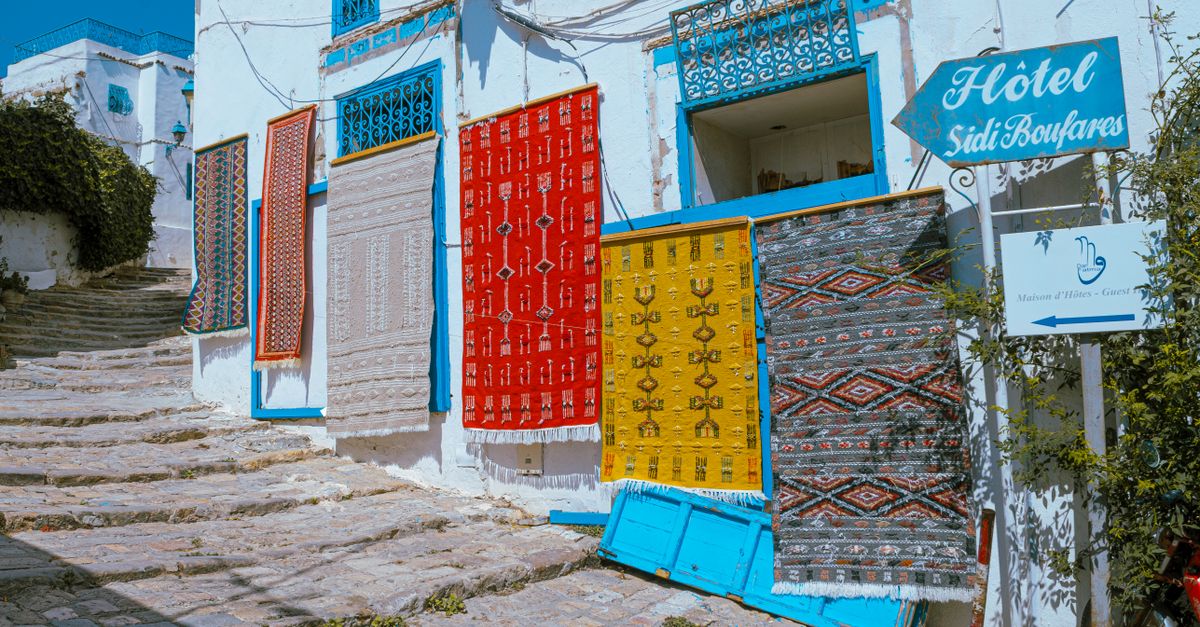
Perched on a coastal cliff 20 km northeast of Tunis, the village of Sidi Bou Said is one of the most photographed places in North Africa: an immaculate hilltop settlement of whitewashed houses with distinctive blue-painted doors, windows, and ironwork, overlooking the Gulf of Tunis and the ruins of ancient Carthage below. The strict blue-and-white colour regulation was established by the Baron Rodolphe d'Erlanger, a French aesthete who bought a house here in 1912 and obtained an official decree enforcing the colour scheme on the entire village.
The village was a gathering point for early 20th-century European artists and writers — Paul Klee, August Macke, Louis Moilliet, and André Gide all visited and found the quality of light extraordinary. Klee's Tunisian watercolours, painted during his 1914 visit to Sidi Bou Said and Tunis, are among the formative works of European modern art. The village maintains its artistic tradition through several active galleries and studios.
Take the TGM train from the Tunis Marine station to Sidi Bou Said (TND 1.40, 25 minutes). The train runs every 30 minutes from 6 a.m. to 10 p.m. The village is entirely walkable on arrival; the climb from the train station to the village centre takes 15 minutes uphill. The famous Café des Nattes — where tea is served on mat-covered platforms in a domed Ottoman structure — charges TND 8–10 per tea but provides the most atmospheric café experience in Tunisia. Arrive before 10 a.m. to avoid the day-tripper crowds.
The village's less-visited back lanes — away from the main tourist street running from the train station to the café — contain genuine Tunisian domestic architecture of extraordinary beauty: carved limestone lintels, domed rooftop terraces, bougainvillea cascading over whitewashed walls. Wander freely and follow the alleys downhill toward the port, where a small fishing harbour and the ruins of the Punic harbor of ancient Carthage are visible below the escarpment. A path leads from the village down to the archaeological zone of Carthage in 30 minutes.
4. Dougga Roman City Day Trip
One hundred kilometres southwest of Tunis, the UNESCO-listed Roman city of Dougga is considered the best-preserved Roman small city in North Africa — an extraordinary ensemble of temples, forum, theatre, baths, and private houses covering a hillside above the Tunisian Tell (the grain-growing highlands that made North Africa the breadbasket of the Roman Empire). Most visitors to Tunisia never make it to Dougga, which is inexplicable given its accessibility and quality.
The city's Capitolium — a temple of Jupiter, Juno, and Minerva built in 166 CE — is among the finest temple facades in the Roman world outside Rome itself. The three-storey theatre (seating 3,500, dating from 168–169 CE) is still used for summer festival performances. The circular funerary monument of Ateban — a 2nd-century BCE Numidian (pre-Roman) tower tomb — is one of the few surviving Numidian monuments in the Mediterranean and links the Roman city to the indigenous North African civilisation that preceded and coexisted with it.
Dougga is accessible by bus from Tunis Bab Saadoun bus station (TND 8, 2.5 hours) or by louage (shared taxi) from Bab Saadoun to Téboursouk (TND 10) and then local taxi to the site (TND 10 return). Hiring a private taxi from Tunis for a day trip costs approximately TND 120–150 ($40–50 USD) including waiting time — excellent value for the independence it provides. Entry to the site costs TND 8 ($2.60 USD). Open daily 8 a.m. to 7 p.m. in summer.
The walk through the site from the entrance to the theatre and back covers about 3 km of Roman streets, some of the original paving still visible, with views over the Tell highlands at each turn. The site is large enough to spread the moderate number of visitors across it effectively; even in summer it rarely feels crowded. Bring substantial water (1.5 litres minimum) and wear sun protection — the site has almost no shade and the Tell in summer is intensely hot between 11 a.m. and 3 p.m.
5. The Zitouna Mosque's View Terrace
The Great Mosque of Zitouna — Tunis's oldest mosque, founded in 732 CE — stands at the heart of the medina surrounded by the souk system that has serviced it for 1,300 years. Non-Muslims cannot enter the prayer hall, but access to the external gallery (riwaqs) surrounding the courtyard is available from the rooftop terrace of the adjacent Café Mrabet. The view down into the Zitouna's arcaded courtyard from this vantage point — the oldest columns in the medina, the minaret dating to the 9th century, the antique Roman columns repurposed into the mosque's hypostyle hall — is one of the finest views in any medina in the Maghreb.
The Café Mrabet terrace (on the roof of a former caravanserai, accessible from the souk through a doorway marked by a hand-painted sign) charges TND 3–5 for a mint tea and provides 30–40 minutes of terrace access. The atmosphere — cushioned benches, the sound of the souk below, the minaret across a narrow gap — is justifiably famous among travellers who have found it. Arrive before 10 a.m. or after 3 p.m. for a seat without waiting.
The Zitouna mosque's approach through the Souk des Étoffes (cloth souk) and Souk el-Trouk (Turkish souk) is itself a textural experience: silk and wool fabric in brilliant Tunisian colours (turquoise, saffron, deep rose), embroidered burnous capes, and the distinctive chechia caps worn by the older shopkeepers who have been trading in these alleys for decades. The souks around the Zitouna represent the most intact medieval Islamic commercial landscape in North Africa.
The Zitouna Library (adjacent to the mosque, accessible to researchers only) contains over 100,000 volumes and manuscripts, including manuscripts dating to the 9th century and an extraordinary collection of Andalusian-Moroccan and North African Islamic scholarship. The exterior reading room is occasionally open for viewings; ask at the mosque's administrative office. The library is the intellectual heritage of the Zitouna university tradition that was, for six centuries, the most important centre of Islamic scholarship west of Cairo.
6. El-Halfaouine Neighbourhood Market
El-Halfaouine is the medina's northern popular quarter — less tourist-oriented than the areas around Zitouna, more genuinely residential, and home to one of Tunis's most vivid local markets. The daily market on Souk el-Halfaouine sells vegetables, dried fruit, spices, and fresh meat at prices that reveal the medina's genuine function as a living commercial neighbourhood rather than a tourist attraction. The smells — cumin, fresh coriander, dried figs, the iron-sweet scent of the butcher stalls — are the medina's true sensory register.
The quarter gained international recognition from the 1990 Tunisian film "Halfaouine" (also known as "Boy of the Terraces") by Férid Boughedir — a coming-of-age story set in this neighbourhood that became a landmark of North African cinema and is still regularly screened at Tunisian film festivals. The hammam depicted in the film — Hammam Kachachine on Rue des Teinturiers — still operates and offers the traditional Tunisian hammam experience (steam room, kessa scrub, and rhassoul clay mask) for TND 10–15 ($3–5 USD).
El-Halfaouine is accessible from the medina's Bab Souika gate (accessible from the northern end of the medina's main axis) or by taxi from the Ville Nouvelle to Bab Souika (TND 3–4). The neighbourhood's café culture is completely local: men playing cards and smoking nargileh (hookah) on plastic chairs outside neighbourhood cafés, conversations in Tunisian Darija, and no tourist infrastructure whatsoever. A glass of tea costs TND 0.60; coffee TND 1.00.
The neighbourhood also contains Tunis's most important zaouia (Sufi lodge) dedicated to Sidi Mahrez — the 15th-century patron saint of Tunis — a domed structure of extraordinary beauty. The annual Moulid celebration at the Sidi Mahrez zaouia draws the neighbourhood's Sufi brotherhoods for all-night music and prayer sessions audible throughout the northern medina. Non-Muslims can observe from the exterior; the sound of the Sufi dhikr chanting, accompanied by drums and the Tunisian flute, is one of the medina's most atmospheric nocturnal experiences.
7. Café de Paris and the Art Nouveau Avenue
The Avenue Habib Bourguiba — Tunis's central boulevard — is the most European-looking street in North Africa: a tree-lined axis with outdoor café terraces, French-language bookshops, cinemas, and a general atmosphere of Mediterranean urbanity. The Café de Paris at the intersection with Rue de Marseille has been the nerve centre of Tunisian intellectual life since 1895 — Bourguiba himself was a regular before independence, and the Café remains the gathering point for journalists, politicians, artists, and academics who want to be seen being intellectually active in public.
The café's interior is Art Nouveau of the late belle époque: mirror panelling, curved wrought-iron chairs, terrazzo floors, and a ceiling of pressed tin that has been accumulating tobacco smoke since the Protectorate era. The coffee — brewed strong in the Italian manner, served with a glass of cold water — costs TND 2.50 ($0.80 USD). The terrace seats are prized; arrive before 9 a.m. on weekdays for a terrace spot with a view of the boulevard's morning theatre.
The surrounding blocks of the Ville Nouvelle preserve Art Nouveau and early Modernist apartment buildings from the 1890s–1920s that are comparable in quality to anything in Paris or Brussels. The facades of Rue de Grèce, Rue de Rome, and Rue d'Angleterre feature wrought-iron balconies, ceramic tile panels, and carved limestone ornamentation that French Protectorate architects imported wholesale from European pattern books and adapted to the Tunisian climate. A self-guided architectural walk covers 10 significant buildings within a 500-metre radius of Place de l'Indépendance.
The Ville Nouvelle's bookshop culture is the last significant French-language literary retail environment in North Africa. Librairie El Kitab on Avenue Habib Bourguiba and Librairie Clairefontaine on Rue Charles de Gaulle both carry comprehensive selections of Tunisian and North African literature in French translation — works by Tahar Haddad, Béchir Khraief, and the extraordinary Hélé Béji — alongside contemporary French publishing. A paperback costs TND 15–25 ($5–8 USD).
8. Carthage Archaeological Sites
The ancient city of Carthage — founded by Phoenician settlers from Tyre (in modern Lebanon) around 814 BCE and for three centuries the wealthiest and most powerful city in the western Mediterranean — is accessible by TGM train from Tunis in 25 minutes and contains a remarkable concentration of archaeological sites spread across the modern residential suburb that has grown over the ruins since the 7th century CE. The sites are individually modest compared to Dougga or Rome, but their historical weight — this is where Hannibal launched his elephant invasion of Italy, where the Third Punic War ended with Rome salting the earth — is extraordinary.
The Tophet (Sanctuary of Tanit and Baal Hammon) is the most historically charged and most debated site: a field of stelae (carved stone markers) above urns containing the cremated remains of infants and young animals. The ancient sources — and ongoing archaeological analysis — debate whether the Carthaginians engaged in child sacrifice or whether the tophet represents a special infant cemetery for children who died young. Standing among the thousands of stelae, each representing an individual burial, the debate becomes less academic and more personal.
The Punic harbours — the military and commercial ports of Carthage, recently excavated to reveal their original circular layout — are visible from the Byrsa Hill archaeological museum. The museum (TND 8 entry) is excellent on Punic civilisation and contains artefacts that contextualise the stelae in the tophet and the harbour layout below. A combined ticket (TND 20) covers the major Carthage sites: Tophet, Punic harbours, Roman baths of Antoninus Pius (some of the largest Roman baths outside Rome), theatre, villas, and museum.
The Roman baths of Antoninus Pius — completed in 162 CE and covering 35,000 square metres — are Carthage's most visually impressive ruins: enormous barrel-vaulted structures of concrete and brick, now with the sea behind them and seagulls nesting in the vaulted chambers. The baths were, for 200 years, the largest Roman bath complex in the world and the most opulent building in Roman North Africa. Even as ruins they communicate the sheer scale of Roman ambition in North Africa.
9. The Medina's Hidden Fondouks
The Tunis medina contains dozens of former fondouqs — the caravanserais that served as hotels, warehouses, and trading centres for merchants visiting the city from across the Islamic world. Several have been converted to craft schools, artisan workshops, and community cultural centres that are freely accessible but completely invisible from the street. Finding them requires either a knowledgeable guide or the willingness to follow any open wooden door set into an unremarkable medina wall.
The Fondouk el-Attarine near the perfume souk still operates as a workshop complex for silversmiths, leatherworkers, and embroiderers. The courtyard — arcaded on two levels with the upper level used for residential workshops — is one of the finest surviving medieval commercial interiors in North Africa. The craftsmen working here produce for both the local wholesale market and direct tourist sales; prices at the workshop door are 30–40% below the souk retail price for the same goods.
The Fondouk de la Laine (wool fondouk) near Bab Souika still trades in wool — both raw fleece and finished Tunisian handwoven blankets (mergoum) from the Gafsa region. The mergoum are one of Tunisia's finest traditional textiles: flat-woven geometric carpets in natural wool colours with supplementary dyed geometric figures, produced by Berber women's cooperatives in the Gafsa highlands. A medium mergoum costs TND 80–150 ($26–50 USD) at the fondouk direct, versus TND 200–400 in the tourist shops of the main souks.
A guided fondouk tour can be arranged through the ASDEAR association at 10 Rue Sidi Ben Arous (adjacent to the Zitouna mosque) for TND 40–60 per person. The tour visits five fondouqs in 2 hours, providing the historical context of the medieval Tunis economy — the city's position as a trading junction between sub-Saharan gold routes and Mediterranean commerce — that transforms the fondouqs from interesting courtyards into comprehensible pieces of a global trade network.
10. El-Abidine Mosque and the Medina Rooftop Walk
For those willing to ask politely and tip generously, the rooftops of the Tunis medina provide one of North Africa's least-visited panoramic experiences. Several of the medina's riad hotels and a handful of the larger fondouqs have rooftop terraces accessible to non-guests in the late afternoon. The view — a sea of whitewashed domes, green-tiled minarets, the pale gold stone of the Zitouna mosque, and (on clear days) the Gulf of Tunis and Cap Bon peninsula in the distance — is extraordinary and almost entirely absent from tourist photography of Tunis.
The Riad Dar Said (on Rue Sidi Ben Arous) has the best non-guest rooftop access — ask at the reception desk and offer TND 10–15 for access during the afternoon hours. The terrace level at Café Mrabet (above the Zitouna souk) provides a lower but equally evocative view into the medina's commercial heart. Both can be visited in a single afternoon walk of about 90 minutes.
The medina rooftop perspective reveals the city's planning logic clearly: the great mosque at the centre, the specialised souks radiating from it in concentric rings (silk closest to the mosque, then gold, then spices, then meat, then vegetables — in decreasing order of social prestige), and the residential quarters filling the spaces between. This centripetal organisation — everything orbiting the mosque as its cultural and commercial anchor — is the defining spatial logic of the Islamic city and is nowhere more legible than from the Tunis medina rooftops.
The adjacent Kasbah Mosque and Palace complex — the governmental centre of the medieval Hafsid dynasty that made Tunis one of the wealthiest cities in the 14th-century Mediterranean world — is accessible for exterior views from Rue de la Kasbah. The minaret of the Kasbah mosque (1233 CE) is considered the finest Almohad minaret in North Africa and the model on which the Giralda in Seville (built by the same dynasty) was based — making it a direct ancestor of Seville's iconic tower and, by extension, of the bell tower of the New York Municipal Building.


