Kunming is the gateway to Yunnan — China's most biodiverse province, where the altitude ranges from tropical river valleys to alpine meadows above 4,000 meters, and where sixteen officially recognized ethnic minority groups have developed food cultures as distinct from each other as they are from the Han Chinese mainstream. The city itself sits at 1,900 meters on the Yunnan Plateau, in a climate so mild that flowers bloom year-round, earning it the nickname "Spring City." That eternal spring produces vegetables, mushrooms, and dairy products that are unlike anything in the rest of China.
What makes Kunming's food extraordinary is the convergence of multiple culinary traditions in a single city. The Dai people bring Southeast Asian-influenced cooking with fresh herbs and river fish. The Bai people produce goat cheese that is the only significant dairy cheese tradition in China. The Yi people contribute an intensely spiced cooking style that uses Sichuan pepper and dried chilies in ways that differ from neighboring Sichuan Province. And the Han population that settled the plateau from southern China brought a noodle culture — anchored by the famous Crossing the Bridge Noodles — that has evolved into something specifically Yunnan over four centuries.
The best way to understand Kunming's food is to understand that everything here grows at altitude and that altitude changes flavor. The mushrooms that emerge after rain in Yunnan's pine and oak forests taste like no mushrooms anywhere else. The goat that grazes on alpine herbs produces milk and cheese with a complexity that lowland dairy cannot approach. The rice noodles made from Yunnan's specific rice varieties have a texture and flavor profile distinct from the southeastern China rice noodle standard. Come attentive to specificity — the pleasure here is in the details that distinguish Yunnan from everywhere else.
10 Must-Try Dishes in Kunming
1. Crossing the Bridge Noodles (过桥米线 — Guòqiáo Mǐxiàn)
Crossing the Bridge Noodles (过桥米线) is Yunnan's most famous dish and one of the most theatrical eating experiences in Chinese food culture. A large bowl of piping-hot, intensely flavored chicken and pork bone broth — sealed under a thin layer of chicken fat that maintains the temperature for extraordinary lengths of time — arrives at the table. Alongside it come separate plates of raw thinly-sliced pork and chicken, rice noodles, vegetables, mushrooms, and various garnishes. You add the ingredients to the hot broth in a specific sequence, and the retained heat cooks everything perfectly as it is added.
The origin story involves a scholar studying on an island, his wife crossing a bridge each day to bring him food. By the time she crossed, the noodles were cold. She discovered that the fat layer on the broth kept it hotter for longer, allowing ingredients added later to cook in the retained heat. Whether historically accurate or not, the technique is genuinely ingenious: the fat layer prevents heat loss from the broth's surface, keeping the temperature above 80°C for long enough to cook paper-thin meat slices in seconds and produce perfectly textured noodles when added last.
The best Crossing the Bridge Noodles in Kunming is at Jianxin Guanqiao Mixian near Nanping Street — a restaurant that has been serving the dish since the 1950s in a setting that has barely changed. Yuansheng Guanqiao Mixian near the Yunnan University campus serves a university-neighborhood version that is excellent quality at accessible prices because its customer base is students and academics rather than tourists. The dish appears everywhere in Kunming, but the quality of the broth — which requires hours of simmering pork and chicken bones — is the decisive variable.
Crossing the Bridge Noodles costs CNY 20–80 per person depending on the number and quality of ingredients provided. The base version (25–35 CNY) provides adequate quantities for a meal; the premium version (60–80 CNY) includes more expensive ingredients like quail eggs, fresh mushrooms, and premium-cut meats. The order of adding ingredients to the broth matters — begin with the meat (which needs the highest temperature to cook), then the egg if included, then the mushrooms and vegetables, then the noodles last. Instructions are typically provided on a card or by the server.
2. Steam Pot Chicken (汽锅鸡 — Qìguō Jī)
Steam pot chicken (汽锅鸡) is Yunnan's most sophisticated technique-forward dish — a whole chicken slowly steamed in a specially designed earthenware pot (qìguō) with a central chimney that channels rising steam from below through the food, cooking the chicken from both outside and within simultaneously. The result is a chicken broth of extraordinary clarity and intensity, with a cooked chicken that is simultaneously firm and moist, and the specific mineral flavor from the steam-cooking process that no other technique replicates.
The qìguō pot is a Yunnan-specific ceramic piece — a round clay vessel with a conical chimney rising from the center of the base. Water is placed in a separate pot below; as it boils, steam rises through the chimney into the cooking vessel, gradually accumulating as a rich broth as the steam condenses on the chicken pieces and falls back. No water is added to the cooking vessel itself — the entire broth comes from condensed steam and the chicken's own released juices. The process takes two to four hours and produces a broth of remarkable purity.
The area around Jintang Street in central Kunming has been the traditional location for steam pot chicken restaurants for decades. Juju Steam Pot Chicken near Nanping Street is one of the city's most respected; Cloud Yun Restaurant serves an upscale version with the addition of precious Yunnan mushrooms including Matsutake (松茸, sōng róng) that elevates the broth's complexity significantly. Some versions incorporate Chinese herbal medicine additions (astragalus, codonopsis) for a health-focused preparation that is simultaneously excellent eating.
Steam pot chicken costs CNY 80–200 per pot (serves two) depending on size and added ingredients. The Matsutake mushroom addition costs significantly more (CNY 300–500+ per pot) because Matsutake is among the world's most expensive fungi and Yunnan is the primary source for the Chinese market. The basic version without premium mushrooms is excellent by any standard and the better introduction if you are tasting the technique for the first time.
3. Yunnan Goat Cheese (Rubing / 乳饼)
Yunnan's goat cheese — rubing (乳饼, literally "milk cake") — is one of the most remarkable facts of Chinese culinary culture: a fresh, high-moisture cheese made from goat or cow milk that can be sliced, cubed, and fried, grilled, or eaten fresh, representing one of the only significant dairy cheese traditions in Chinese cooking. The Yunnan plateau's Hui Muslim community and the Bai ethnic minority both maintain cheese-making traditions that date back centuries, producing a fresh curd cheese with a mild, slightly tangy flavor and a firm, sliceable texture.
Rubing has a higher moisture content than Indian paneer but a similar texture and cooking behavior — it does not melt when fried or grilled, making it ideal for the high-heat applications it typically receives. The most common preparation is sliced thick and pan-fried or deep-fried until the exterior crisps to a golden crust while the interior remains soft and mild, served with chili salt or a spiced dipping sauce. The Bai version, found in the Dali area and in Kunming restaurants serving Bai cuisine, is made with raw local goat milk and has a more complex, more aged character than the fresher cow milk version.
Rubing appears at night market food stalls throughout Kunming — fried on a flat griddle with salt, dried chili, and cumin as a street snack, sold by vendors in the Nanping Street and Dongfeng Road night market areas. For the most refined version incorporating rubing into a full Bai cuisine meal, the Yunnan restaurant Bai Cuisine in the Wuhua District uses cheese from highland producers in the Dali region. The freshest and most artisanal rubing is found at the morning markets near Cuihu Lake, where highland farmers bring their weekly production on Tuesday and Saturday mornings.
Fried rubing at a street stall costs CNY 8–20 per serving. Rubing as an ingredient in a restaurant meal appears within the dish price. Fresh uncooked rubing at a market costs CNY 20–40 per 200g block. The fried version is the most accessible introduction — the crispy exterior and mild interior make it easy to understand, and the chili-salt seasoning that accompanies it at most street stalls adds an appropriate contrast. Eat it immediately from the griddle.
4. Yunnan Wild Mushrooms (野生菌 — Yěshēng Jūn)
Yunnan Province produces more edible mushroom species than any other region in Asia — over 800 species have been documented in the province's forests, and approximately 250 of them are regularly consumed. The mushroom season from June to September is when Kunming's food culture reaches its annual peak: fresh boletus, chanterelles, porcini equivalents, milk caps, and the legendary and extremely valuable Matsutake and truffle species arrive at markets and restaurants, and the city effectively reorganizes its eating around the availability of the season's finest fungi.
The most important Yunnan mushrooms: Jian Shou Qing (见手青) — a striking blue-bruising boletus with extraordinary flavor and mild toxicity when raw that requires cooking to neutralize but produces a distinctly nutty, rich result; Ganba Jun (干巴菌) — a fibrous, intensely savory mushroom unique to Yunnan's pine forests with a dried meat-like texture and flavor; and Matsutake (松茸, sōng róng) — the most prized and expensive, with a distinctive spice-and-seafood aroma that the Japanese compare to the finest dashi stock. Each species has a specific optimal preparation that Kunming's best mushroom restaurants have mastered over generations.
The Golden Bridge Mushroom Market near the Xiaoximen bus station is Kunming's specialized mushroom wholesale and retail market, operating at peak capacity during mushroom season with hundreds of vendors selling fresh specimens from across the province. Adjacent restaurants cook the day's market purchase to order. Yunnan Yi Xiu restaurant in the Wuhua District is considered the finest address for upscale mushroom cooking in the city — their mushroom tasting menu during the June–September season uses fifteen to twenty species and is among the most fascinating eating experiences in Chinese cuisine.
Mushroom dishes at local restaurants cost CNY 30–80 per portion for common species. Matsutake preparations cost CNY 200–500+ due to the ingredient's extraordinary market price. Fresh mushrooms at the market in season cost CNY 10–80 per 100g depending on species, with the rare varieties commanding extraordinary premiums. Eating the full mushroom tasting menu at a premium restaurant during peak season (July–August) costs CNY 400–800 per person and represents one of the most genuinely exceptional Chinese food experiences available to visitors.
5. Erkuai (饵块 — Rice Cake)
Erkuai (饵块) is Yunnan's version of rice cake — glutinous rice that has been cooked, pounded into a smooth, elastic mass, and formed into cylindrical shapes or flat sheets. It can be grilled directly over charcoal, stir-fried with vegetables, sliced into soups, or eaten as a street snack with various sauces and toppings. The texture is simultaneously chewy and slightly springy — more elastic than the Japanese mochi it superficially resembles, less sticky, and with a nuttier flavor from the specific Yunnan short-grain rice varieties used.
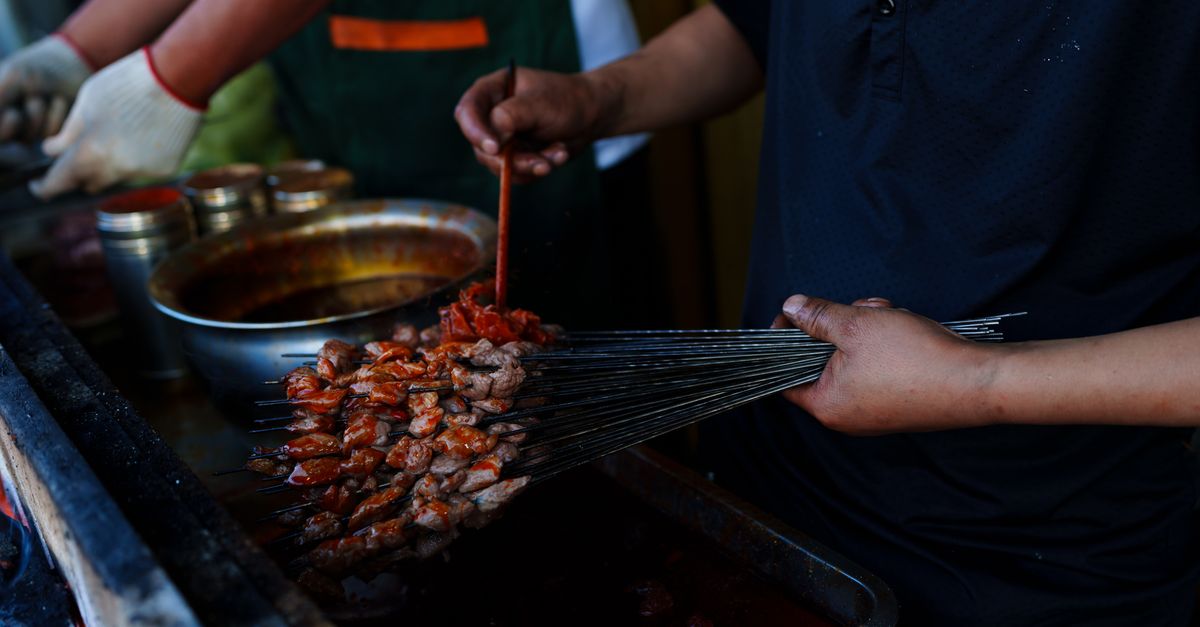
The most popular erkuai preparation is grilled on an open charcoal grill until the exterior forms a browned, slightly charred crust while the interior remains soft and yielding, then brushed with a sauce of fermented chili bean paste, sesame oil, and soy sauce. This preparation — erkuai kaosao (饵块烤烧) — is a defining street food experience in Kunming and appears at markets and food streets throughout the city from breakfast time through late night. The smell of rice cake crisping on charcoal is as characteristic of Kunming's streets as the smell of pine resin is of the surrounding forests.
Erkuai vendors operate throughout Kunming's food streets. The night market on Jinma Biji Square in the old city has multiple erkuai grilling stations. The morning market at Xiaoximen has vendors selling erkuai alongside other Yunnan breakfast items for the early-morning working crowd. For the more refined version of erkuai in a restaurant setting, erkuai rice cake incorporated into a traditional Yunnan soup (米线, noodle soup) appears at local restaurants as a daily staple.
Grilled erkuai costs CNY 5–15 per piece at street stalls. Erkuai as a soup component adds CNY 3–5 to the base noodle price. Fresh erkuai at markets costs CNY 5–10 per block. The chili sauce that accompanies grilled erkuai is the preparation's most critical element — the fermented chili paste's complexity and the balance of sesame oil are what distinguish an excellent erkuai from a mediocre one. Do not eat erkuai without its sauce.
6. Across the Bridge Noodle (米线 — Mǐxiàn, Various Preparations)
Beyond the famous Crossing the Bridge Noodles, Yunnan's rice noodle (米线, mǐxiàn) culture is extraordinarily deep — the province has multiple distinct rice noodle soup traditions beyond the famous one, including: jianer mixian (甲板米线 — a breakfast noodle with light pork and mushroom broth); xiaoguo mixian (小锅米线 — a single-serving pot of rice noodles cooked to order in a clay pot over high heat with fresh vegetables and pork); and ganban mixian (干拌米线 — dry-dressed rice noodles tossed with sesame paste, chili oil, and peanuts without broth).
The xiaoguo mixian (小锅米线) is arguably more representative of daily Kunming eating than the more famous Crossing the Bridge preparation. The single-serving clay pot is brought directly to your table still on a portable stove ring, bubbling with fresh rice noodles in a pork and vegetable broth. The cooking continues at the table for another minute or two until the noodles are perfectly done. This preparation retains all the freshness and temperature that the shared hot broth technique attempts to achieve — and it is what most Kunming residents eat for breakfast before going to work.
Xiaoguo mixian is found at the local noodle shops (米线店) distributed throughout every neighborhood in Kunming. Unlike the tourist-facing Crossing the Bridge restaurants, these local noodle shops cater to residents and open from 6am. The best ones are always full of locals at 7–8am and have cleared out by 10am. The street behind Yunnan University near the south gate has several decades-old xiaoguo mixian shops that have been serving students and residents continuously.
Xiaoguo mixian costs CNY 8–20 at local noodle shops. The price reflects the size of the clay pot and the number of added toppings. The base version with rice noodles, pork, and vegetables in broth costs CNY 8–12 and is a complete breakfast or lunch. Add an egg (加蛋, jiā dàn) for CNY 2–3. The cooking time at your table is not optional — arrive at the noodle shop prepared to eat immediately once your pot arrives, not to photograph it while it cools.
7. Yunnan Ham (云腿 — Yúntuǐ)
Yunnan ham (云腿, yúntuǐ) — particularly Xuanwei ham (宣威火腿) from Xuanwei County in northeastern Yunnan — is considered one of the finest cured hams in China and draws comparisons to Prosciutto di Parma and Iberian jamón in international food writing. The pigs raised in the cool, high-altitude climate of Yunnan produce a meat with a specific fat content and texture; the curing process using salt and the cold, dry mountain air of winter produces an intensely flavored, beautifully marbled ham that keeps indefinitely and provides concentrated umami to every preparation it enters.
Yunnan ham appears in dozens of applications throughout Kunming's cooking: sliced thin as part of a cold platter, stir-fried with vegetables, used to season soups and broths where a piece of ham bone adds depth that no other ingredient can match, and in the famous "ham and pea" (云腿豌豆) combination where the cured ham's salt and fat renders into fresh peas, producing a dish of absolute simplicity and remarkable flavor. The ham sold at Kunming's markets in whole legs or in prepared slices is a standard food souvenir for Yunnan visitors.
Yunnan ham is sold at every significant market in Kunming. The large market at Xiaoximen has dedicated ham vendors selling whole legs and prepared slices. Restaurants throughout the city use it as a seasoning ingredient in soups, noodles, and vegetable dishes — asking which dishes use Yunnan ham gives you a map to the kitchen's most flavor-dense preparations. Yunnan Yi Xiu restaurant uses premium Xuanwei ham as a featured ingredient in their traditional dishes.
Sliced Yunnan ham at a market costs CNY 40–80 per 100g depending on age and grade. A whole leg (8–15kg) costs CNY 500–2,000 — significant as a souvenir but completely practical in the kitchen for months. Dishes featuring Yunnan ham at restaurants typically cost CNY 30–60 depending on ham quantity. The ham is meant to be a seasoning presence rather than the primary protein — use small quantities in vegetable dishes and soups rather than treating it as a meat course.
8. Yunnan Dai Cuisine (傣族菜 — Dǎizú Cài)
The Dai ethnic minority's cooking tradition represents the most Southeast Asian influence in Yunnan's food — a cuisine built on fresh lemongrass, galangal, fresh turmeric, banana leaves, river fish, and tropical vegetables that mirrors northern Thai and Burmese cooking traditions while remaining distinctly Yunnan in its specific ingredient and technique combinations. Dai cuisine arrives in Kunming through the migration of Dai community members from the Xishuangbanna region in southern Yunnan, and the restaurants they operate are among the city's most distinctive and most flavorful.
Key Dai preparations: banana blossom salad (凉拌芭蕉花, liángbàn bājiāo huā) — the inner sections of fresh banana blossoms tossed with lime, fresh herbs, ground pork, and chili in a preparation that resembles Thai yam (salad) techniques; baked fish in banana leaf (香茅烤鱼, xiāngmáo kǎo yú) — whole fish marinated with lemongrass, ginger, and fresh herbs wrapped in banana leaf and baked or grilled; and fresh herb and vegetable platters that accompany virtually every Dai meal, providing the raw counterbalance to the cooked dishes' richness.
Dai cuisine restaurants in Kunming are concentrated near the university area and in the ethnic minority restaurant strip near the Yunnan Nationalities Museum. Mengsha Dai Restaurant in the Wuhua District is one of the city's most respected Dai cuisine addresses — the owner is from Xishuangbanna and sources ingredients from her home region. The riverside Dai restaurant district along Panlong River has a more casual atmosphere with outdoor seating and a menu that emphasizes grilled and banana-leaf preparations.
Dai cuisine at a restaurant costs CNY 30–80 per shared dish. A full Dai meal for two with four dishes and rice costs CNY 120–200. The fresh herb platter (usually included as complimentary or CNY 10–20 extra) is not optional — the raw herbs, including fresh peppercorn branches, lemongrass, and Thai basil, provide the fresh contrast that Dai cuisine requires for its full flavor range to be expressed. Do not skip it because the herbs look unfamiliar.
9. Yunnan Coffee (云南咖啡)
Yunnan Province is China's only significant coffee-producing region — a fact that surprises visitors who associate China entirely with tea culture. Arabica coffee grown in the high-altitude valleys of Baoshan, Pu'er, and Xishuangbanna at elevations between 1,000–2,000 meters produces beans with a distinctive flavor profile: low acidity, medium body, smooth finish, and flavor notes of chocolate, caramel, and a faint earthiness from the red volcanic soil. Yunnan coffee has been exported to major international roasters for years as a lower-cost alternative to East African and Central American arabica.
The coffee culture in Kunming has developed rapidly over the last decade, building on the quality of local beans while incorporating global third-wave roasting and brewing approaches. Third-wave cafés in the Wuhua District and around Yunnan University campus use locally sourced Yunnan arabica roasted in-house, served as pour-over, cold brew, and espresso preparations that allow the bean's specific flavor character to express clearly. The best Yunnan coffee roasters also export to Japan and Korea, where the coffee has developed a following among specialty buyers.
Coffee in Kunming occupies an interesting cultural space — consumed by young urban residents as a modern lifestyle drink rather than as a traditional beverage, it has developed alongside Yunnan's existing pu'er tea culture rather than displacing it. The coffee bars near Cuihu Lake and in the arts district near Wuchuanhe Park are the best concentration. For the most educational experience, several cafés offer Yunnan coffee origin tastings where multiple cultivars and processing methods are compared side by side.
A specialty single-origin Yunnan coffee costs CNY 30–55 at third-wave cafés. Yunnan coffee beans for home purchase cost CNY 80–200 per 100g for specialty roasted beans. Fresh green (unroasted) beans cost significantly less at production farms. The pu'er tea and Yunnan coffee combination — alternating between the two on successive mornings — provides one of the most interesting flavor-landscape explorations available in a single Chinese city.
10. Pu'er Tea (普洱茶)
Pu'er tea — the post-fermented aged tea produced in Yunnan's ancient tea forests — is among the most complex and fascinating beverages in the world, and Kunming is both the main distribution market and the premier tasting and buying destination for this category. Pu'er is produced in two main styles: sheng (raw, green) pu'er that ages slowly over years to decades, developing increasing complexity; and shou (ripe, cooked) pu'er that undergoes accelerated fermentation and produces a dark, earthy, full-bodied tea immediately available for drinking. Both styles have sophisticated producer-vintage-terroir parameters that parallel fine wine culture in their depth.
The experience of drinking old pu'er from a specific mountain (Lao Banzhang, Yi Wu, and Jing Mai are Yunnan's most revered tea mountains) is genuinely revelatory — a twenty-year-old sheng pu'er from Lao Banzhang has a depth and complexity that accumulates in the body over multiple infusions of the same leaves, changing flavor with each pour in a way no other beverage category manages. Young sheng pu'er is pleasantly bitter and grassy; medium-aged sheng develops stone fruit and incense notes; old sheng achieves a earthiness and complexity that connoisseurs spend significant money accessing.
The pu'er tea market in Kunming is centered on the Juhua Village tea market (菊花村茶叶市场) in the Panlong District — the largest tea wholesale market in Yunnan, where hundreds of vendors sell everything from cheap shou pu'er bricks for daily drinking to extraordinarily valuable aged single-mountain cakes that cost more than premium Burgundy by weight. The vendors are overwhelmingly knowledgeable and will spend significant time guiding serious buyers through their selection. Approach with curiosity and patience rather than a purchasing agenda.
A session of pu'er tea tasting at a reputable Kunming tea shop costs CNY 50–150 per person for the time and tea provided, though many shops offer this complimentarily to serious potential buyers. A compressed pu'er tea cake (357g standard size) ranges from CNY 30 for young factory shou pu'er to CNY 500–5,000+ for aged single-mountain sheng from celebrated producers. Buying pu'er requires some knowledge to avoid overpaying for fake "aged" tea — an introduction through a trusted local guide or established tea shop is the appropriate approach for first-time buyers.

Kunming's Essential Food Neighborhoods
Nanping Street and Dongfeng Road (南屏街/东风路): The city's main commercial pedestrian area and the highest concentration of restaurants, street food stalls, and food-oriented shopping. The Crossing the Bridge Noodles restaurants that tourists seek are concentrated here, alongside xiaoguo mixian shops, erkuai street vendors, and the specialty shops selling Yunnan ham, dried mushrooms, and pu'er tea. The night market atmosphere from 6–10pm is excellent.
Yunnan University Area (云南大学周边): The university district south of Wenlin Street has the most creative and authentic food scene for daily eating — student-budget restaurants with excellent local food, third-wave coffee shops, Dai cuisine restaurants, and the unpretentious local noodle shops that represent Kunming's baseline eating standard. The Wenlin Street café culture and the food streets behind the university are worth an afternoon of dedicated wandering.
Xiaoximen Market and Surrounding Streets: The wholesale market area around the Xiaoximen bus terminal has Kunming's densest concentration of traditional food markets — the mushroom market, the vegetable markets, the meat and fish sections — along with the adjacent restaurants that serve market workers and early-rising locals. This is where the cooking supply chain is most visible and where the best xiaoguo mixian and erkuai breakfast is found at 7am.
Practical Eating Tips for Kunming
Budget guidance: Kunming is excellent value for food. A xiaoguo mixian breakfast costs CNY 8–20. A lunch at a local Yunnan restaurant costs CNY 40–80 for two. A mushroom hot pot dinner for two during season costs CNY 150–300 at a specialist restaurant. The full steam pot chicken for two costs CNY 100–200 depending on added ingredients. Total daily food spend for enthusiastic eating is CNY 100–200 per person — roughly USD 15–28, which is exceptional value for the quality and variety.
Dietary accommodations: Kunming's Chinese Han and ethnic minority food cultures are generally meat-forward, but the exceptional vegetable and mushroom variety of the region makes vegetarian eating genuinely excellent rather than a compromise. Buddhist vegetarian restaurants are present throughout the city; ethnic minority restaurants that emphasize vegetable and mushroom preparations (Dai, Bai, Yi cuisines) are excellent vegetarian options. Request "no meat" (不要肉, bù yào ròu) and most local restaurants will accommodate with a genuinely good resulting meal.
Getting around the food scene: Kunming's food culture is distributed across several distinct neighborhoods. The metro system (地铁, dìtiě) connects the main food districts efficiently. The Nanping Street area is at Dongfeng Square Station; the university district is at Yunnan University Station; the market areas at Xiaoximen Station. A food-focused day in Kunming should include two to three metro rides to capture the full range from tourist-facing restaurant culture to local morning market eating to student-neighborhood evening dining.