
Colmar is Alsace in miniature — a perfectly preserved medieval and Renaissance city of half-timbered houses, canal-threaded neighborhoods, and flower-draped windowsills that looks impossible even when you are standing in it. It is also one of the most important food cities in France: the gateway to the Route des Vins d'Alsace, the hometown of Paul Bocuse's childhood hero Fernand Point, and a city that takes the Alsatian table — an already magnificent tradition — with extraordinary seriousness. The food here is the product of a borderland: French technique and sensibility applied to German ingredients and comfort-food instincts, producing a cuisine that is simultaneously rich, refined, and deeply satisfying.
Alsace changed hands between France and Germany four times between 1871 and 1945, and every exchange left its mark on the food. Choucroute (sauerkraut with pork) is French by nationality and German by instinct. Tarte flambée (flammekueche in Alsatian dialect) looks like pizza and tastes like northern France and the Rhine plain simultaneously. Kugelhopf is a yeast cake with Austrian grandparents and French citizenship. The wines — Riesling, Gewurztraminer, Pinot Gris — are categorically Alsatian, grown on the granite and limestone slopes of the Vosges foothills, classifiable nowhere else on earth.
To eat and drink in Colmar is to experience a food culture that has survived, adapted, and deepened through centuries of historical turbulence, emerging with an identity so distinctive and so confident that it requires no explanation. This is not French-German fusion. This is Alsace, and nothing else is quite like it.

10 Must-Try Dishes in Colmar
1. Tarte Flambée (Flammekueche)
Tarte flambée is one of the simplest and most perfect dishes in French regional cuisine — a thin sheet of bread dough (unleavened, almost like a stretched and rolled pizza base, but thinner and more cracker-like), spread with fromage blanc or crème fraîche, topped with thinly sliced raw onions and lardons (smoked bacon), and baked in a wood-fired oven at extremely high temperature (400°C+) for about 3–4 minutes until the edges char, the onions soften and caramelize slightly, and the cream topping bubbles and sets. It is the dish of the Alsatian winegrower — traditionally eaten at harvest time, cooked in the bread oven after the bread was withdrawn, when the oven was at maximum heat.
The name "tarte flambée" (flaming tart) refers to the way the high oven temperature causes the edges to char and sometimes flame briefly, which is the correct and desired result. The Alsatian dialect name flammekueche means the same thing. The dough must be thin — so thin it can be carried on a large wooden paddle — and it must char at the edges while remaining slightly supple in the center. Overcooked tarte flambée is dry and cardboard-like; perfectly cooked, it has the same relationship with pizza that a cracker has with bread: thinner, crispier, more direct, and utterly delicious.
The best tarte flambée in Colmar is at Winstub Brenner (1 Rue Turenne) — a traditional Alsatian winstub in a 16th-century building where the wood-fired oven produces excellent flammekueche from a recipe unchanged for decades. Also outstanding at Chez Hansi (23 Rue des Marchands) and at Zum Christoph in the old town, both of which maintain traditional tarte flambée preparation. The evening winstub tradition is to order one classic (fromage blanc, onion, lardons), eat it communally at a long table, then order variations — cheese, mushroom, spätzle.
A tarte flambée costs €12–18, serving 1–2 people as a main course. Pair with Sylvaner d'Alsace — the lightest of the Alsatian white wines, fresh, slightly mineral, with low alcohol and a clean finish that makes it the traditional tarte flambée wine. Alternatively, a glass of local Pinot Blanc is excellent. Do not order red wine with tarte flambée; the Alsatian whites are the only appropriate accompaniment.
2. Choucroute Garnie
Choucroute garnie — garnished sauerkraut — is Alsace's great one-pot feast and one of the most important dishes in the French culinary tradition, despite (or because of) its unmistakably German character. Fermented white cabbage (choucroute/Sauerkraut) is cooked slowly in dry Riesling with Goose fat, juniper berries, bay leaves, and caraway seeds until it becomes golden, silky, and deeply flavored — neither the raw-sharp tang of uncooked sauerkraut nor the insipid softness of poorly cooked versions, but a precise, aromatic middle ground. It is served "garnished" with an extravagant variety of pork: smoked pork belly (poitrine fumée), Strasbourg sausages (Würste), Montbéliard sausages, white sausages (boudin blanc), and sometimes a salted knuckle (jambonneau) — all arranged atop the sauerkraut mountain with boiled potatoes alongside.
The quality of a choucroute garnie depends on three things: the quality of the choucroute itself (good Alsatian choucroute is lacto-fermented in large barrels from local white cabbage, finely shredded, with a clean, lactic tang — avoid any version that tastes of vinegar or brine rather than fermentation), the quality of the pork (Alsatian smoked sausages and pork belly from local butchers are the standard; inferior versions use commercial charcuterie), and the patience of the cooking (a minimum of 1.5–2 hours of slow braising in Riesling).
The finest choucroute garnie in Colmar is served at Winstub Brenner (1 Rue Turenne) and at Restaurant JY'S (17 Rue de la Poissonnerie) — Jean-Yves Schillinger's sophisticated version that maintains tradition while adding refinement. For the most traditional, no-frills version, try Winstub la Petite Venise on Rue de la Poissonnerie, which serves a generous, properly cooked choucroute at honest winstub prices.
Expect to pay €22–36 per person. Pair with Riesling Grand Cru from a Colmar-area producer — Riesling is the traditional choucroute wine and provides the crucial acidity to cut through the richness of the pork. Domaine Weinbach in Kaysersberg (15 minutes from Colmar) or Hugel in Riquewihr are benchmark producers. The pairing of choucroute with Alsatian Riesling is one of the great regional wine-food combinations in the world.
3. Baeckeoffe
Baeckeoffe is the great slow-braise of Alsatian cuisine and one of the most satisfying dishes of cold-weather French cooking. Three meats — pork, lamb, and beef — are marinated overnight in white wine, onions, garlic, leeks, and bouquet garni, then layered with thinly sliced potatoes in a special sealed terrine (the baeckeoffe pot), sealed with a strip of flour-and-water paste to trap the steam, and slow-cooked for 2–3 hours in a moderate oven. The result is a dish in which each ingredient maintains its character while all combine into a deeply harmonious whole: the meats tender and wine-perfumed, the potatoes absorbed with the braising liquid, the vegetables sweetened by the long cooking.
The name means "baker's oven" in Alsatian — the dish was traditionally taken to the village baker on Monday morning (laundry day, when women were occupied) to cook slowly in the bread oven throughout the day, collected at lunchtime. This practical origin explains the sealed terrine and the long, unattended cooking: it was designed to cook without supervision. The flour seal is broken at the table, dramatically releasing the aromatic steam. Some winstubs still maintain this theatrical presentation.
Baeckeoffe is on the menu at traditional Colmar winstubs — try Winstub Flory (1 Rue des Augustins) or Winstub Brenner. It must be ordered 24 hours in advance at some establishments because of the overnight marinade requirement — call ahead. The version at Brenner, using local Alsatian pork and lamb from nearby farms, is particularly fine.
Costs €24–38. Pair with Pinot Gris Grand Cru from the Colmar area — the full-bodied, slightly smoky Alsatian Pinot Gris has the richness and depth to stand alongside a three-meat braise without being overwhelmed. A Tokay Pinot Gris Vendanges Tardives (late harvest, slightly off-dry) is an extraordinary pairing if available. This is a winter Sunday lunch dish at its most magnificent; order it when the temperature drops.
4. Kugelhopf
Kugelhopf is Alsace's most iconic baked good — a rich, yeast-leavened cake made with flour, butter, eggs, sugar, milk, rum-soaked raisins, and almonds, baked in the distinctive fluted circular mold (also called a kugelhopf) that gives it its characteristic shape: a tall, ring-molded dome with a crown of toasted almonds pressed into the base (which becomes the top when unmolded) and a dusting of icing sugar. It is simultaneously a breakfast cake, a pastry-shop staple, and a gift item — the characteristic molds are one of Alsace's most-exported artisan objects.
What distinguishes a great kugelhopf from a mediocre one is the quality of the yeast dough enrichment — the butter-to-flour ratio must be high enough to produce a genuinely tender, moist crumb without becoming heavy; the raisins should be properly plumped in good rum; the almonds should be toasted and fragrant. The baking must be slow enough to allow the interior to fully set without over-browning the exterior. An excellent kugelhopf is almost bread-like in its yeast-leavened depth while being unmistakably a cake in its richness and sweetness.
Buy kugelhopf at Pâtisserie Schwartz (15 Rue des Têtes) — one of Colmar's oldest and finest pastry shops, baking traditional Alsatian pastries since the 19th century. Also excellent at Pâtisserie La Maison des Têtes and at several boulangeries throughout the old town. The best kugelhopf of all, arguably, is made at home: look for a ceramic kugelhopf mold at any kitchen shop in Colmar (starting from €15) and take the recipe home with you.
A whole kugelhopf (serves 6–8 people) costs €12–22. A single slice from a pâtisserie counter costs €3–5. Pair with Gewurztraminer Vendanges Tardives (a late-harvest off-dry Gewurztraminer) — the wine's rose, lychee, and spice notes are designed by nature to accompany this cake. For breakfast, simply a very good coffee.
5. Foie Gras d'Alsace
Alsace is one of France's two great foie gras-producing regions (alongside Périgord/Gascony), and the Colmar area is the center of Alsatian foie gras production. The Alsatian tradition uses goose liver (foie gras d'oie) rather than the more common duck liver (foie gras de canard) of southwest France — a product that connoisseurs consider superior in flavor complexity and textural subtlety, with a more delicate, less assertive character than duck liver. Goose foie gras is paler, more ivory-toned, with a fine, silky texture when properly prepared as a terrine or as a warm escalope.
Foie gras appears in Colmar menus in several forms: as a terrine (cool, set, sliced thickly and served with brioche toasties and Gewurztraminer jelly), as a warm escalope sautéed briefly in a screaming-hot pan until caramelized outside and barely warm within, served with a fruit sauce (Riesling-poached pear, quince paste, or sautéed apple), or worked into more elaborate dishes involving truffles, pastry cases, or Alsatian wines. The terrine form is the most traditional and most forgiving for the home cook; the warm escalope the most dramatic and least forgiving.
The finest foie gras in Colmar is at Maison des Têtes (19 Rue des Têtes) — one of the most beautiful restaurant rooms in Alsace, housed in a 1609 building, serving terrine and escalope of goose foie gras with exceptional sourcing. Also excellent at JY'S (17 Rue de la Poissonnerie) where Jean-Yves Schillinger prepares foie gras with contemporary creativity alongside traditional respect. Buy Alsatian foie gras terrine to take home from Maison Ferber on Rue des Marchands — the most important Alsatian delicatessen in Colmar.
A foie gras starter costs €22–38. A main course foie gras preparation costs €38–55. Pair with Gewurztraminer Vendanges Tardives or Sélection de Grains Nobles (the great sweet Alsatian wine, made from botrytized Gewurztraminer or Pinot Gris) — the sweet wine and foie gras pairing is one of gastronomy's perfect combinations. The fat of the liver and the sweet wine create a tension that resolves into something greater than either alone.
6. Onion Soup à l'Alsacienne
Alsatian onion soup diverges from the Parisian classic in several important ways: where Paris uses beef broth and Gruyère, Alsace uses a base of white wine (Sylvaner or Pinot Blanc) alongside a light stock, and the cheese is typically Münster (the pungent, washed-rind Alsatian cheese) or Comté rather than Gruyère. The onions are caramelized slowly in butter until deeply golden and sweet — a process that takes minimum 45 minutes and cannot be rushed — and the soup is ladled over a thick slice of toasted country bread before being gratinéed under a hot grill. The result is simultaneously warming, slightly sweet, slightly alcoholic from the wine, and deeply savory from the onion caramelization.
The Alsatian version benefits from the quality of local onions — the Roscoff-adjacent Alsatian onion varieties are sweet, mildly pungent, and caramelize beautifully because of their high sugar content. Combined with the local wine in the broth, the soup develops a regional specificity that the national standard version lacks. It is a winter soup of great depth, and it is the dish that most clearly demonstrates how food can carry a specific geography in its flavor.
Order it at Winstub Brenner or at any traditional Colmar winstub in autumn and winter — onion soup is a seasonal dish and the best versions are made from October through March when the Alsatian onion harvest is freshest. Also available at Zum Christoph on Rue des Têtes, which makes a particularly good Alsatian version with Munster cheese gratinéed over the top.
Costs €12–18. Pair with Alsatian Sylvaner — the most straightforward of the local white wines, lighter than Riesling, with a fresh, slightly mineral quality that echoes the wine used in the soup base. This is perhaps the most Alsatian of all Alsatian pairings.
7. Spaetzle (Spätzle)
Spätzle — egg noodles in the German tradition, called spaetzle in the Alsatian French spelling — are one of the fundamental starch components of Alsatian cuisine, equivalent to pasta in Italian cooking: present at virtually every traditional meal, serving as the base for meat sauces, as a side dish, or as the main component when gratinéed with cheese. Made from flour, eggs, salt, and a little water or milk, pressed through a colander or a special spaetzle maker into boiling water, cooked for two minutes, drained, and then finished in butter, they have a tender, slightly chewy character that is entirely different from dried pasta.
Spaetzle gratinés — butter-fried spätzle finished in the oven with crème fraîche and Munster or Comté cheese until bubbly and golden — is one of Alsace's most comforting dishes. Eaten as a standalone gratinée or served alongside a slow-braised meat (coq au Riesling, pork cheeks, or venison), they provide a starchy richness that amplifies rather than competes with the main. Spaetzle aux girolles (with chanterelle mushrooms) is a summer specialty in Colmar that represents the alpine forest ingredients entering the Alsatian kitchen in the most elemental way.
Order spaetzle as a side at virtually any traditional Colmar restaurant. Spaetzle as a main course (gratinéed) is at Winstub Flory (1 Rue des Augustins) and at Au Koïfhus (2 Place de l'Ancienne Douane) — the latter in the most historically significant building in Colmar's market quarter. Also available at the winstub adjacent to the Unterlinden Museum (Colmar's most famous museum).
As a side dish, €6–10. As a main course gratinée, €16–22. Pair with Pinot Blanc d'Alsace — relatively neutral in flavor, with enough fruit and body to complement cheese without competing with the spaetzle's subtlety. For the mushroom version, a glass of light Pinot Noir d'Alsace from a good producer like Domaine Muré or Zind-Humbrecht.
8. Münster Cheese
Münster AOC — the great washed-rind cheese of Alsace, produced in the Munster valley in the Vosges mountains above Colmar — is one of France's most characterful cheeses and one of the world's great pungent cheeses. Made from raw cow's milk, washed periodically with brine during its 5–8 week aging period (which develops the characteristic orange rind and the intensely savory, barnyard-aromatic interior), Münster ranges from mild and milky at 5 weeks to extraordinarily robust and penetrating at 8+ weeks. The interior paste should be golden-ivory, almost runny at the edge of a fully ripe wheel, with a flavor that is simultaneously creamy, savory, slightly acidic, and powerfully aromatic.
Münster is eaten in Alsace most traditionally with cumin seeds sprinkled over the cut surface — the caraway-like note of the cumin providing a spice that amplifies the cheese's earthiness and makes the combination greater than either element alone. It is also used in cooking: melted over spaetzle, in gratins, as a tarte flambée topping (a wonderful variation), or simply eaten at room temperature on sourdough bread with a glass of Gewurztraminer. The Gewurztraminer-Münster pairing is one of the great wine-cheese matches anywhere in the world.
Buy Münster at the Fromagerie du Marché in Colmar's indoor market on Place de la Cathédrale, or at Maison Ferber on Rue des Marchands (the finest delicatessen in Colmar, stocking artisan Münster from small-farm producers in the Munster valley). The Saturday market includes several fromagers selling Münster at various stages of aging — taste before you buy.
A 200g wedge costs €4–8 depending on age and source. Farm Münster (fermier) from a small Vosges producer costs more but is categorically better than commercial versions. Pair with Gewurztraminer — the rose-and-lychee aromatics of Alsatian Gewurztraminer are the natural and irresistible complement to Münster. Do not pair with red wine; the tannins clash with the lactic acid and create an unpleasant metallic note.
9. Brioche de Colmar
Colmar's pastry shops produce a distinctive enriched brioche — golden, buttery, slightly sweet, with a tender crumb and a shining, egg-washed crust — that is the morning bread of choice for Alsatian households. Unlike the Parisian brioche à tête (the round loaf with a small ball on top), Colmar's brioche is typically baked in a loaf or a crown shape, enriched with the same high butter-to-flour ratio as the kugelhopf but without the raisins or almonds, giving it a purer, more buttery expression. Eaten fresh from the oven with good butter and apricot jam or with the local Maison Ferber fruit preserves, it is one of the finest morning bread experiences in France.
The quality of Alsatian brioche depends on the butter — and Alsace, as a dairy region, produces exceptional cream butter from the Vosges pastures. The best Colmar boulangeries use local butter in their brioche recipe, which gives it a clean, slightly grassy richness that distinguishes it from brioche made with industrial butter. The fermentation time is also important: a properly made brioche dough ferments overnight in the refrigerator, developing flavor complexity before the final shaping and baking.
Buy it at Pâtisserie Schwartz (15 Rue des Têtes) on any morning — they bake fresh throughout the day. Also at the Saturday morning market from boulangerie vendors who bring fresh-baked product from surrounding village bakeries, and at the boulangerie in the Marché Couvert (covered market on Rue des Ecoles).
A small brioche costs €3–6. A slice from a larger loaf with jam at a café costs €4–7 including coffee. Pair with a grand crème (large white coffee, the Alsatian morning coffee standard) or, for a more luxurious start, a glass of Crémant d'Alsace brut (Alsatian sparkling wine, made from Pinot Blanc, Auxerrois, Pinot Gris, and Pinot Noir) — the brioche with bubbles is a weekend treat of considerable elegance.
10. Crémant d'Alsace
Crémant d'Alsace — the appellation sparkling wine of Alsace — is one of France's most undervalued and most reliably excellent sparkling wines, made by the traditional method (secondary fermentation in bottle, as in Champagne) from Pinot Blanc, Auxerrois, Pinot Gris, Pinot Noir, Riesling, and occasionally Chardonnay. The result is a wine of considerable freshness and complexity: fine, persistent bubbles, aromas of green apple, white flowers, and brioche, with a clean, moderately dry finish and considerably more personality than most similarly priced Champagnes. It is consumed throughout Alsace as an aperitif and with virtually every food — and it costs a fraction of Champagne.
Colmar is surrounded by the Crémant d'Alsace production zone — the vineyards visible from the old town's towers are within the appellation. The major Colmar négoce houses (Wolfberger, Dopff au Moulin, Wolfberger) produce substantial quantities; the best Crémants come from smaller producers who control their own vineyards and harvest by hand. A Crémant d'Alsace Rosé (from Pinot Noir) is particularly fine with the Alsatian charcuterie tradition — the slight fruitiness of the rosé bubbles against the smoked lardons and fromage blanc of a tarte flambée is an excellent pairing.
Buy Crémant d'Alsace at the Cave de Ribeauvillé (16 Rue de la Mairie, Ribeauvillé — 15 minutes from Colmar) or at the Wolfberger shop on Rue des Marchands in Colmar center. Prices range from €10–25 per bottle for excellent quality — the best value in French sparkling wine. At a restaurant, a glass costs €6–12; a bottle €25–50.
Pair with everything — but most specifically with tarte flambée as the classic Alsatian aperitif accompaniment, and with foie gras d'oie as the celebratory first-course pairing. Crémant d'Alsace Blanc de Blancs (all white grapes) with chilled goose foie gras terrine is a Colmar luxury that costs a fraction of the equivalent Champagne version and tastes at least as good.
Colmar's Essential Food Areas
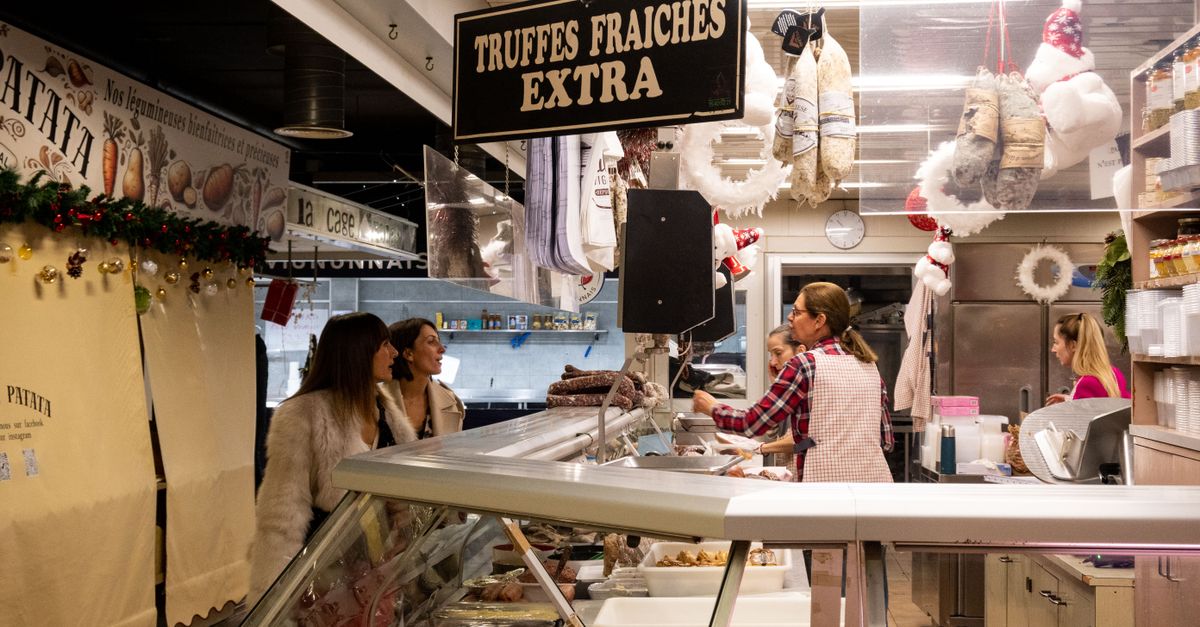
The Old Town Center, around Rue des Marchands, Place de la Cathédrale, and Rue des Têtes, is the historic core of Colmar's restaurant and food shop scene. Maison Ferber (the finest delicatessen), Pâtisserie Schwartz, and several excellent winstubs operate within a five-minute walk of each other. The covered market (Marché Couvert) at Rue des Ecoles operates daily (Monday–Saturday 8am–12:30pm) and is the best indoor food market in the area.
La Petite Venise, the canal-threaded district southeast of the center, is Colmar's most photographed neighborhood and also home to excellent traditional restaurants — Winstub la Petite Venise on Rue de la Poissonnerie serves reliable traditional Alsatian food in one of the most beautiful settings in France. Slightly more tourist-oriented than the old town winstubs but the food quality at the better establishments is maintained.
Route des Vins d'Alsace, beginning just outside Colmar and extending 170km north to Marlenheim, is the most important single food and wine experience in the region. Villages like Riquewihr, Ribeauvillé, Kaysersberg (24km from Colmar, Albert Schweitzer's birthplace), and Eguisheim (5km from Colmar — often rated the most beautiful village in France) each have winstubs, patisseries, and wine cellars serving the Alsatian table with their own local inflection. Half a day on the Route des Vins is among the finest food and landscape experiences in France.
Ammerschwihr and Kientzheim, the wine villages immediately west of Colmar, are where the finest Grand Cru Riesling of the Colmar massif is produced. Visiting a winery in these villages for a cellar tasting (available at Maison Trimbach in Ribeauvillé and several others) and eating lunch at a local winstub is the most direct way to understand how Alsatian wine and food are inseparable from their landscape.
Practical Tips for Eating in Colmar
Colmar is moderately priced by French standards and excellent value relative to Paris. A full winstub meal (tarte flambée, main course, dessert, and wine) costs €35–55 per person. A fine-dining meal at Maison des Têtes or JY'S costs €80–140. The Saturday market provides excellent food for picnic or self-catering budgets — a complete Alsatian picnic (bread, Münster, smoked sausage, wine, fruit) can be assembled for €15–25 per person. The Route des Vins villages offer good-value lunch menus (€18–28, three courses) that are among the best restaurant deals in eastern France.
Colmar is crowded July–August and during the famous Christmas market season (late November–December) when the town becomes one of the most visited Christmas market destinations in Europe. During these periods, restaurant reservations 2–3 days in advance are essential at the better establishments. The quieter seasons (March–May and September–October) offer both better weather for vineyard visits and more relaxed dining. Wine shops and the Saturday market are always accessible without reservation. The Colmar Christmas market is genuinely magical and worth planning around, but book accommodation and restaurants months in advance.


