
Sicily is not a small island with a few famous ruins — it's the largest island in the Mediterranean, with a layered civilisational history (Greek, Carthaginian, Roman, Byzantine, Arab, Norman, Spanish) that has produced one of the most complex and fascinating cultures in Europe. The tourist circuit concentrates on Palermo, Taormina, the Valley of the Temples, and Mount Etna. Between those points lies an island that most visitors never see: the extraordinary Baroque cities of the interior, the Sicilian wine country of the western mountains, the ancient theatre at Segesta with no facilities and no queues, and the most extraordinary street food culture in Italy.
This guide is for the traveller who is willing to rent a car and drive south from the A19 autostrada into the Sicilian interior — where the towns are medieval and the landscapes are the rolling golden hills that have been the backdrop to Sicilian history since the Greeks arrived. It's for someone who wants to eat arancino at a Palermo market stall, swim in the sea at Riserva Naturale dello Zingaro, and understand why Sicilians are simultaneously the most suspicious and the most generous people in Italy.
Sicily is large enough to require decisions. This guide gives you ten reasons to choose the road less driven.
1. Palermo's Ballarò Market
The Ballarò market in Palermo's Albergheria neighbourhood is the most extraordinary street market in Italy — a dense, chaotic, multi-sensory experience that has been operating in the same streets since the Arab period (10th century) and shows no signs of tidying itself up for tourism. It's the working-class food market of the city: fishmongers, butchers, vegetable sellers, street food vendors, and the occasional stall selling contraband phone accessories, all operating simultaneously at extreme volume. To walk through it is to understand that Palermo is not quite like anywhere else in Europe.
The Arab-Norman heritage of Palermo is visible in the Ballarò's geography — the street pattern of the Albergheria follows the medieval Islamic city layout, and the market's tradition of intense commercial activity in tight spaces is directly descended from the Arab suq. The street food stall holders are practising an unbroken culinary tradition: pane con la milza (spleen sandwich in beef fat, €3), stigghiola (grilled intestines on a skewer, €2), and frittola (fried offal scraps, €2.50) are all medieval street food that have survived because they're delicious and cheap.
Walk west from the Quattro Canti on Via Maqueda and then south into the market streets — the market occupies the streets around Piazza Ballarò, Piazza del Carmine, and Via Ballaro itself. Open most mornings Monday to Saturday from 6am to 2pm; Sundays are quieter. The fishmongers are at their most theatrical by 8am; the street food stalls are open from 7am. Bring cash (sellers rarely have card readers) and a healthy appetite.
The best street food in the market: the pane con la milza from the stall on Piazza Ballarò (the vendor who has been there since the 1970s; look for the one with the longest queue of locals). The arancino (fried rice ball, either al ragù with meat sauce or al burro with butter and ham) from the counter stall near the market entrance. A coffee from any bar costs €1. Total street breakfast: under €5 and more memorable than anything served in a restaurant.
2. Noto: Baroque at Golden Hour
Noto is UNESCO-listed for its extraordinary Baroque architecture — rebuilt entirely from scratch after the catastrophic 1693 earthquake that destroyed the medieval city, using the local honey-coloured limestone in a coordinated urban plan that makes it one of the finest 18th-century urban ensembles anywhere in Europe. The main street, Corso Vittorio Emanuele, is a straight line of church facades, palazzo steps, and Baroque balconies that is always beautiful but becomes extraordinary at the golden hour of late afternoon when the limestone glows amber-gold and the shadows deepen.
The 1693 earthquake destroyed dozens of Sicilian towns simultaneously, and the subsequent rebuilding — funded by the Spanish viceroy and the Church — created what's called "Val di Noto Baroque," a recognised architectural style across eight towns (Noto, Ragusa, Modica, Scicli, and others). The genius was in the planning: the new Noto was built on a new site, on a flat terrace, with a rational grid of streets that replaced the chaotic medieval plan. The result is one of the most complete Baroque townscapes in the world, preserved almost intact because the town was too poor to modernise.
Drive southeast from Siracusa (32 kilometres) or from Catania (89 kilometres). Noto is best experienced in the late afternoon — arrive at 4pm, walk the Corso from west to east, and be standing on the steps of the Cathedral (San Nicolò) at 6pm in summer when the light turns the facade to molten gold. The Cathedral admission is free; the interior has been beautifully restored after the dome collapse of 1996. The almond pastries at Bar Mandorla on Corso Vittorio Emanuele are among the finest in Sicily.
Stay overnight to see Noto after the day-trippers leave — the Corso at 10pm, with string lights and the facades lit from below, is magnificent. Accommodation is surprisingly affordable: B&B rooms in converted palazzi from €60–90. The restaurant Trattoria del Carmine on Via Ducezio serves cucina netina (local Noto cuisine) including the extraordinary pasta with wild fennel, sardines, and pine nuts that is one of Sicily's signature dishes. Dinner runs €20–28 per head.
3. Zingaro Nature Reserve
The Riserva Naturale dello Zingaro, on the northwest coast between Scopello and San Vito lo Capo, is the oldest nature reserve in Sicily — 1,650 hectares of coast with no roads, seven small coves accessible only on foot (or by boat), and crystal-clear water over rock and posidonia that is among the finest snorkelling in the Mediterranean. The reserve was established in 1981 after a local protest campaign stopped the construction of a road through it — a remarkable act of environmental activism that has preserved one of the finest coastal walks in Italy.
The trail runs 7 kilometres along the coast from the southern entrance at Scopello to the northern entrance at San Vito lo Capo, with a series of small coves (Cala dell'Uzzo, Cala Marinella, Cala Beretta) reached by short descents from the main path. The water clarity is genuinely extraordinary — you can see the sea floor at 12 metres depth clearly enough to watch fish moving. The posidonia seagrass meadows offshore are healthy and intact, a direct result of the prohibition on anchoring within the reserve.
Drive to the Scopello entrance (the town of Scopello, 6 kilometres east, has good accommodation and restaurants). The reserve entrance opens at 7am; admission €5. The natural history museum at the entrance has good information about the reserve's ecosystem in Italian and English. Walk the full 7 kilometres to San Vito lo Capo and return by bus (if running) or retrace; alternatively, select specific coves and make a shorter day of it.
The swimming from the coves is exceptional. Cala dell'Uzzo (2.5 kilometres from the south entrance) is the most popular and most beautiful — a perfectly framed cove of white pebbles and turquoise water surrounded by maquis-covered cliffs. Arrive before 10am to secure space. Bring all provisions — no food or drink is available inside the reserve. The walk in full sun in July and August is demanding; start by 8am and carry 3 litres of water per person minimum. The light on the coves in early morning is extraordinary.
4. Segesta Temple at Sunset
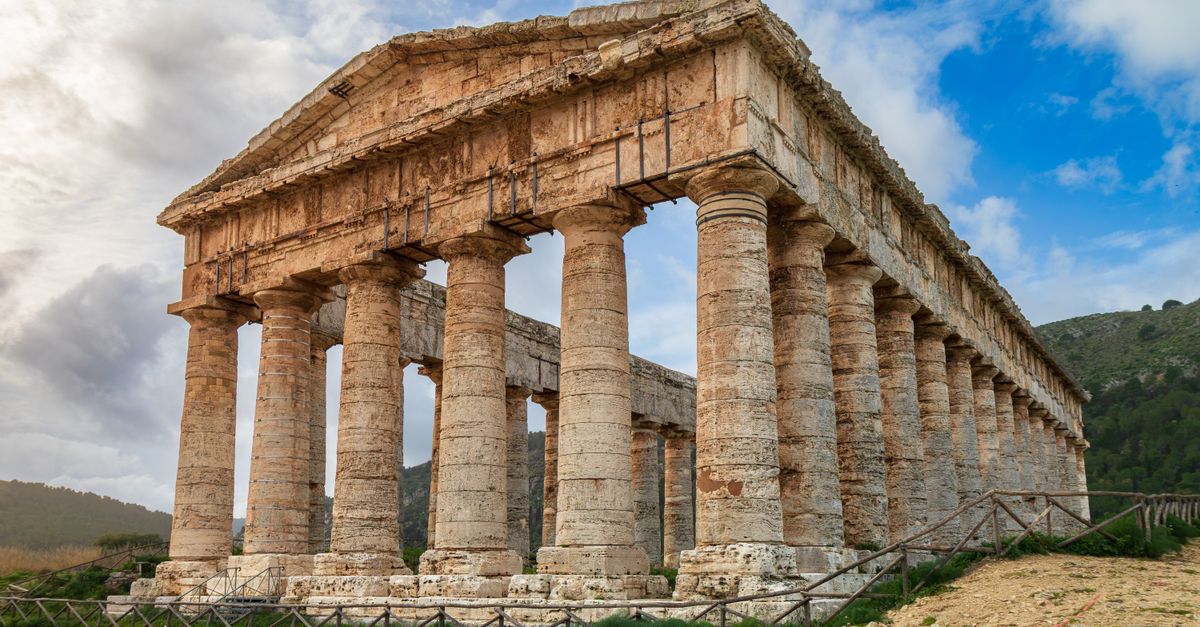
The Doric temple at Segesta, in the northwest of Sicily, is one of the finest and most atmospheric Greek temples in existence — because it stands completely alone on a hillside, with no town around it, no later construction obscuring it, and a mountain backdrop that places it in exactly the landscape the Greeks who built it would have known. Unlike the Valley of the Temples at Agrigento, which is accessible and therefore crowded, Segesta gets a fraction of the visitors despite being architecturally equivalent.
The temple dates from around 430 BC and was built by the Elymian people (a pre-Greek indigenous Sicilian population who adopted Greek architectural forms). It was never completed — the columns were never fluted and the interior never built — making it, paradoxically, one of the best-preserved because the absence of a roof meant there was nothing to collapse and damage the standing columns. The adjacent theatre on the hilltop above has a view of the entire northwestern corner of Sicily and is used for summer performances.
Drive the A29 autostrada from Palermo (37 kilometres) and take the Segesta exit. Open daily from 9am to dusk. Admission €9. A shuttle bus runs from the ticket office to the theatre on the hilltop (included in admission). Come at 5pm in summer to arrive as the afternoon visitors are leaving — the light on the temple columns turns golden by 6pm and the orientation of the building means the sunset light hits it from behind, casting the surrounding hills into deep shadow while the temple glows.
The site is large enough to be uncrowded even in peak season — and the absence of a town gives it a solitude that feels genuinely ancient. Walk the path around the temple (takes 20 minutes) to see it from all angles; the north facade in evening light is particularly beautiful. The summer programme of ancient theatre at the hilltop theatre runs July–August; performances in Italian but the theatrical context is powerful regardless of language. Check the programme at the Regione Siciliana tourism website.

5. Ragusa Ibla Old Quarter
Ragusa Ibla is the medieval lower town of Ragusa — a UNESCO Baroque town — that survived the 1693 earthquake and was subsequently overlaid with Baroque architecture while retaining its medieval street plan. It's the finest of the Val di Noto towns for simply walking: the labyrinth of lanes, the extraordinary series of Baroque churches and palaces descending toward the valley, the views from the belvedere of the surrounding countryside. The Giardino Ibleo park at the eastern end is one of the most beautiful public gardens in Sicily and almost always peaceful.
The town of Ragusa split into two after the 1693 earthquake — the aristocracy rebuilt on the new upper hill (Ragusa Superiore), while those who couldn't afford to move rebuilt in place in the destroyed valley (Ragusa Ibla). The result is two different towns sharing a name: the modern commercial centre above, the medieval-Baroque lower town below, connected by a staircase. Ibla has been reinhabited by architects, restaurateurs, and creative professionals who have restored the abandoned palazzi — it's one of the most successful examples of historic centre regeneration in Italy.
Drive to Ragusa from Catania (1.5 hours, 103 kilometres). Park in Ragusa Superiore and walk down the staircase to Ibla — the descent takes 15 minutes and the arrival, as the Baroque dome of the Cathedral San Giorgio appears at the end of the lane, is one of the great urban reveals in Sicily. The Cathedral facade (1738, by Rosario Gagliardi) is the masterpiece of Val di Noto Baroque — a three-register facade of extraordinary sculptural quality.
The best restaurant in Ragusa Ibla is Ristorante Duomo (one Michelin star, €80–100 tasting menu) — exceptional but demanding. For a more accessible meal, Trattoria La Bettola on Largo Camerina serves home cooking in the Ibleo tradition: rabbit with wild herbs, ricotta fritters, pasta with local sausage and aubergine. Lunch €15–20 per head. The Giardino Ibleo is perfect for the afternoon — ancient carved stone benches, old palms and pines, the valley visible below. Free, always open.
6. Marsala Saline and Mothia Island
The salt pans (saline) of Marsala, on the western tip of Sicily, are one of the most visually extraordinary landscapes in Italy — windmills, herons, pink salt crystals, and the distant silhouette of the Egadi islands on the horizon. The island of Mothia (San Pantaleo) in the middle of the salt lagoon was the site of the most important Phoenician city in Sicily — the museum there holds the famous "Young Man of Mozia," a 5th-century BC marble youth that is one of the greatest works of ancient Sicilian art.
The Phoenician city on Mothia was founded in the 8th century BC and destroyed by Dionysius of Syracuse in 397 BC. The island has been uninhabited since — creating the extraordinary condition of an ancient city entirely preserved by abandonment. The Whitaker Museum on the island (built by the British wine merchant Joseph Whitaker who excavated the island in the early 20th century) houses the finds, dominated by the marble youth whose ambiguous smile and flowing garment give it an emotional quality rare in ancient sculpture.
Drive from Trapani (30 kilometres south) to the Saline di Marsala nature reserve. The boat to Mothia departs from the salt pans — small flat-bottomed boats pole across the shallow lagoon (€5 return, running approximately 9am–4pm, weather dependent). The Whitaker Museum on the island charges €9 admission and contains the marble youth and other Phoenician finds. Open daily April to October 9am–6pm, reduced hours in winter.
The salt pans are at their most visually dramatic in August–September when the harvest creates vivid colour contrasts (white salt, pink water, black volcanic rock) that make the landscape look like an abstract painting. The windmills are still operating and the salt is still harvested — the Trapani sale integrale (unrefined sea salt with trace minerals) is sold throughout the region and is considered one of the finest salts in Italy. Buy a bag at the visitor shop for €3; it's excellent.
7. Mount Etna North Slope Vineyards
The northern slopes of Etna — the Etnean DOC wine zone, specifically the Solicchiata and Passopisciaro areas — have become one of the most exciting wine regions in the world over the past decade. The volcanic soil, the extreme altitude (600–1,000 metres), and the centenarian pre-phylloxera vines (which survived the 19th-century vine pest on volcanic soil that the pest couldn't penetrate) produce Nerello Mascalese red wines of extraordinary complexity and a mineral quality that Burgundy comparisons, however grandiose, are not entirely wrong.
The northern slope is less touristy than the summit access routes and the southern approach from Catania. The town of Castiglione di Sicilia, above the vineyards, is a medieval hill town with extraordinary views of the volcano and the coast and a single perfect bar (Bar Barbagallo on the main square) that makes the best arancino in the province. The drive through the vineyards — black volcanic rock walls, ancient vines at head height, the summit of Etna above — is one of the finest drives in Sicily.
Drive from Catania north on the SS120 and turn uphill toward Passopisciaro. Winery visits require advance booking: Cornelissen Winery (a Belgian-Sicilian producer making some of the most idiosyncratic wines in Italy), Benanti, and Terre Nere are the key addresses. Tasting visits typically cost €20–30 per person and are worth every euro. The wines (Etna Rosso DOC from Nerello Mascalese, Etna Bianco from Carricante) cost €15–30 per bottle at the winery — exceptional quality for the price.
Etna itself is a functioning volcano and an extraordinary landscape — the most recent lava flows (some from the last decade) have created areas of completely bare black rock beside 2,000-year-old olive groves. The Sentiero delle Ginestre trail on the north slope passes through a landscape that transitions between lava desert and chestnut forest in the space of 200 metres. The summit crater access is from the south side via Rifugio Sapienza; guided tours run year-round, approximately €70 per person including the cable car and 4WD vehicles for the upper section.
8. Agrigento Valley of the Temples at Dawn
The Valley of the Temples at Agrigento is one of the most impressive ancient Greek sites in the world — eight temples from the 5th century BC, several almost entirely intact, aligned along a ridge above the Mediterranean. It's also heavily visited. The solution is identical to most overcrowded ancient sites: arrive at 9am when the gates open, before the tour buses from Catania and Palermo arrive at 10:30am. The first 90 minutes in the valley, with the light still low and the tours not yet flooding the paths, are extraordinary.
The Temple of Concordia (420 BC) is the finest surviving Doric temple outside of Greece — more intact than the Parthenon, more accessible than Segesta, and with a history of continuous religious use (converted to a Christian church in the 6th century, which saved it) that gives it a particular living quality. The Temple of Juno (Hera) at the opposite end of the ridge has a different atmosphere: burnt and partially ruined, with a view over the modern city and the sea that is powerful in its incompleteness.
The site is 3 kilometres from Agrigento town; bus service or taxi from the station. Open daily from 9am; admission €15 (includes the associated Museo Regionale Archeologico, 1 kilometre north of the site). The museum holds the Telamon — the largest surviving piece of ancient architectural sculpture in the world, a 7.65-metre figure that once supported the architrave of the Temple of Zeus. The museum opens at 9am; visit it before the valley to provide context, then the valley afterward while the bus groups are still at the museum.
The valley at dusk (it stays open until sunset) is also extraordinary — and the bus groups have left by 4pm. Night visits are available in summer (Tuesday, Thursday, Saturday evenings, separate ticket €10) and the temples lit against the sky are genuinely magical. Agrigento town itself is unremarkable — stay for a night in a B&B in the historic centre, eat at Trattoria dei Templi (Via Panoramica dei Templi), and use the base for a morning visit at opening time.
9. Ortigia Island in Siracusa
Siracusa (Syracuse) was the most powerful Greek city in the western Mediterranean in the 5th century BC — larger than Athens and Carthage. The historic core is Ortigia, a small island connected to the modern city by two bridges, with Greek temple columns incorporated into the 7th-century Cathedral, a Baroque piazza that is one of the finest in Sicily, and a waterfront fountain (the Fonte Aretusa, a freshwater spring that flows directly into the sea) that has been mythologised since antiquity. Most visitors come, see the Cathedral, and leave. The quarter deserves more time.
The Cathedral of Siracusa is one of the most extraordinary religious buildings in Europe — a Doric Greek temple converted to a Christian church, with the original Greek columns still standing as the nave walls. You're walking between 2,500-year-old columns to reach an 18th-century Baroque altar, and the temporal vertigo of the combination is one of the finest architectural experiences in Italy. The Norman Maniace Castle at the tip of the island (€8) commands extraordinary sea views and has an important collection of Byzantine and Norman architectural fragments.
Ortigia is small enough to walk in 20 minutes end-to-end; the best approach is to get lost in the lanes between the Cathedral and the seawall. The morning market on Via Trento e Trieste sells fresh fish and produce — the swordfish (pesce spada) of the Sicilian strait is one of the finest in the Mediterranean. The bar Caffe Minerva on the Cathedral piazza does the best granita di mandorla (almond granita) in Siracusa. Afternoon gelato from Gelato DaVid on Via Savoia is a local institution: the pistachio of Bronte is the flavour to order.
Stay in Ortigia rather than the modern city — accommodation in the historic island quarter is €70–100 per room in B&Bs and small hotels, and the experience of waking in a medieval palazzo is incomparably superior to any modern hotel in the new city. The evening passeggiata on Ortigia's Foro Vittorio Emanuele is a proper Sicilian social spectacle — families, couples, old men walking very slowly, everyone dressed with great care, the ritual playing out as it has every evening for centuries.
10. Cefalu's Rock Climb and Back Streets
Cefalù is the most touristy small coastal town in Sicily — a Norman cathedral, a medieval square, a good beach, and a steeply rising rock behind the town known as the Rocca di Cefalù. The tourists visit the Cathedral (unmissable — the mosaic Christ Pantocrator in the apse, begun in 1148, is the finest Byzantine mosaic image in Sicily) and the beach. Fewer climb the Rocca, and almost none explore the medieval lanes behind the market, where the old Arab fishing quarter is preserved in a grid of lanes so narrow that two people must turn sideways to pass.
The Rocca climb starts behind the cathedral and ascends through the medieval fortifications to the top of the 270-metre crag. The path is steep (30 minutes up) and requires reasonable fitness. At the top: the ruins of a medieval castle, a pre-Greek temple that may predate the Phoenician settlement, and a view that takes in the entire northern coast of Sicily from Palermo to Milazzo. The sea below is so clear that you can see the sandy bottom from 270 metres up.
The Arab fishing quarter (La Giudecca area, behind Via Amendola) retains a street plan from the medieval Islamic city — narrow lanes, blind alleys, houses built right to the lane edge. The lavatoio (public wash house) fed by Arab-period channels is one of the finest surviving examples of medieval urban water infrastructure in Sicily. The wash house is free, always open, and extraordinary — the sound of the spring water flowing through the carved stone channels has been continuous since the 12th century.
The Rocca climb is free. The medieval wash house is free. The Cathedral is €4. Of the three, the Cathedral is the obvious priority for the mosaic; the Rocca is the priority for the view; and the wash house is the priority for understanding that Arab-Norman Sicily was not a distant abstract history but an engineering civilization that built things so well they still work. Come in September when the beach season is ending and Cefalù becomes a real town again after the summer tourist peak.


