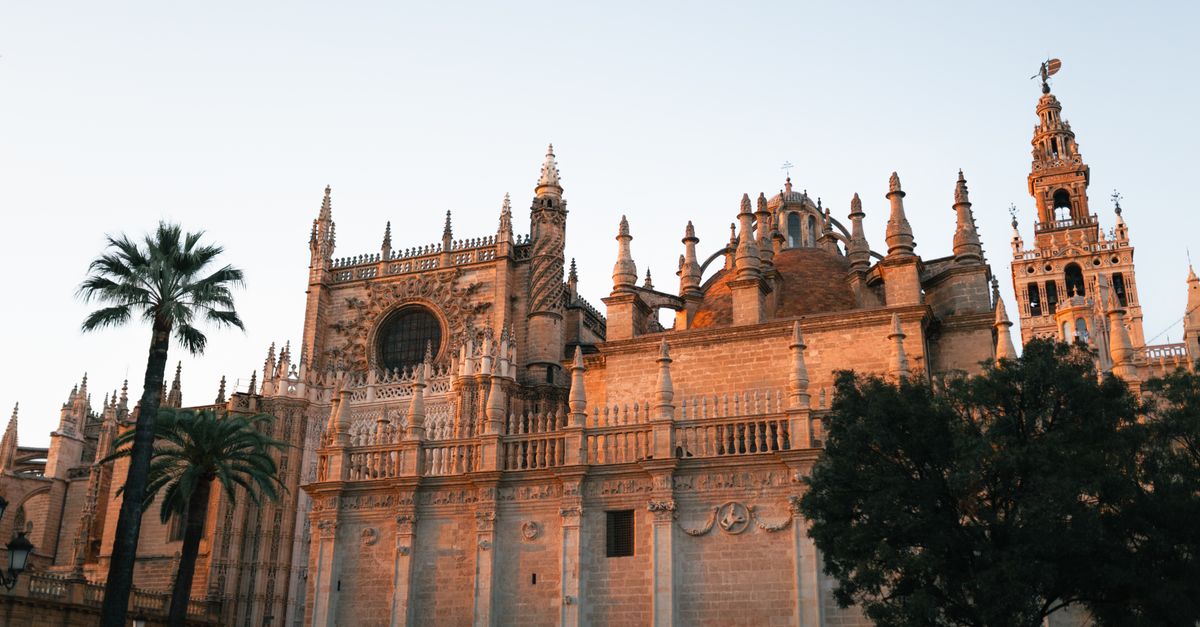
Seville sells itself on flamenco, orange trees, and the Alcázar. Those things are real and worth your time — but they're also where every cruise-ship passenger ends up between 10am and 2pm. The city you want is the one that lives behind the tourist circuit: the workshops off Calle Feria where craftspeople still stitch flamenco dresses by hand, the rooftop bars in Triana that locals treat as their living rooms, the Roman ruins you can walk into for free on a Tuesday afternoon.
This guide is for the traveller who has already done the postcard version — or who wants to skip it entirely and go straight to the neighbourhood tapas bars where no menu exists in English. It's for people who are happy to take the wrong bus once or twice in exchange for ending up somewhere genuinely surprising.
Seville rewards slowness. The heat enforces it. The city's best discoveries happen when you stop planning and start wandering — but these ten gems give you a map for those wanderings.
1. Mercado de Feria
Forget Mercado de Triana — it's been polished into a food hall for tourists. Mercado de Feria, on the street of the same name in the Macarena district, is a working neighbourhood market that still smells of fresh fish and sawdust. The stalls open from 8am and the serious shopping is done by 10am. Come early and you'll share the space with grandmothers haggling over artichokes and fishmongers shouting prices at the top of their lungs.
Feria is one of Seville's oldest streets, and the market has been here in various forms since the 19th century. It's the commercial spine of La Macarena, a barrio that has resisted gentrification better than most parts of the city centre. The street outside is lined with traditional hardware shops, candlemakers, and bakeries — the kind of street that makes you wonder what central Madrid must have looked like before the rents went mad.
Take the C5 bus to the Macarena stop and walk two minutes north along Calle Feria. The market building is a handsome early 20th-century structure with a tiled facade. Don't go on a Sunday — it's closed, and the street is quieter than a library.
Entry is free. The market stalls sell at prices that will shock you after the Centro: a kilo of ripe tomatoes for under €1.50, fresh anchovies for €4. The bar inside the market does a €1.80 café con leche and the best tortilla in the neighbourhood. Sit at the counter and eat it before the morning rush ends.
2. Jardines de Murillo
These gardens run along the eastern wall of the Alcázar and are somehow always half-empty. The tourists queue outside the Alcázar entrance forty metres away; the gardens beside them see a fraction of that foot traffic. Shaded by ancient orange and palm trees, with tiled fountains and benches that catch the afternoon breeze, they're one of the best free escapes from Seville's summer heat.
The gardens were created in 1911 on land gifted by Alfonso XIII, laid out in the formal Andalusian style with geometric hedging and azulejo-lined paths. They're named after Bartolomé Esteban Murillo, the 17th-century Sevillano painter, whose statue stands near the main entrance. The monument at the centre is dedicated to Columbus — a Sevillano tradition of claiming anyone who ever passed through.
Find the entrance on Calle Santa María la Blanca, on the eastern edge of Santa Cruz. The gardens connect through to the Paseo Catalina de Ribera and the riverbank beyond. In the morning they're populated by dog walkers and pensioners with newspapers; in the afternoon by students with books and the occasional sleeping backpacker.
Admission is free. The gardens are open from roughly 8am to midnight (hours vary by season). Bring something to read and a bottle of water. The only downside is that the park has no bar — but the streets immediately outside have several, including a quiet terrace on Calle Ximénez de Enciso that pours chilled fino for €2.20 a glass.
3. Basílica de la Macarena at Non-Peak Hours
The Basílica de la Macarena is technically on the tourist map — its statue of the Weeping Virgin is the most venerated image in Seville, and during Semana Santa the procession that carries it is watched by hundreds of thousands of people. But visit on a weekday morning in October or March, and you'll find yourself alone in the nave with the gilded altarpiece, the candles, and one of the most emotionally powerful pieces of religious art in Spain.
The current basilica is relatively modern — built in 1949 — but the statue of the Virgen de la Esperanza Macarena dates from the 17th century. The adjacent museum holds the elaborate floats used in Holy Week processions, the vestments, and a collection of jewels donated by devotees over the centuries, including a famous gift from the bullfighter El Joselito. The museum costs €5 and is almost always uncrowded.
The basilica is on Calle Bécquer, just inside the old Macarena gate in the city walls. Bus C5 drops you nearby. Morning mass takes place at 9am most days, and the atmosphere during and immediately after is extraordinary — worshippers lighting candles, the smell of incense, old women in black praying in whispers.
The museum is open 9am–2pm and 3–8pm, Monday to Saturday, and 9am–2pm on Sundays. Museum entry €5, basilica free. If you're here during Semana Santa, the experience is irreplaceable — but book accommodation six months in advance and expect prices to triple.
4. Triana's Calle Betis at Dusk
Calle Betis runs along the Triana side of the Guadalquivir, facing the Torre del Oro across the water. At dusk — roughly 7 to 9pm in summer — the light on the river turns gold, the cathedral silhouette darkens against an orange sky, and the terrace bars fill up with sevillanos who've just finished work. This is one of the great urban views in Europe, and most visitors miss it because they're eating dinner at 7pm like tourists instead of 10pm like locals.
Triana is Seville's other city — historically working class, the birthplace of most of the city's great flamenco artists and bullfighters, with a distinct identity that makes residents bristle slightly when you call it a neighbourhood of Seville rather than a place in its own right. The ceramics tradition here dates from Moorish times; you can still buy hand-painted azulejos from workshops on Calle Alfarería.
Cross the Puente de Isabel II (the Triana bridge) from the Centro and turn left onto Calle Betis. The best bars for river views are La Otra Orilla and the unnamed terraces near the old bullring site. On summer nights the street is packed by 10pm and stays that way until 2am.
Most bars on Betis charge €3–4 for a caña (small beer) or a glass of Manzanilla sherry. The food is average and overpriced — eat elsewhere and come for drinks and views only. The proper Triana tapas experience is one street back, on Calle San Jacinto and Calle Pagés del Corro, where bars like Bar El Patio and Casa Cuesta serve proper raciones at honest prices.
5. Italica Roman Ruins
Twelve kilometres outside Seville, in the town of Santiponce, lie the ruins of Italica — the Roman city that gave birth to two emperors, Trajan and Hadrian. The site contains some of the finest mosaic floors in Iberia, a massive amphitheatre that held 25,000 people (bigger than the Colosseum in capacity terms), and enough atmospheric urban ruins to keep a history enthusiast busy for a full morning. Most visitors to Seville never make it here.
Italica was founded around 206 BC as a settlement for Roman veterans. It flourished under the Empire and reached its peak in the 2nd century AD, when Hadrian invested heavily in expanding and beautifying the city. The remains visible today — the street grid, the baths, the mosaics in the villa floors — date largely from that Hadrianic expansion period. The amphitheatre is remarkably intact, with the underground passages where animals and gladiators waited still visible.
Take bus M-172A from Plaza de Armas bus station in Seville — the journey takes about 30 minutes and costs around €1.80 each way. The site is open Tuesday to Saturday 9am–3pm (and to 6pm in winter), Sunday 9am–3pm. Closed Monday. EU citizens enter free; non-EU visitors pay €1.50.
The site is large enough that you'll want walking shoes and water. Bring a hat — there's minimal shade. The best mosaics are in the Casa de los Pájaros (House of the Birds) and Casa de Neptuno. Don't skip the amphitheatre: stand in the arena and look up at the stone seating and you'll feel the scale of Roman Hispania in a way no museum can replicate.

6. Alameda de Hércules on a Sunday Morning
The Alameda de Hércules is Seville's oldest public promenade — a long, tree-shaded boulevard in the north of the old city that has been the gathering place for bohemians, artists, and the city's LGBTQ+ community for decades. On a Sunday morning, it transforms into an informal flea market, with vendors selling vintage clothing, records, ceramics, old photographs, and improbable quantities of second-hand books.
The Alameda was laid out in 1574 on what had been a marshy area prone to flooding — they drained it and planted rows of poplar trees, making it one of the first public promenades in Europe. The two Roman columns at the southern end were brought from a ruined temple elsewhere in the city; the statues of Hercules and Julius Caesar atop them were added later, a nod to the city's mythological founding story.
Walk north from the Centro along Calle Amor de Dios and you'll hit the Alameda in about fifteen minutes. The Sunday market starts around 10am and winds down by 2pm. The rest of the week the Alameda is an excellent bar-crawl destination — the streets immediately around it have some of Seville's best indie bars and tapas spots.
Market vendors set their own prices; reasonable haggling is expected and appreciated. The surrounding bars open for Sunday breakfast from 9am — Bar Eslava on the nearby Calle Eslava is worth a detour for its award-winning tapas. A glass of mosto (young grape juice, the non-alcoholic cousin of wine) goes for €1.50 in the market bars.
7. Iglesia de San Luis de los Franceses
This Baroque church near the Alameda is one of the finest buildings in Seville that tourists consistently walk past. Built by the Jesuits between 1699 and 1731, it has an interior so lavishly decorated — frescoed ceilings, gilded altarpieces, multicoloured marble — that it feels almost absurd. The facade is a masterpiece of Sevillian Baroque. Entry costs €3.50, and on a given weekday morning you may have the whole place to yourself.
The church has had a turbulent history: it was deconsecrated during the Napoleonic occupation, used as an army barracks, then as a mental institution, and only restored as a cultural monument in the 21st century. That explains why it's not on the mainstream tourist circuit — it's technically not a functioning church but a heritage site, which means mass tourism hasn't discovered it yet. The Junta de Andalucía manages it now and has done an excellent restoration job.
Find it on Calle San Luis, a short walk north of the Cathedral area and east of the Alameda. Opening hours vary — typically Tuesday to Sunday 10am–2pm and 4–7pm, but confirm on the Junta de Andalucía cultural heritage website before going. Closed Monday.
The €3.50 entry includes a brief audio guide. The ceiling frescoes are by Lucas Valdés, son of the great Sevillian painter Juan de Valdés Leal. Take your time in the transept — the interplay of light through the dome at midday is genuinely spectacular. This is one of those buildings that makes you genuinely angry that it's not better known.
8. Real Fábrica de Tabacos Interior Courtyards
The 18th-century tobacco factory that inspired Bizet's Carmen is now the main building of the University of Seville — and it's open to the public during term time. Walk through the gate on Calle San Fernando and you can wander the vast interior courtyards, stairwells, and corridors of one of the largest baroque buildings in Spain. It employed 10,000 workers at its peak, mostly women, and the scale of the building reflects that industrial ambition.
The Real Fábrica was built between 1728 and 1771 and was, at the time, the second-largest building in Spain after El Escorial. The building has a moat (now dry), its own jail, and chapels — it was effectively a self-contained city. After the tobacco monopoly ended, the university moved in and the building became academic offices and lecture rooms. The architecture is visible in the corridors if you wander respectfully.
Enter from Calle San Fernando, opposite the Jardines de Murillo. No ticket required — just walk in during university hours (roughly 8am–9pm on weekdays during term). Dress reasonably and don't disrupt any classes. The main courtyard with its baroque fountain is the highlight, but the secondary courtyard toward the back is larger and quieter.
Free admission. The building is busiest midmorning with students — come at lunchtime (2–4pm) when corridors quiet down. The Carmen connection is heavily mythologised — the historical tobacco workers were far more interesting than Bizet's opera suggests, having successfully organised labour actions in the 18th century, an extraordinary achievement for the time.
9. Capillita del Carmen on Triana Bridge
On the Triana side of the Puente de Isabel II sits a tiny chapel that most people walk straight past. The Capilla del Carmen is built into the bridge itself — a miniature baroque chapel housing a devotional image of the Virgin. Locals stop to cross themselves or leave flowers; tourists barely glance at it. It's the kind of detail that makes you understand that for sevillanos, the sacred and the everyday share the same pavement.
The original chapel on this site dates from 1926, built when the bridge was reconstructed. The current version is a small neoclassical structure with a tiled facade and a wrought-iron gate. It's rarely open to enter — mainly used for the annual blessing in July — but the exterior and the act of watching people interact with it is observation enough. At night it's lit and reflected in the river below.
You'll pass it automatically if you walk the Puente de Isabel II between the Centro and Triana. The bridge itself dates from 1852 and is the oldest iron bridge in Spain. Walk it at sunset when the light catches the river and the cathedral tower glows across the water. It takes four minutes to cross and offers the best free view in the city.
No admission, always accessible from the exterior. The chapel is most atmospheric during Holy Week in April, when the Virgen de la Esperanza Macarena procession crosses this bridge in the early hours of Good Friday — an event that brings tears to the eyes of even confirmed atheists. If you're in Seville then, stay up for it.
10. Barrio de San Bernardo
San Bernardo is the neighbourhood directly east of the train station — walkable from the city centre, crossed by the AVE rail lines, and almost completely ignored by visitors. It's a working-class barrio of whitewashed houses, neighbourhood churches, and the kind of corner bars where the TV is always on showing football and the bocadillo costs €2.50. If you want to see how ordinary sevillanos live, come here on a Saturday morning.
The neighbourhood grew up around the Convent of San Bernardo, a 16th-century Cistercian institution. The convent still functions and the nuns still sell their hand-made pastries through the traditional wooden turning wheel at the entrance — a centuries-old custom where the nuns remain unseen behind a wooden partition. Ring the bell, request your pastries, leave the money, and receive the goods through a rotating wooden drum. The polvorones and yemas are extraordinary.
Take the metro to Nervión station and walk south, or walk east from Santa Justa train station. Calle San Bernardo is the main spine. The convent entrance for pastry sales is on Plaza de San Bernardo — look for the simple door, ring the bell, and be patient. They open for sales in the morning, typically 9am–1pm.
Pastries cost €5–12 per box, depending on what you order — excellent value for hand-made convent sweets. The neighbourhood bars are good for a cheap lunch: a menú del día (set lunch) typically runs €9–11 with three courses and wine. Bar Antojo on Calle Industria is a reliable local option that never appears in guidebooks and is the better for it.