
Bangkok is one of those rare megacities where budget travel doesn't mean suffering — it means thriving. For ฿500-800 per day ($14-22 USD), you can sleep in an air-conditioned room, eat three meals of some of the most celebrated street food on the planet, visit ancient temples gilded in gold leaf, cruise the city's canal network for the price of a bottle of water, and watch the sun set over the Chao Phraya River from a rooftop that costs nothing to access.
Bangkok's budget infrastructure is so deeply embedded in the city's fabric that spending less doesn't push you to the margins of the experience — it pulls you closer to the authentic center of how Bangkok actually lives and breathes.
The trap for tourists in Bangkok is surprisingly easy to avoid once you understand how it works. The city operates on two parallel pricing tracks: the tourist track (Sukhumvit bars, rooftop restaurants, shopping malls, packaged tours) and the local track (street food stalls, canal boats, public ferries, neighborhood markets, temple festivals).
The gap between these two Bangkoks is enormous — you can eat a plate of pad thai for ฿40 from a street vendor or pay ฿220 for the same dish at a tourist restaurant on Khao San Road. This guide maps the affordable Bangkok in forensic detail, covering accommodation, food, transport, free attractions, and the daily strategies that keep your spending at ฿500-800 without compromising on experience.

Budget Accommodation: ฿200-800 per Night
Bangkok's accommodation market is fiercely competitive, which works entirely in the budget traveler's favor. The sheer density of hostels, guesthouses, and budget hotels means that prices stay low and quality keeps climbing as properties compete for reviews and repeat guests.
Whether you prefer a social hostel dorm or a private room with air conditioning, Bangkok delivers remarkable value.
Hostels: ฿200-400 per Night
Bangkok's hostel scene is one of the best in Asia, with a range that spans basic fan-cooled dorms to design-forward properties with rooftop bars and swimming pools. At the lower end (฿200-300), you'll find clean dorm beds with personal lockers, shared bathrooms, air conditioning, fast WiFi, and a common area designed for meeting other travelers.
Properties like NapPark Hostel near Khao San Road (from ฿250) and Bed One Block Hostel in Silom (from ฿280) consistently deliver quality at this price point. At ฿300-400, hostels like Lub d Bangkok Silom and Here Hostel add pod-style beds with privacy curtains, USB charging points, reading lights, and sometimes rooftop spaces with city views.
Solo travelers spending ฿250-350 on a dorm bed are getting accommodation that would cost three times as much in any European or North American city.
Guesthouses on Khao San Road and Surrounds: ฿400-800
The Khao San Road area (Banglamphu) remains the epicenter of Bangkok's backpacker universe, and the side streets — Soi Rambuttri, Phra Athit Road, and the lanes leading toward the river — are dense with guesthouses offering private rooms from ฿400-800. At the lower end, expect a small but clean room with a fan, shared bathroom, and basic furnishings.
At ฿600-800, you step up to air-conditioned rooms with private bathrooms, a double bed, and often a small balcony. Rambuttri Village Inn (from ฿550), Lamphu Treehouse (from ฿650), and Baan Dinso (from ฿500) all represent the quality you can expect in this range.
The great advantage of Banglamphu is location — you're walking distance from the Grand Palace, Wat Pho, the Chao Phraya express boats, and the canal boat piers, making it the most budget-friendly base for sightseeing.
Chinatown and Beyond
Bangkok's Chinatown (Yaowarat) is an underrated base for budget travelers. Guesthouses here tend to be older and less polished than Khao San options, but prices are lower (฿350-600 for a private room), the food scene is extraordinary, and you're close to Hua Lamphong MRT station for onward transport.
The area around Sam Yan and Ari stations also offers budget guesthouses and small hotels from ฿500-800 that put you in real Bangkok neighborhoods where tourists are rare and local life unfolds around you.
Street Food: Eating Like Royalty for ฿40-80 per Meal
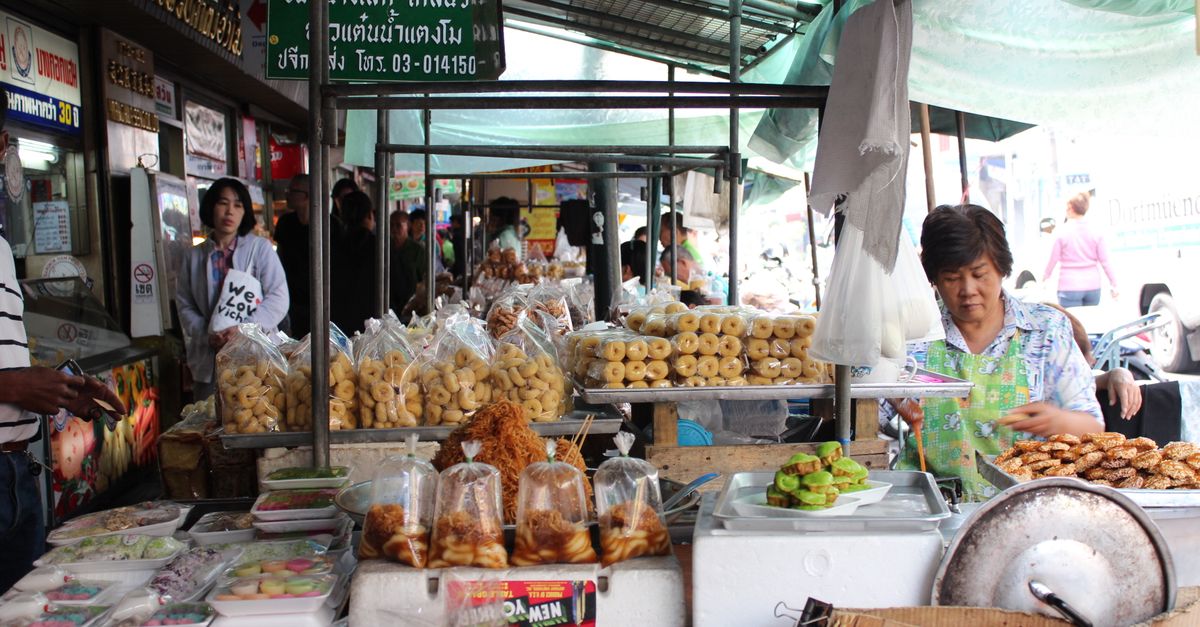
Bangkok's street food is not a consolation prize for being on a budget — it is the reason many people come to Bangkok in the first place. The city's street food culture is so deeply woven into daily life that it earned UNESCO recognition, and Michelin inspectors have awarded stars and Bib Gourmand ratings to restaurants that are barely distinguishable from the stalls next to them.
When you eat street food in Bangkok, you're not eating "cheap food" — you're eating the food that Bangkokians themselves eat every day, prepared by cooks who have often been making the same three or four dishes for decades, refining their craft to a level of mastery that no formal restaurant can easily replicate.
What to Eat and What It Costs
Pad thai from a street stall costs ฿40-60 — smoky wok-charred rice noodles with shrimp or chicken, bean sprouts, peanuts, and lime, served on a banana leaf or styrofoam plate. The most famous pad thai stall in Bangkok, Thipsamai on Maha Chai Road, charges ฿60-80 and draws hour-long queues.
Som tam (green papaya salad) costs ฿40-60 and delivers a punch of chili, lime, fish sauce, and peanuts that will make your eyes water and your mouth sing. Pair it with kai yang (grilled chicken) at ฿60-80 for a half bird, and a basket of sticky rice at ฿10-20 — that's a complete Isaan-style meal for under ฿150.
Khao man gai (Hainanese chicken rice) is the perfect budget lunch — poached chicken over fragrant rice with a ginger-chili sauce, served at dedicated stalls across the city for ฿40-50. Kuay teow (noodle soup) is Bangkok's breakfast and lunch staple — a bowl of rice noodles in clear or dark broth with pork, chicken, or fish balls, fresh herbs, and condiments, for ฿40-60.
Pad kra pao (stir-fried basil with meat and a fried egg over rice) is arguably the most eaten dish in Thailand — a fiery, savory plate that costs ฿40-50 and is available at virtually every rice-and-curry stall in the city.
Mango sticky rice costs ฿60-80 during mango season (March-June) — sweet glutinous rice with fresh mango slices and coconut cream, one of the great desserts in the world. Roti stalls (฿30-60) serve crispy flatbread with banana and condensed milk, Nutella, or egg — a street-side dessert that's quick, cheap, and addictive.
Thai iced tea (cha yen) costs ฿25-40 and is the perfect antidote to Bangkok's heat.

Where to Find the Best Street Food
Yaowarat (Chinatown) transforms at night into one of the world's great food streets — a kilometer of stalls, smoke, neon, and extraordinary dishes from grilled seafood to roast duck to fish maw soup. Victory Monument has a ring of boat noodle stalls (฿15-30 per tiny bowl — you order 3-5 to make a meal) and som tam vendors that locals consider some of the best in the city.
Or Tor Kor Market near Chatuchak is Bangkok's finest fresh market — a dazzling array of fruits, prepared dishes, curries, and sweets at fair prices. Bangrak and Silom Soi 20 have night food stalls popular with office workers — consistently good, consistently cheap.
Free and Nearly-Free Temples and Attractions
Bangkok's temple circuit is the heart of any visit, and while the most famous temples charge admission, several of the city's most beautiful and historically significant wats are completely free. Beyond the temples, Bangkok offers a wealth of free experiences — parks, markets, neighborhoods, and festivals — that cost nothing to enjoy.
Free Temples
Wat Saket (The Golden Mount) charges no entrance fee and is one of the most rewarding temple visits in Bangkok. Climb the 344 steps of an artificial hill through a spiral pathway shaded by trees, passing bells and meditation spots, to reach a golden chedi at the summit with 360-degree views of the old city.
Early morning or late afternoon are ideal for cooler temperatures and better light. Wat Traimit in Chinatown houses the world's largest solid gold Buddha — a 5.5-ton, 3-meter-tall statue from the Sukhothai period that was accidentally discovered inside a plaster shell in 1955.
The ground floor and main temple hall are free (the museum upstairs charges ฿40). Wat Suthat, near the Giant Swing, has some of the finest murals in Bangkok and is free to enter — its peaceful courtyard feels worlds away from the chaos outside.
Wat Ratchanadda, with its distinctive Loha Prasat (metal castle) of 37 spires, is free and rarely crowded.
Paid Temples Worth the Admission
Wat Pho (฿200) is home to the 46-meter reclining Buddha and is the birthplace of Thai massage — the admission includes a bottle of water and access to the extensive grounds, which most tourists rush through. Spend an hour exploring the smaller chedis, courtyards, and rock gardens.
Wat Arun (฿100) across the river is Bangkok's most photogenic temple, especially at sunset from the Wat Pho side. The Grand Palace and Wat Phra Kaew (฿500) is the most expensive temple visit in Bangkok, but the complex is dazzling — allow 2-3 hours and go early to beat both the heat and the tour groups.
Free Activities and Experiences
Lumpini Park is Bangkok's green heart — 142 acres of lawns, lakes, and walking paths where locals practice tai chi at dawn, paddle boats in the afternoon, and picnic at dusk. Monitor lizards — some over a meter long — patrol the lake edges, and the park hosts free concerts and events.
Chatuchak Park and the adjacent Queen Sirikit Park form a green corridor near the weekend market. Benjakitti Park behind the Queen Sirikit Convention Centre has a beautiful elevated walkway through a wetland area — a free and peaceful escape from the concrete jungle.
Transport: Getting Around Bangkok on ฿5-50
Bangkok's public transport system is remarkably cheap and, once you understand the options, remarkably effective. The key insight is that Bangkok has multiple transport layers — river boats, canal boats, the elevated BTS, the underground MRT, public buses, and motorcycle taxis — and the cheapest option depends on where you're going and what time of day it is.
Canal Boats: ฿5-15
The Khlong Saen Saep canal boat is Bangkok's best-kept transport secret. Running east-west through the city center from the Golden Mount area to Bangkapi, with a transfer at Pratunam, these long-tail boats carry commuters along a canal that cuts straight through some of the worst traffic in Bangkok.
The ride is loud, wet (splash guards go up at speed, and you may still get splashed), and thrilling — and costs just ฿5-15 depending on distance. From Pratunam pier, you can reach the Golden Mount, Jim Thompson House area, and the old city in minutes.
It's the fastest east-west crossing in Bangkok during rush hour.
Chao Phraya Express Boats: ฿10-40
The Chao Phraya express boats run north-south along the river, connecting major temples (Wat Pho, Wat Arun, Wat Saket area), the Grand Palace, Chinatown, Khao San Road area, and northern piers near Chatuchak. The orange flag line (฿15 flat fare) is the most useful for tourists.
The blue flag tourist boat charges ฿60 and has English commentary — skip it and take the orange flag for a quarter of the price. Cross-river ferries at each pier cost ฿5 and run constantly.
BTS Skytrain and MRT
The BTS Skytrain and MRT subway are Bangkok's modern rail systems — air-conditioned, efficient, and covering most tourist areas in the central and eastern parts of the city. Single rides cost ฿16-62 depending on distance.
For heavy sightseeing days, the BTS One Day Pass (฿140) offers unlimited rides and pays for itself after 3-4 trips. The Rabbit Card (stored-value card, ฿100 deposit) saves the hassle of buying individual tickets and offers a small discount per ride.
The MRT accepts the MRT Plus card — note that BTS and MRT use separate payment systems, which is frustrating but manageable.
Public Buses: ฿8-25
Bangkok's bus network covers every corner of the city at rock-bottom prices — ฿8 for non-air-conditioned buses, ฿12-25 for air-conditioned ones. The challenge is navigation: routes are complex, signage is in Thai, and buses don't always stop where you expect.
However, for specific routes — like bus 47 from Khao San Road to Chatuchak Market (฿8) or bus 2 along Silom Road — the savings are significant. Google Maps now shows Bangkok bus routes in real time.
Money-Saving Hacks for Bangkok
1. Drink Water Smart
Bangkok tap water is not drinkable, and buying plastic bottles at ฿10-20 each adds up fast. Instead, carry a refillable bottle and fill it at the filtered water dispensers found in most hostels, 7-Elevens, and shopping malls. Many temples also have free drinking water.
Over a two-week trip, this saves ฿300-500 and reduces plastic waste.
2. Use 7-Eleven Strategically
Thailand's 7-Elevens are everywhere — reportedly one on every street corner in Bangkok — and they're a budget traveler's secret weapon. Toasted sandwiches (฿25-35), onigiri (฿25), instant noodles with hot water (฿15), fresh milk and yogurt (฿15-25), and cold drinks at convenience store prices rather than restaurant markup.
A 7-Eleven breakfast of a toasted sandwich and a coffee costs ฿50-60.
3. Skip Tuk-Tuks for Actual Transport
Tuk-tuks in tourist areas are entertainment, not transport. They cost more than taxis, more than Grab, and infinitely more than public transport. A tuk-tuk ride from Khao San to Sukhumvit might be quoted at ฿200-300; the same journey by canal boat and BTS costs ฿35.
Take a tuk-tuk once for the experience (negotiate hard — never accept the first price), then use public transport for everything else.
4. Negotiate at Markets, Accept Prices at Stalls
At clothing and souvenir markets like Chatuchak and MBK, bargaining is expected and prices are typically inflated 50-100% above the expected sale price. Start at 50-60% of the asking price and settle around 70%.
However, at food stalls, noodle shops, and local restaurants, prices are fixed and non-negotiable — attempting to haggle over a ฿40 plate of pad thai is disrespectful and marks you as an inexperienced tourist.
5. Take Advantage of Happy Hours
If you want a night out without destroying your budget, Bangkok's happy hours — particularly along Khao San Road and in the Sukhumvit soi bars — offer beers from ฿60-80 (regular price ฿100-150) and cocktails from ฿100-150 (regular ฿200-350). Happy hours typically run 4-7 PM.
The rooftop bars that Bangkok is famous for (Vertigo, Sky Bar) charge ฿400-600 per cocktail — visit once for the view, then retreat to street-level bars for the rest of your trip.
6. Visit the Weekend Market Early
Chatuchak Weekend Market (Saturday-Sunday, 9 AM-6 PM) has 15,000+ stalls and is one of the world's largest markets. Arrive before 10 AM when it opens fully — you'll find better prices from vendors who haven't made their first sale yet (there's a Thai belief that the first sale should be discounted for good luck), cooler temperatures, and thinner crowds.
The JJ Green night market adjacent to Chatuchak operates Friday-Sunday evenings with vintage clothing, collectibles, and food at lower prices than the main market.
Daily Budget Breakdown
Here's what a realistic day in Bangkok costs at different comfort levels, based on actual 2024-2025 prices:
| Category | Shoestring (฿500/day) | Budget (฿650/day) | Comfortable Budget (฿800/day) |
|---|---|---|---|
| Accommodation | ฿250 (hostel dorm) | ฿400 (guesthouse private fan room) | ฿550 (guesthouse AC private) |
| Breakfast | ฿30 (7-Eleven + market fruit) | ฿40 (street noodle soup) | ฿50 (khao man gai stall) |
| Lunch | ฿40 (pad kra pao from stall) | ฿50 (som tam + chicken + rice) | ฿60 (market food court) |
| Dinner | ฿50 (street food) | ฿60 (Chinatown night stalls) | ฿80 (casual restaurant) |
| Snacks/Drinks | ฿20 (Thai iced tea) | ฿30 (drink + fruit) | ฿40 (coffee shop + fruit) |
| Transport | ฿30 (canal boat + ferry) | ฿50 (BTS + ferry) | ฿70 (BTS day pass portion) |
| Activities | ฿0 (free temples + parks) | ฿50 (one paid temple) | ฿100 (temple + activity) |
| Daily Total | ฿420-500 | ฿580-680 | ฿750-950 |
When to Visit Bangkok on a Budget
Bangkok's peak tourist season (November-February) brings cooler, drier weather and the highest accommodation prices. The hot season (March-May) sees temperatures hit 35-40°C, which drives down tourist numbers and accommodation prices by 20-30%.
The rainy season (June-October) is the cheapest time to visit — hostel and guesthouse prices drop to their lowest, and the rain typically falls in intense afternoon bursts of 1-2 hours rather than all-day drizzle, leaving plenty of dry time for sightseeing. September and October offer the best combination of low prices and manageable weather.
Major Thai festivals can both help and hurt a budget. Songkran (Thai New Year, April 13-15) turns the city into a giant water fight and is an unforgettable experience, but accommodation prices spike.
Loy Krathong (November full moon) is a beautiful lantern-floating festival with modest price increases. Chinese New Year in Chinatown (January-February) brings spectacular celebrations to Yaowarat — free to watch and photograph.
The bottom line on Bangkok: this is a city that was practically designed for budget travelers. The street food alone justifies the trip, the temple circuit would fill a week of free and cheap mornings, the canal and river boats turn commuting into sightseeing, and the accommodation market is so competitive that quality keeps rising while prices stay flat.
At ฿500-800 per day, you're not surviving in Bangkok — you're eating world-class food, visiting ancient monuments, and navigating one of Asia's most dynamic cities with money to spare. The question isn't whether you can afford Bangkok — it's why you'd spend more than you need to.
Bangkok Street Food Guide: What to Eat and Where to Find It Bangkok 5-Day Itinerary: Temples, Markets, and Street Food Bangkok Hidden Gems: 10 Places Most Tourists Miss


